From the journal

White Palace, Red Palace: Reading the Potala

On Lhasa’s Red Mountain, the Potala joins ceremonial rooms, residences and religious spaces in a single stepped complex.

In the same city · Lhasa ↗
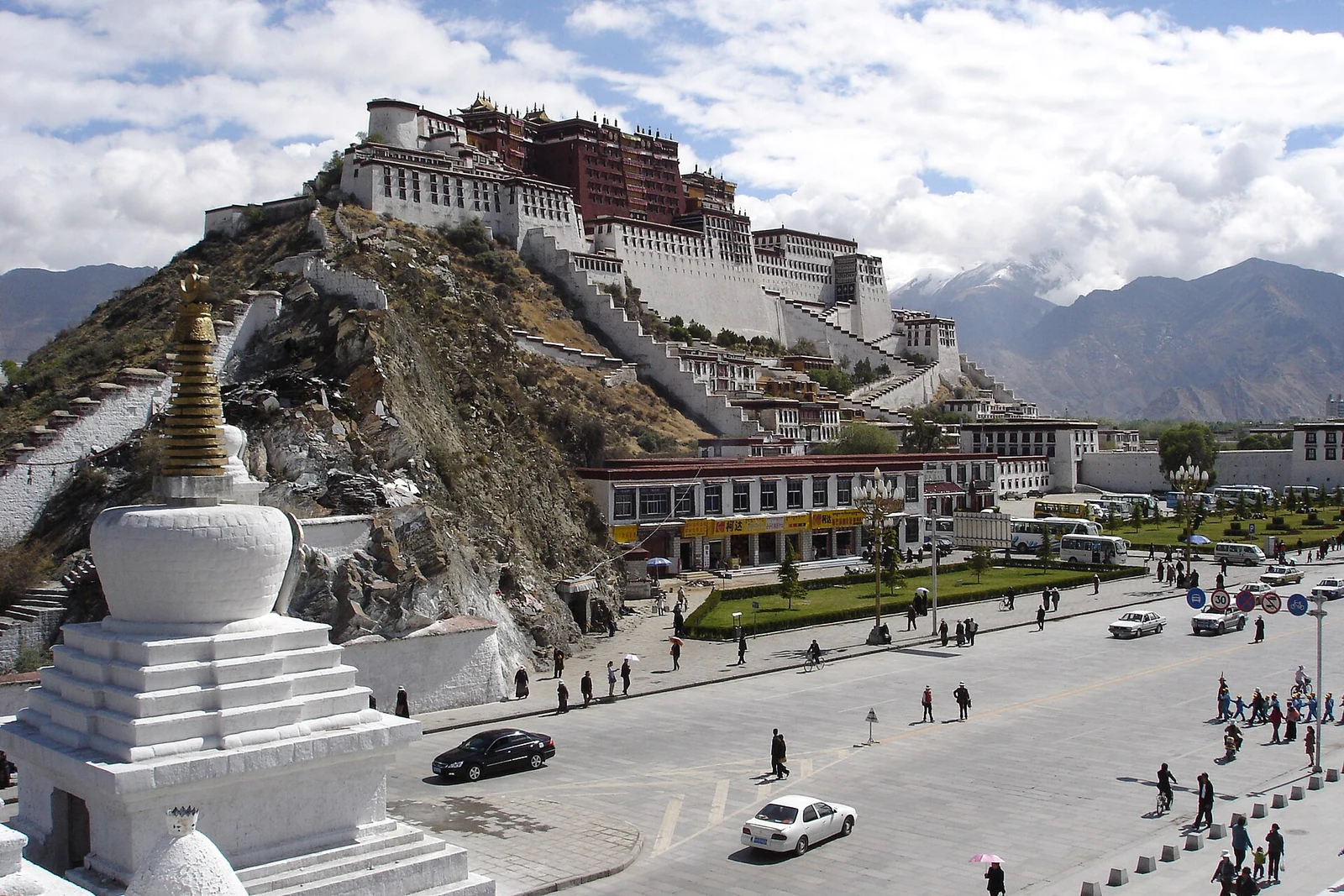
The Potala’s white and red buildings rise above the slope of Red Mountain.
White and red building masses make the Potala’s organisation visible from the valley.

A building with a mountain inside it

From the valley, the Potala can seem like one enormous building. Closer attention reveals a succession of white walls, darker red masses and smaller structures stepping over Red Mountain. The rock is not simply a pedestal placed below the architecture: its shape helps explain why the complex rises in terraces and why different parts appear and disappear as the viewpoint changes.

The White Palace and Red Palace are the two principal names with which to begin. They identify connected parts of the complex rather than two isolated monuments. Their relationship gives the familiar silhouette its changing rhythm: broad pale surfaces, concentrated red volumes and roofs gathered along the summit.

Rooms for different kinds of authority

The White Palace contained the main ceremonial hall and the Dalai Lama’s throne. Private rooms and an audience hall occupied its uppermost level. Those functions bring the building down to a human scale. A palace needs places for arrival, waiting, formal assembly and private retreat; their arrangement connects different kinds of activity within a common institution.

The Red Palace introduces the religious dimension of the ensemble. Read together, the two parts express the historical closeness of political and religious authority in Tibet. UNESCO identifies that integration as central to the site’s importance. Colour makes the distinction memorable, but the rooms and their uses give it substance.

An interior made of many materials

The palace’s collections extend far beyond its walls. UNESCO’s account lists murals, painted scrolls, sculptures, carpets, canopies, porcelain, jade, and gold and silver objects. Such things once belonged to particular ceremonies, furnishings and systems of patronage. They are part of how a room was understood, rather than decoration detached from its purpose.

That is why the Potala rewards more than a search for its most recognisable façade. Its exterior gathers a mountain into an architectural image; its interiors gather different activities and materials into a historical world. The white and red divisions are an opening into that world, not its complete explanation.

Continue exploring · Potala Palace ↗
Photo credits and rights
  1. White and red building masses make the Potala’s organisation visible from the valley.Ondřej Žváček · CC BY 2.5 Photo source ↗ Rights information ↗