From the journal

The Potala’s Painted Walls and Written Leaves

Murals, scroll paintings and palm-leaf manuscripts reveal another scale of the Potala, where architecture shelters fragile surfaces and recorded knowledge.

In the same city · Lhasa ↗
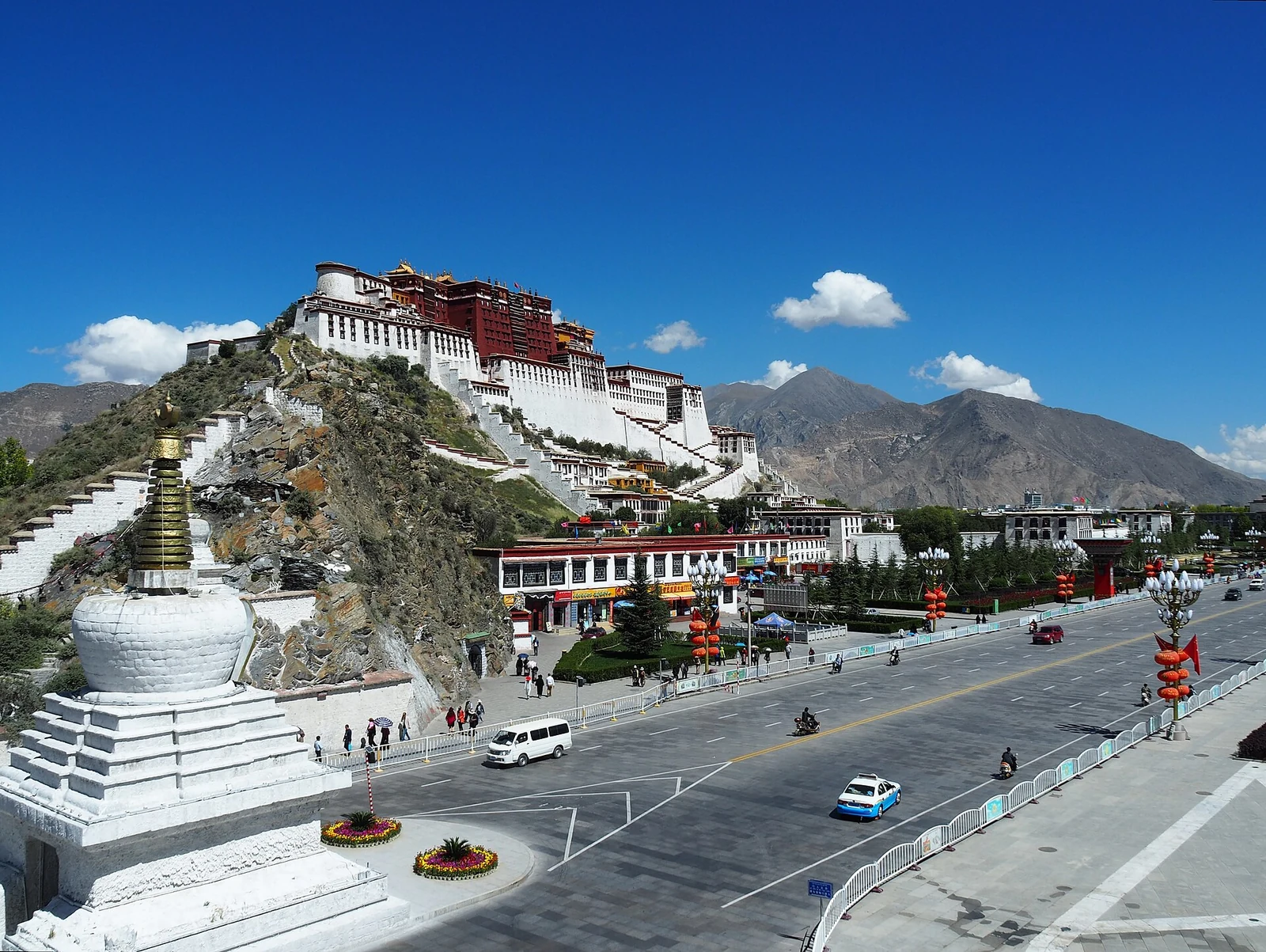
The Potala’s stepped buildings stand on Red Mountain.
The palace exterior forms the architectural setting for its paintings and manuscripts.

Inside the monumental outline

The Potala’s distant silhouette gives little indication of the materials held within it. UNESCO’s account lists murals and painted scrolls alongside sculpture, textiles and objects of metal, porcelain and jade. The building contains a world of surfaces that have to be encountered at the scale of a room or a page.

A mural belongs to the wall that supports it, while a scroll is a separate object with its own mounting and handling. Their different physical forms shape how paintings occupy religious interiors. Looking at them introduces another relationship between architecture and art, closer and more vulnerable than the broad exterior masses suggest.

A manuscript can begin with a leaf

The palace also holds palm-leaf manuscripts. Their writing is carried on prepared leaves of the palmyra palm, giving the object a material character very different from a modern bound paper book. The text depends on a support that has its own condition, edges and vulnerabilities.

An October 2023 report on the palace’s manuscript project recorded work on cataloguing and condition surveys, high-resolution digital scanning and hyperspectral imaging. These processes create different kinds of record: an inventory identifies an object, a condition survey describes its state, and imaging allows its surface to be examined in new ways.

Conservation connects walls and pages

A May 2025 cultural-heritage report described continuing work for 2025–2028, including assessments of buildings, attached murals, sculpture and stone objects. It also set out plans for further manuscript conservation. These are activities on different materials, joined by the need to understand an object before intervening.

The palace’s material history is therefore still being studied and cared for. A painted wall and a written leaf require different approaches, but both connect an image or text with a physical support. Attending to that support brings the Potala down from an immense landmark to the fragile things through which much of its history survives.

Continue exploring · Potala Palace ↗
Photo credits and rights
  1. The wider Lingkhor circuit includes the Potala among the city’s religious landmarks.Laika ac from UK · CC BY-SA 2.0 Photo source ↗ Rights information ↗