A roof with grain on it
The roof of a Jiaju house is flat, and it is a working surface. Grain is spread there to dry, turned by hand, and covered when the weather changes. The roof is reached by a ladder or a stair, and it doubles as a place to work, to sit and to look down at the fields. The house below is stone, with white walls and painted windows, and the roof edge is the line between the private interior and the open air. Around it the village steps down the hillside in the same pattern: wall, roof, field, wall. The effect is not decorative. A flat roof is a piece of agricultural equipment.
Stone without mortar
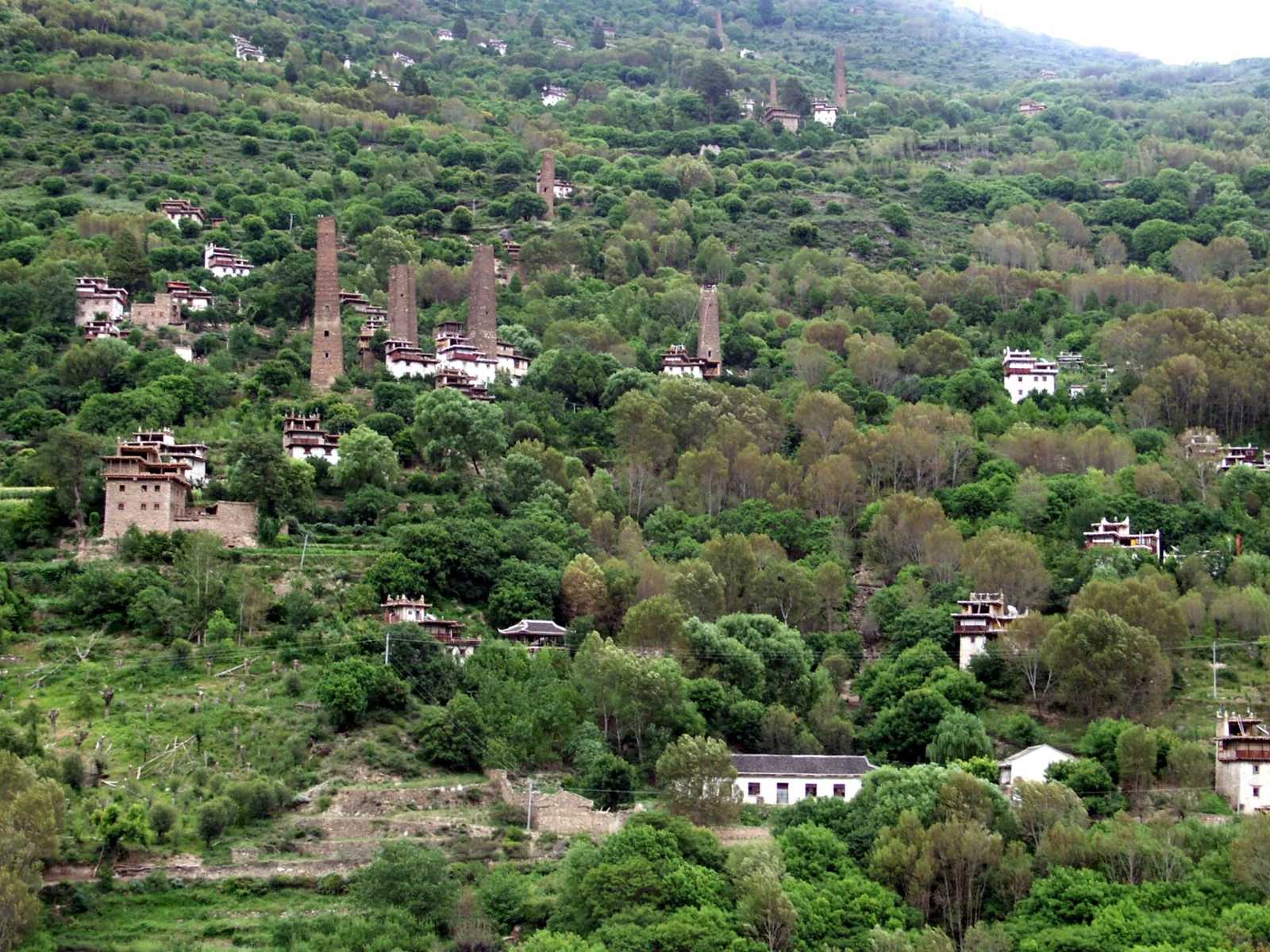
The towers and the houses are built of stone. The towers have tapered walls and no mortar; the houses share the material but not the purpose. A tower is a defensive object: it watches, it stores, it marks a boundary. A house is a domestic one: it keeps warmth, stores grain, and connects to the next house by roof and lane. The same craft is visible in both, but they answer different questions. The tower asks who can see the approach. The house asks how a family can live on a slope. The village is the place where both answers stand in the same view, and where the defensive and the domestic cannot be separated.
The view and the viewpoint
Tourism has added guesthouses and viewpoints to Jiaju. A viewpoint is a strange thing in a village: it selects one direction and frames it, and the framed view is usually the roofs and the towers, not the work that keeps them standing. From above, the village looks complete, a pattern of white walls and dark roofs. From the roof of a house, it looks like a set of neighbours, each with a field and a repair list. Both views are true, but only one of them is available to a visitor in a hurry. The guesthouses are also houses, and the village is still lived in. The viewpoint is a recent addition, and the village was not arranged around it.
What repair takes
Danba's towers are protected, and some are broken at the top. Repair is slow because the craft depends on masons who can build without drawings and on stone that matches the original. The same is true of the houses, which are repaired continuously rather than restored once. A white wall is repainted, a roof is reset, a window frame is replaced. This is maintenance, not conservation, and it is the reason the village looks inhabited rather than preserved. The towers get the attention, but the houses do the work. A village below a tower is not a monument with houses attached; it is a settlement that has kept its walls standing by using them.