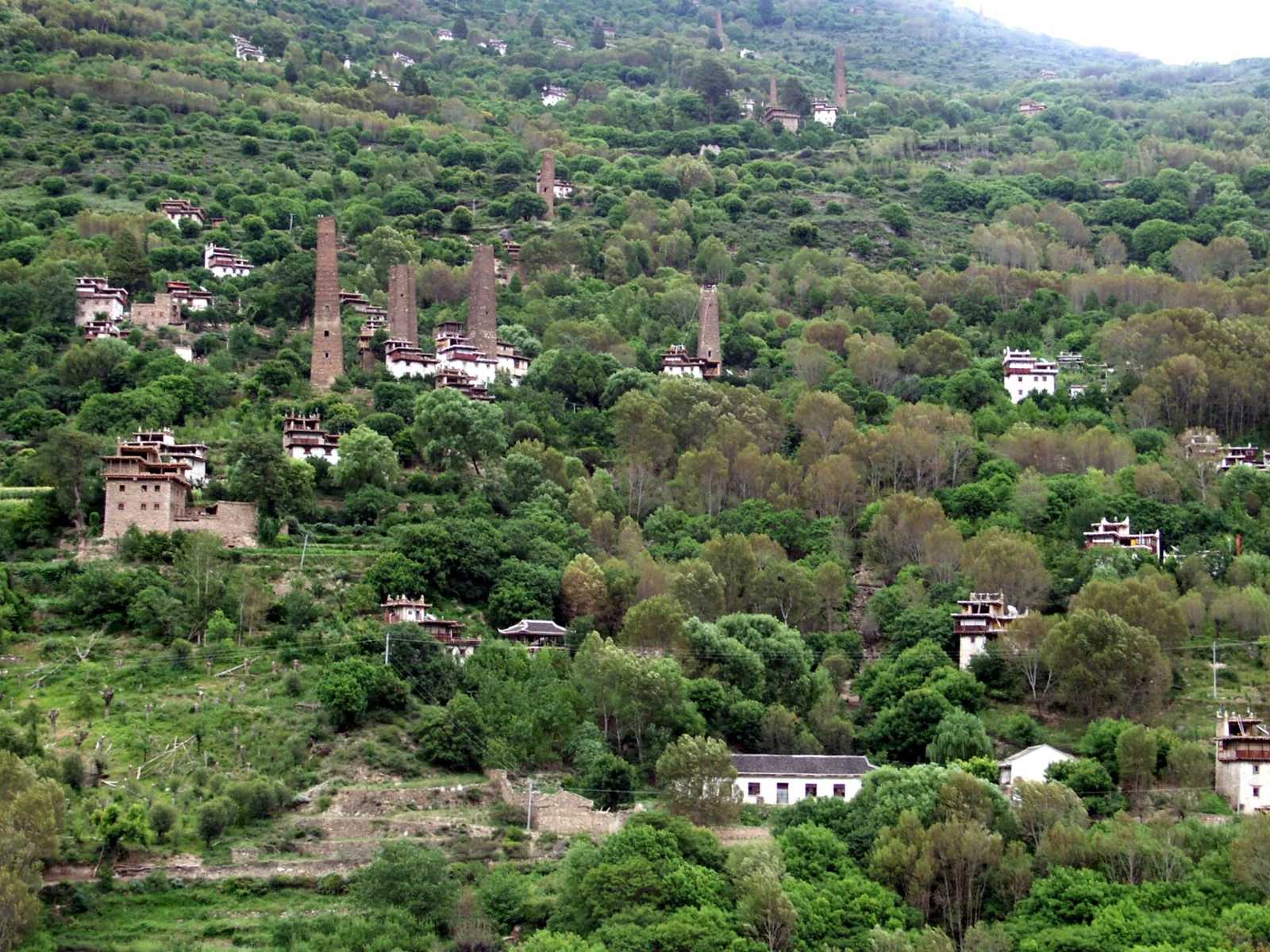
A county of towers
Danba is known as the land of a thousand towers. A 2006 survey counted 562 towers and tower sites, with the densest groups at Suopo, 175, and Zhonglu, 88. The towers are square, five-sided, eight-sided or thirteen-sided; the last two are rare. Most stand twenty to twenty-five metres high, and the tallest, at Zuobi village, reaches 68 metres. They were built for defence, for watching, for storing grain and for marking boundaries, not for a single purpose.
Stone, clay and a steady eye
The walls are made of local stone, clay and wood. The builders did not use drawings or set out lines on the ground. They built an inner frame, laid the outer wall against it and tapered the tower as it rose, judging the slope by eye. Long corner stones, called crossing stones, tied the faces together, and small stones filled the gaps. A tower could take months or years and needed a team. The technique is still visible in the houses beside the towers.
Conservation and a new label
The Danba towers became a national key cultural relic in 2006. Some are intact, many are broken at the top, and a few are ruins. Repair is difficult because the craft depends on experienced masons and on stone that matches the original. In 2025 the nearby village of Jikeyi was named a UN World Best Tourism Village, a label that brings attention and visitors. The towers are not a backdrop: they are the reason the valley's villages are arranged the way they are.