Tianyi Pavilion

Fan Qin and the Books That Built Tianyi Pavilion

A sixteenth-century official carried a collecting habit across his career. The library he built in Ningbo turned that personal pursuit into a structure meant to outlast him.

In the same city · Ningbo ↗

A collector on the move

Fan Qin (1506–1585) was a Ming official from the Ningbo area. Public service took him to different parts of the empire, where he collected and copied books. His shelves brought together works that were useful to an administrator as well as to a reader: local gazetteers, examination records, editions printed in the Ming and writing by Ming authors. The collection was not assembled in one grand purchase. It grew through attention to books encountered across a working life.

That habit matters because it gives Tianyi Pavilion a local and a wider scope. The library belonged to one family in Ningbo, yet its books recorded places and institutions beyond Ningbo. A gazetteer could preserve the shape of a region; an examination register could record who entered the civil service. The objects in the collection were small, but together they formed a map of knowledge gathered piece by piece.
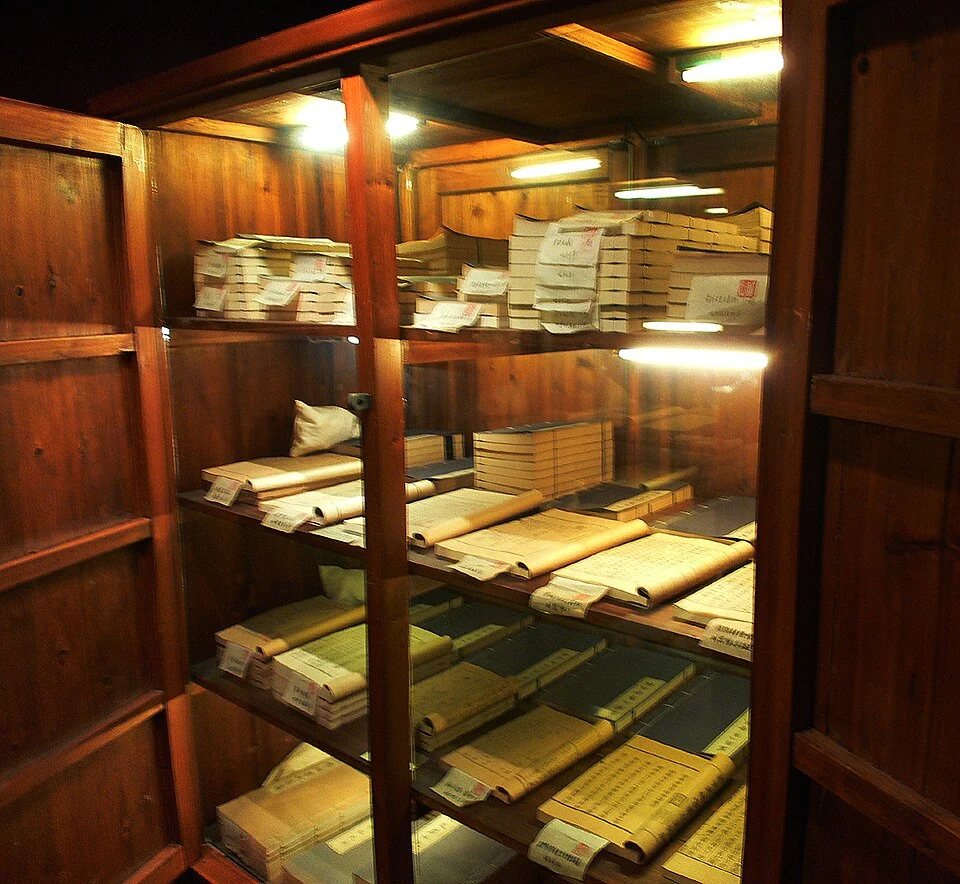
Old books and stitched volumes sit inside a dark wooden bookcase at Tianyi Pavilion.
Book storage at Tianyi Pavilion, photographed in October 2008.

A room designed to endure

Fan Qin built Tianyi Pavilion in the sixteenth century as a private library. The name draws on the phrase “Heaven creates water,” a classical idea associated with protection from fire. The building gave that idea a physical form. The upper floor was arranged as one open room, while the lower floor was divided into six rooms; a pond in front could hold water. The arrangement joined symbolic meaning with a practical concern familiar to anyone who kept books in a timber building.

Books also needed rules and care. Family regulations limited access to the collection, and later generations continued to guard it. The rules could be strict, but they addressed a real problem: a private library survives only when people agree to treat it as more than a store of household property. A collector can begin a library; preservation depends on habits shared after his lifetime.

What a bookcase can tell you

The surviving library is not simply a display of titles. Look at the cases: storage keeps books in order and separates fragile volumes from everyday handling. Tianyi Pavilion’s collection changed over time, as successive generations added to and cared for the collection. The museum today presents a wider history of collecting and preservation, but the old library remains the clearest starting point.

Fan Qin’s story is therefore not only about how many volumes he possessed. It is about a sequence: finding books, arranging a place for them, setting rules for access and asking later generations to continue the work. In Ningbo, a private collection became a public cultural landmark. The bookcases make that change visible at human scale: each shelf holds separate objects, while the room gives them a shared home.

Continue exploring · Tianyi Pavilion ↗
Photo credits and rights
  1. Book storage at Tianyi Pavilion, photographed in October 2008.Gisling · CC BY 3.0 Photo source ↗ Rights information ↗ Resized; WebP conversion.