Zhouzhuang

Zhouzhuang: Homes Beside Bridges, Trade on the Water

At Zhouzhuang’s Twin Bridges, the riverfront mansions and narrow canals reveal how a Jiangnan town joined family life to commerce by water.

In the same city · Suzhou ↗

Two bridges, one working crossing

At Zhouzhuang’s northeast corner, two bridges meet over the crossing of Yinzi Bang and the north–south town river. One is Shide Bridge, a stone arch; beside it is Yong’an Bridge, a flat stone-beam bridge. Seen together, their openings make one round and one square shape, often compared to an old-fashioned key. Their fame rests on a precise piece of town engineering: each bridge answers a different channel and crossing, while together they mark a place where routes through the town converge.

The bridges are not a detached monument set in a scenic backdrop. Streets approach them, houses press close to the banks, and the water continues under and beyond them. The familiar view makes more sense when read as part of a network: At this crossing, the two waterways meet at right angles, and stone bridges let people cross without breaking the routes boats could use. A bridge here joined neighborhoods and markets as much as it framed a picture.
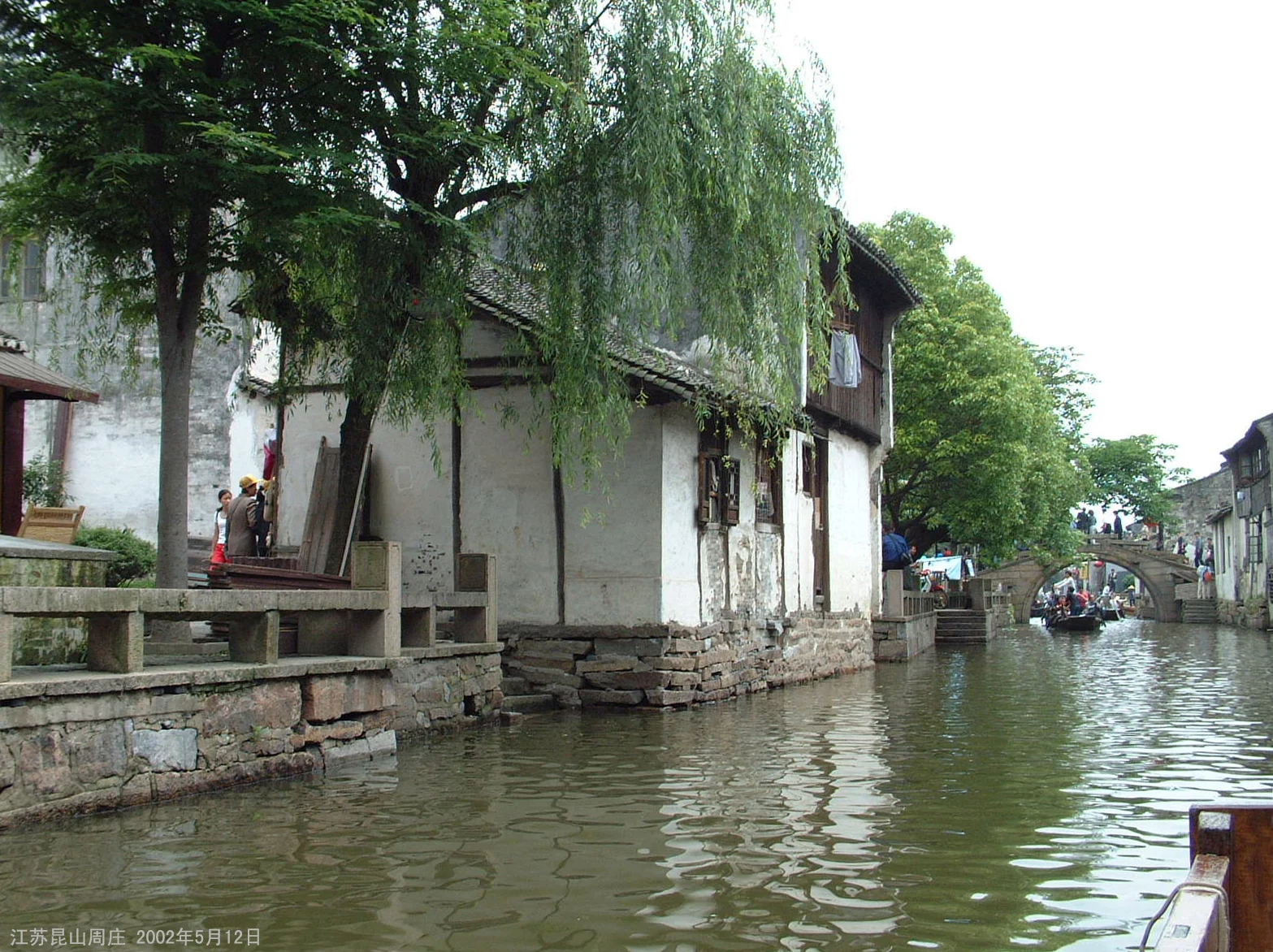
Stone bridges near the Twin Bridges crossing in Zhouzhuang, photographed in 2002.
The Twin Bridges area in 2002; a historical view of the crossing.

A street in front, a boat landing behind

The old town’s canals formed a grid-like framework, with long streets running along their banks. A house could face a street and still depend on the river at its back. Local records describe the characteristic arrangement of large residences such as Shen Hall and Zhang Hall: a front water gate and shops by the street, with a landing or boat shed at the rear canal. Water was an address, a working entrance and a route for moving goods.

This arrangement helps explain why the canals were not simply picturesque scenery. A boat could reach the household side of a property; a shop could open to foot traffic; and a family could move between public business and private rooms through a sequence of courtyards. The riverfront and the street were two faces of the same urban life. Even where present-day uses have changed, the plan preserves the logic of a settlement built around water transport.

Shen Hall and the man behind the legend

Shen Hall, also called Jingye Hall and later Songmao Hall, stands near the east end of Fu’an Bridge on Nanshi Street. It was built in 1742 by Shen Benren, a descendant of Shen Wansan. The mansion is commonly described as having seven successive sections, five gate towers and more than one hundred rooms. Its arrangement moves from the water-facing entrance and reception spaces toward the family’s inner living quarters. That sequence makes the house a useful guide to how wealth could be organized spatially: receiving visitors, conducting household affairs and living privately had different places.

Shen Wansan was a real merchant remembered for his wealth, but he was not the builder of this eighteenth-century mansion. Stories about his fortune—especially the tale of a magical “treasure bowl”—belong to local legend. Keeping the generations distinct makes the house more interesting, not less: a later descendant used a family name with a celebrated past to establish a residence that still shows the relationship between status, business and domestic life.

A town made of thresholds

Zhouzhuang is best understood at the thresholds where land meets water: the bridge landing, the shopfront, the waterside gate and the courtyard beyond it. The surviving stone bridges span waterways of different widths and forms; the old residences show that household plans responded to both street and canal. These details explain how a water town worked without turning its history into a picture of an untouched past.

Today, Zhouzhuang is also a protected historic town and a destination shaped by conservation and tourism. Its bridges and houses remain part of a lived settlement, even as many spaces now serve visitors. Look at the town as a connected system—crossings, riverbanks, doors and rooms—and the famous water-town image opens into something more concrete: an urban landscape where trade and home life shared the same narrow edge of water.

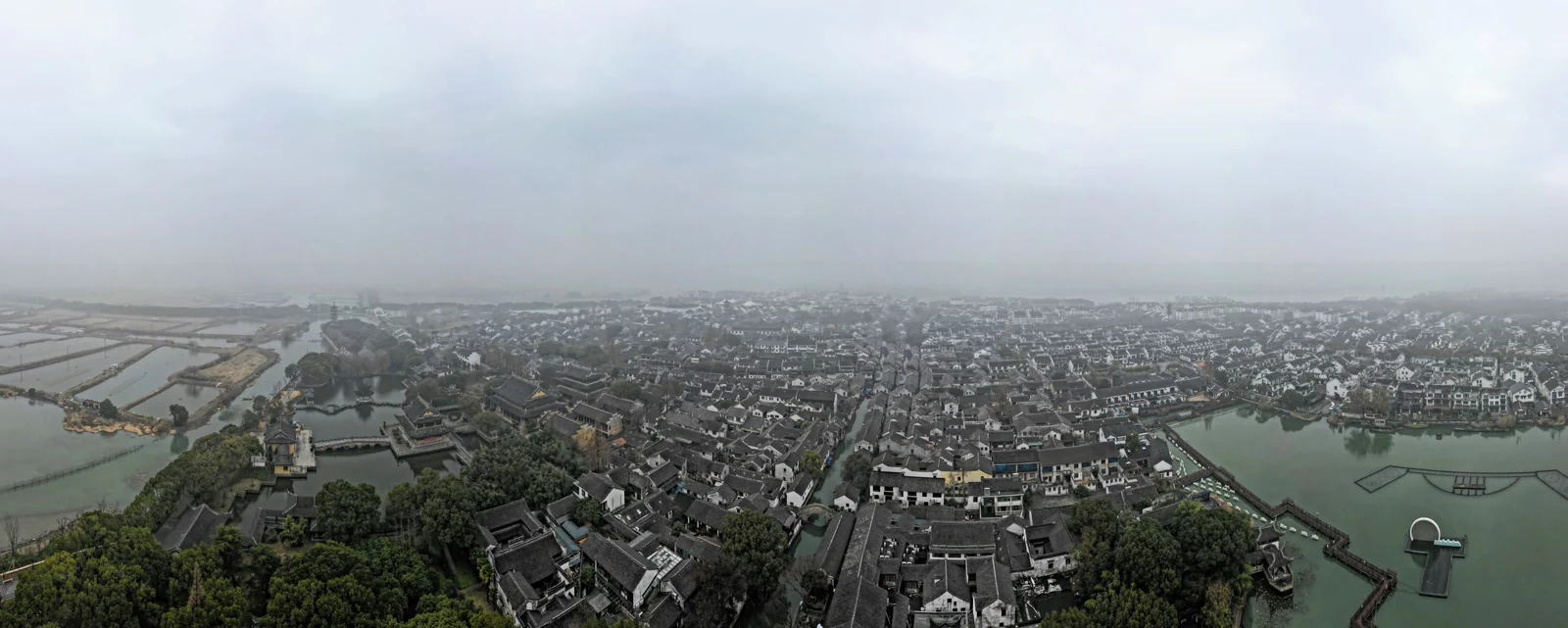
Aerial panorama showing Zhouzhuang’s interconnected canals and rooftops.
From above, the canals read as a connected town network rather than isolated scenery.
Continue exploring · Zhouzhuang ↗
Photo credits and rights
  1. The Twin Bridges area in 2002; a historical view of the crossing.wanghongliu · CC BY-SA 3.0 Photo source ↗ Rights information ↗ Resized down only; converted to WebP.
  2. From above, the canals read as a connected town network rather than isolated scenery.Wanderingchina · CC BY 4.0 Photo source ↗ Rights information ↗ Resized down only; converted to WebP.