From the journal

A city at the scale of a doorway

Read Zhangzhou Ancient City through stone archways, the Confucian Temple, narrow houses and shopfronts that bring several urban histories into one walk.

In the same city · Zhangzhou ↗

A monument in the way through

A stone archway asks to be looked at, but it also marks a route. In Zhangzhou Ancient City, that double role is a useful introduction to the historic centre. Monument and ordinary passage occupy the same urban space. The visitor can pause for carving and proportions while the street continues around it.

Ming-period stone archways and the Dacheng Hall of the Confucian Temple give the old city some of its most substantial landmarks. These give institutional and commemorative weight to the district. They also offer fixed points within a much finer network of streets and buildings. Begin with one such landmark, then pay attention to the change of scale at its edges. The city’s story continues in the neighbouring doorway.
Different buildings make different streets

Qilou arcades, narrow “bamboo-pole” houses and overseas-Chinese villas contribute different forms to Zhangzhou’s historic architectural mix. The nickname for a long, narrow house directs attention to proportion rather than decoration. A frontage can be small while the building extends much farther into its plot.

These types produce different relationships with the street. An arcade makes a sheltered public passage beneath an upper floor; a narrow frontage concentrates the encounter at a doorway or shop opening; a more expansive residence announces itself differently again. Compare the threshold before comparing ornament. It reveals how each building organizes the meeting of household, business and passer-by, and prevents the district from dissolving into a generic impression of “old Chinese architecture.”

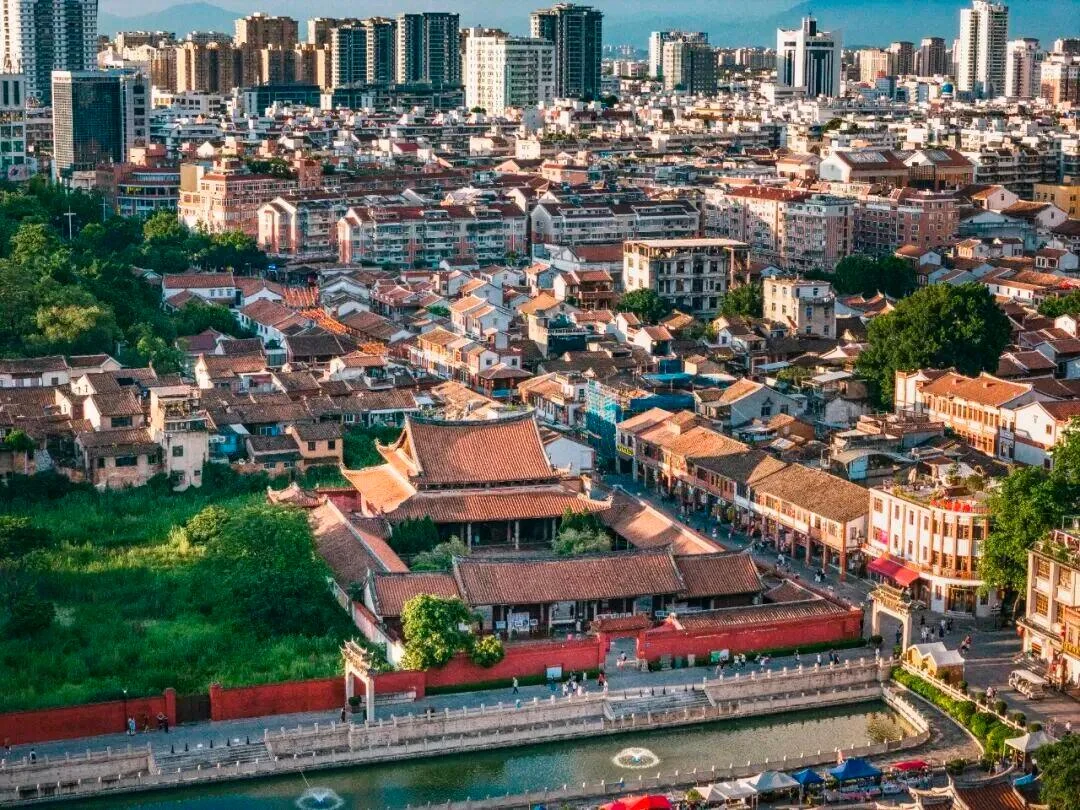
Red-tiled roofs, narrow streets and arcaded buildings cluster around a walled temple compound, with high-rises beyond.
An elevated view across Zhangzhou Ancient City and the surrounding modern city.

Learning, commerce and memory

The provincial plan for the Minnan cultural ecological protection area identifies several strands of Zhangzhou’s urban heritage together: the Confucian Temple, stone archways, established shops and literary residences. The grouping is revealing. A city preserves more than architecture; it also preserves places associated with education, commercial reputation and intellectual life.

The Confucian Temple is a useful anchor for that wider field of learning. An old shop name points toward another kind of continuity, built through customers and repeated transactions. A literary residence attaches a biography to an address. None of these needs to dominate the whole walk. Their proximity is the point: public ideals, private households and everyday exchange helped make the same city.

Let the present remain visible

A heritage plan inventories things worth protecting; it cannot turn an urban neighbourhood into one historical instant. The most attentive way to walk Zhangzhou is to keep different layers visible. A stone structure, a house type and a contemporary shop use may each tell a story from a different period.

This also changes what counts as a satisfying encounter. A doorway does not have to conceal a museum to matter, and an occupied building need not open to visitors to contribute to the street. Look at the relationship between public route and private interior, then allow the boundary to remain. The historic centre gains depth when daily uses are read alongside its monuments. Its character lies in their closeness: civic memory and ordinary urban life encountered within a few steps.

Continue exploring · Zhangzhou Ancient City ↗
Photo credits and rights
  1. An elevated view across Zhangzhou Ancient City and the surrounding modern city.福建省住房和城乡建设厅 / 福建发布;图片组署名:漳州市文旅康养集团、漳州市布袋木偶传承保护中心 · Rights status unspecified Photo source ↗ Original aspect ratio retained. Display copies resized only when needed; no enlargement, crop or retouching.