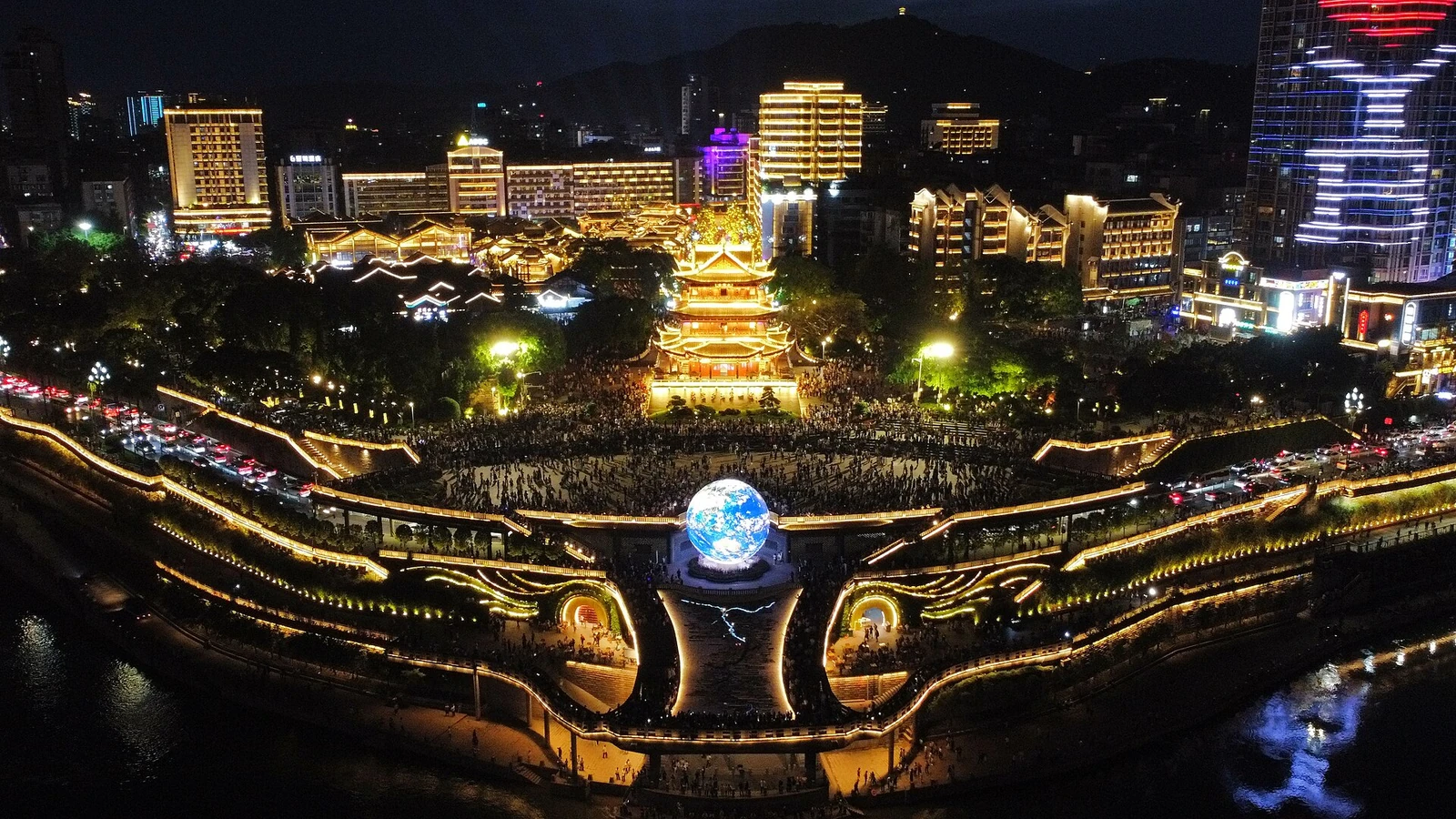
Steps down to the water
The steps at Hejiangmen are wide enough for porters to pass side by side, and they end in water that is never still. Above them the gate marks the line between the old town and the wharf. Below, the Min and the Jinsha arrive together, and from that point the current carries a new name. The stone is the working surface: a boat could be loaded or emptied at the foot of the street, and goods could be carried up without a cart. Nothing here announces a port. There is no warehouse wall and no crane, only the drop between the town and the river. That drop is the reason the city grew at this point.
What the water carried
Yibin was a river port for salt, tea, timber, liquor and goods moving between Sichuan and the Yangtze. The list is ordinary, and that is the point: the river carried what the region produced and what it could not make. Salt came down from the Zigong wells, tea came from the surrounding hills, and timber came from the forests. A cargo did not need a road or a schedule on the scale of a railway yard. It needed a boat, a landing and people willing to carry. The trade shaped the town less through a single great commodity than through the habit of handling many. A landing is a front door, and Yibin's front door faced the water. The river is still a working waterway.
Two rivers, one channel
At the confluence the Min and the Jinsha do not blend at once. They arrive with different colours and different speeds, and for a short distance the line between them can be read from the bank. A boatman entering the combined current has to choose a line and hold it. Downstream the water is called the Yangtze, and the city describes itself as the zero-kilometre point of the main stream. The phrase is civic, but the physical fact behind it is plain: from here the river is wide enough to carry larger loads. The road does not run beside the water. The road is the water. The steps, the gate and the current are one system, and the system is still in use.
Behind the wharf
Behind the gate the old town keeps the shape the port gave it: lanes that run downhill to the river, guild halls built by merchant associations, and houses packed close because land near the landing was useful. The halls are the clearest trace of an economy organised by trade rather than by plan. They were not built by the city; they were built by the merchant groups that used the wharf. Today the waterfront is also a place to walk, and the line between a working wharf and a promenade is not always visible. The test is the steps. As long as they lead down to water that is used, the river is still a road.