From the journal

Zhu Xi at Wuyishan: A Landscape Made for Learning

Wuyi Jingshe connects a riverside place to Zhu Xi’s teaching, the Four Books and a tradition of close attention to the world.

In the same city · Nanping ↗

A school beside the fifth bend

Below Yinping Peak, near the fifth bend of the Nine-Bend Stream, Wuyi Jingshe gives an address to one of the mountain’s most influential stories. Zhu Xi founded the teaching retreat in 1183. The setting placed study beside a river and beneath a distinctive rock landscape, bringing the work of reading into a place later visitors could recognize and remember.

The present complex was comprehensively reconstructed in 2001. Its buildings help communicate the academy’s historical role; they should be read as a modern presentation of an older foundation. The relationship between mountain, water and teaching site remains the most immediate way to understand why this location carries such cultural weight.
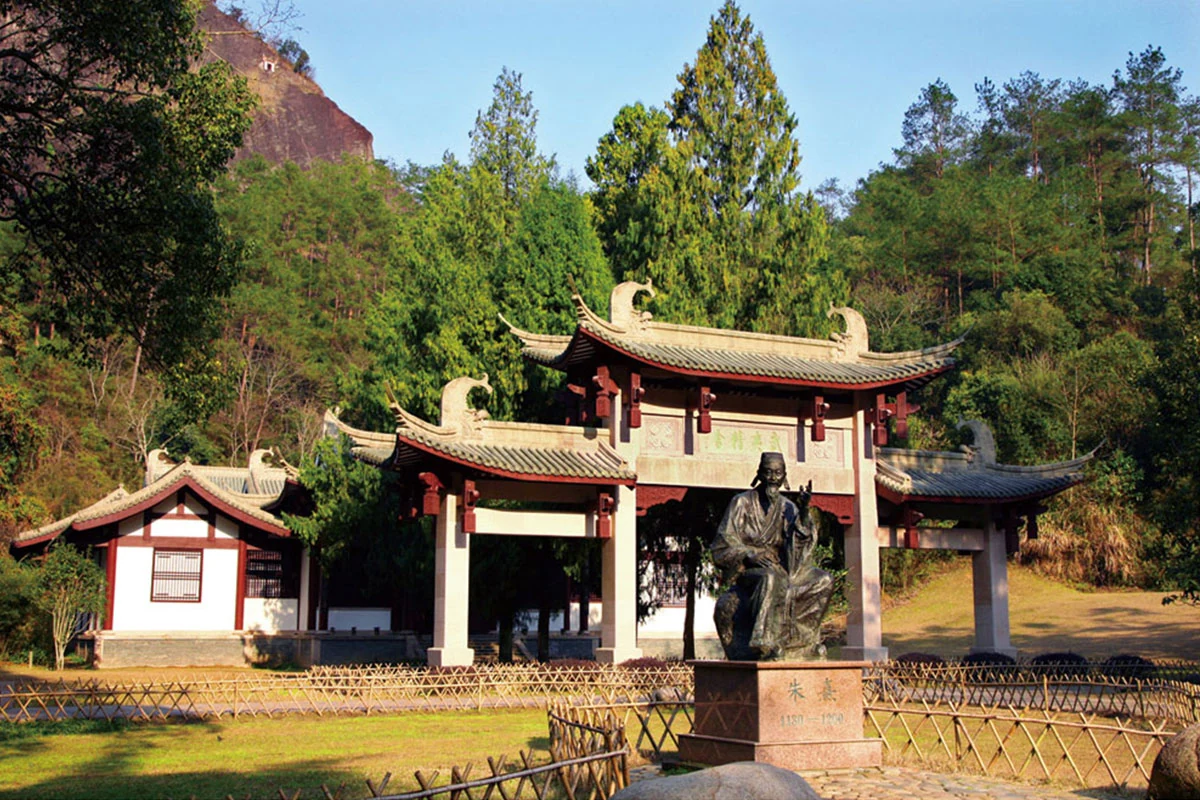
A seated bronze figure on a plinth marked Zhu Xi stands before a tiled gateway among trees.
A statue of Zhu Xi before Wuyi Jingshe.

What the students were studying

Zhu Xi’s influence grew partly through his work on the Four Books: the Analects, Mencius, Great Learning and Doctrine of the Mean. His commentaries brought these texts into a connected educational programme concerned with learning and moral conduct. Their later authority reached far beyond the valley, shaping education and intellectual life across East Asia.

An academy in this tradition was more than a quiet room for solitary reading. Teaching required explanation, discussion and practice. The historical names of spaces at Wuyi Jingshe, including Renzhi Hall and Guanshan Study, place intellectual and ethical aspirations within the built setting. A retreat could be removed from ordinary bustle while remaining intensely concerned with how people should live.

Attention was an ethical task

One accessible entry into Zhu Xi’s thought is “investigating things to extend knowledge.” His concern was not simply to collect interesting facts. Careful study should deepen a person’s understanding of patterns and relationships and help them respond appropriately in life. Li, often translated as principle or pattern, connected the order of things with moral understanding.

This makes the landscape suggestive without turning a mountain walk into a substitute for philosophy. A learner attends to particulars, tests an understanding and returns to the wider relations among them. Reading, reflection and conduct belong together. Zhu Xi developed this programme through an existing intellectual tradition and exchanges with other thinkers; the Wuyi academy was an important setting in that larger life of work.

The valley remembers through words and places

Inscriptions and named sites add a written layer to Wuyishan. They preserve the presence of visitors, patrons and scholars within a landscape that might otherwise seem entirely natural. A few characters on stone can change a cliff from a scenic surface into a record of attention.

The effect is cumulative. A teaching foundation, a remembered scholar and successive acts of commemoration allow later generations to enter a conversation with the place. UNESCO’s recognition of the region’s cultural significance rests partly on this long association with Neo-Confucian learning.

Wuyi Jingshe is therefore most rewarding when the reconstructed halls lead the imagination towards an activity rather than only a famous name: people gathering to read, question and improve their judgment. The stream and rock face remain close by. Together they make a setting in which intellectual history feels spatial, with a path, a bank and a place to sit.

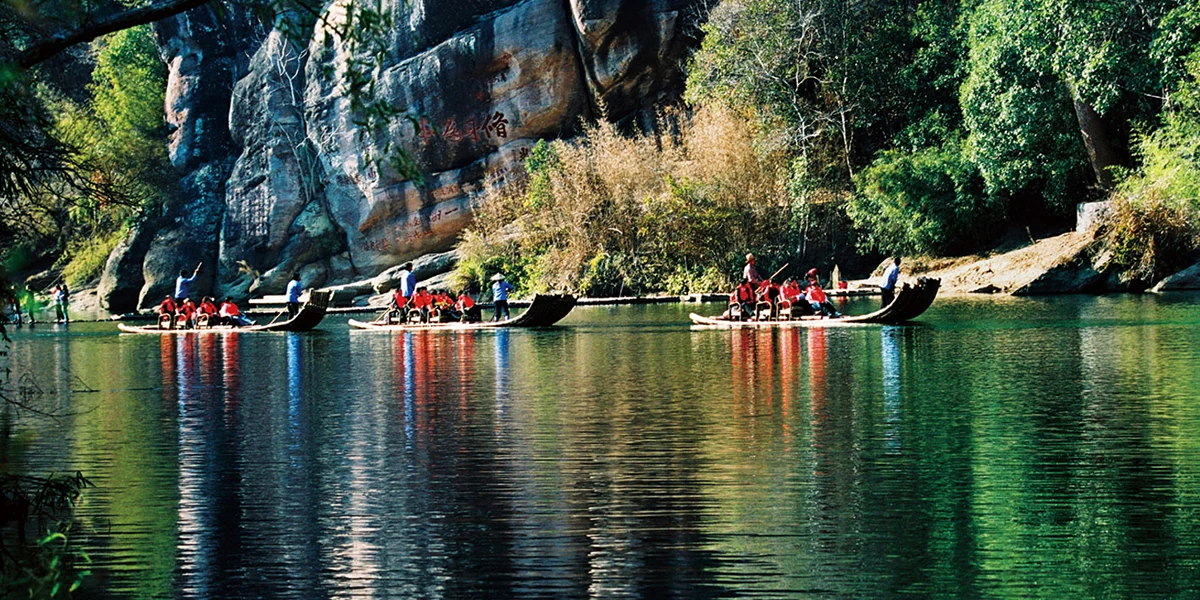
Three bamboo rafts pass beneath a rock face bearing red Chinese inscriptions.
Riverside inscriptions above the Nine Bend Stream.
Continue exploring · Wuyishan ↗
Photo credits and rights
  1. A statue of Zhu Xi before Wuyi Jingshe.Administration Commission of Mt. Wuyi Scenic Area / Mt. Wuyi Tourism Development Co., Ltd.; Website photographer list (individual image author not specified): Yu Zelan, Ruan Xueqing, Liu Dayou, Chen Youyu, Wu Xinzheng, Chen Meizhong, Weng Peiyi, Liu Lijun · Rights status unspecified Photo source ↗ Original aspect ratio retained. Display copies resized only when needed; no enlargement, crop or retouching.
  2. Riverside inscriptions above the Nine Bend Stream.Administration Commission of Mt. Wuyi Scenic Area / Mt. Wuyi Tourism Development Co., Ltd.; Website photographer list (individual image author not specified): Yu Zelan, Ruan Xueqing, Liu Dayou, Chen Youyu, Wu Xinzheng, Chen Meizhong, Weng Peiyi, Liu Lijun · Rights status unspecified Photo source ↗ Original aspect ratio retained. Display copies resized only when needed; no enlargement, crop or retouching.