Qocho, or Gaochang, stands about forty kilometres south-east of Turpan, below the Flaming Mountains. The regional government's account describes three enclosures: an outer city, an inner city and a palace city. The outer wall is roughly square, about five kilometres round, and encloses about two million square metres. It was rammed earth, its base some twelve metres thick and its top about eleven and a half metres above the ground, with projecting bastions along the outside. Two gates are recorded on the west. One of them still shows the curve of a barbican, the outer court that makes a gate harder to rush. These are rounded figures from a government description, not a fresh survey. They are enough to show that this was a city, not a fort with a village inside it.
From the journal
Rammed up, not dug down
Qocho, east of Turpan, raised its walls in layers of earth and kept three enclosures inside them. Yar, the other inscribed city in the basin, was cut into its terrace instead.
Three enclosures of earth
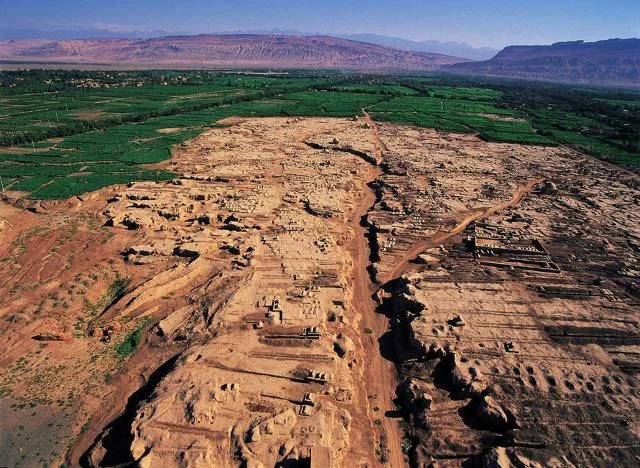
What stood within the wall
The ground inside is divided into quarters. Temple ground lies in the south-east and south, and the south-western block is the largest: a gate, a courtyard, a main hall and the stepped base of a multi-storeyed stupa, with painted murals and Buddha figures still visible in the niches. Outside the walls, to the south-east and north-east, the account notes ground read as workshops and market stalls. Near the centre of the inner city, a small irregular fort holds a raised building about fifteen metres high. Locally it is called the Khan's fort. The name is modern and local; the building is not. What survives is a plan in dry earth, read by its walls rather than by its objects.
The opposite of Yar
Yar City, west of Turpan, was made by cutting down into a terrace. Rooms were taken out of the ground, and the walls were what remained between them. Qocho was raised the other way: earth was piled and rammed into walls, and rooms were built inside them. Both are components of the Silk Roads corridor inscribed in 2014, Yar as 1442-006 and Qocho as 1442-005. They are two inscribed cities in one basin, not two views of one site. Qocho was named a national protected site in 1961, in the first group the State Council listed, and its life runs from a Han frontier post to abandonment in the early Ming, more than fifteen hundred years. A visitor who has seen Yar has seen how a city can be dug. Qocho is the other lesson.