The Thao, one of Taiwan's smallest recognised indigenous peoples, call the lake Zintun. Their origin story tells of hunters following a white deer through the mountains until it led them to a lake full of fish, and a marble deer now stands on Lalu, the islet in the middle. The islet has been renamed several times by successive states: Jade Island under Japanese rule, Kwanghwa Island after 1945, and Lalu again after the 1999 earthquake, when the pavilion on it collapsed and much of the island sank. The lake is the centre of Thao ceremony, and the community still lives around Ita Thao on the southern shore.
From the journal
The lake with a sacred island
Sun Moon Lake lies at the heart of the Thao homeland. Hydroelectric power, tourism and ritual all shape life around its shores.
In the same city · Nantou ↗Zintun and the white deer
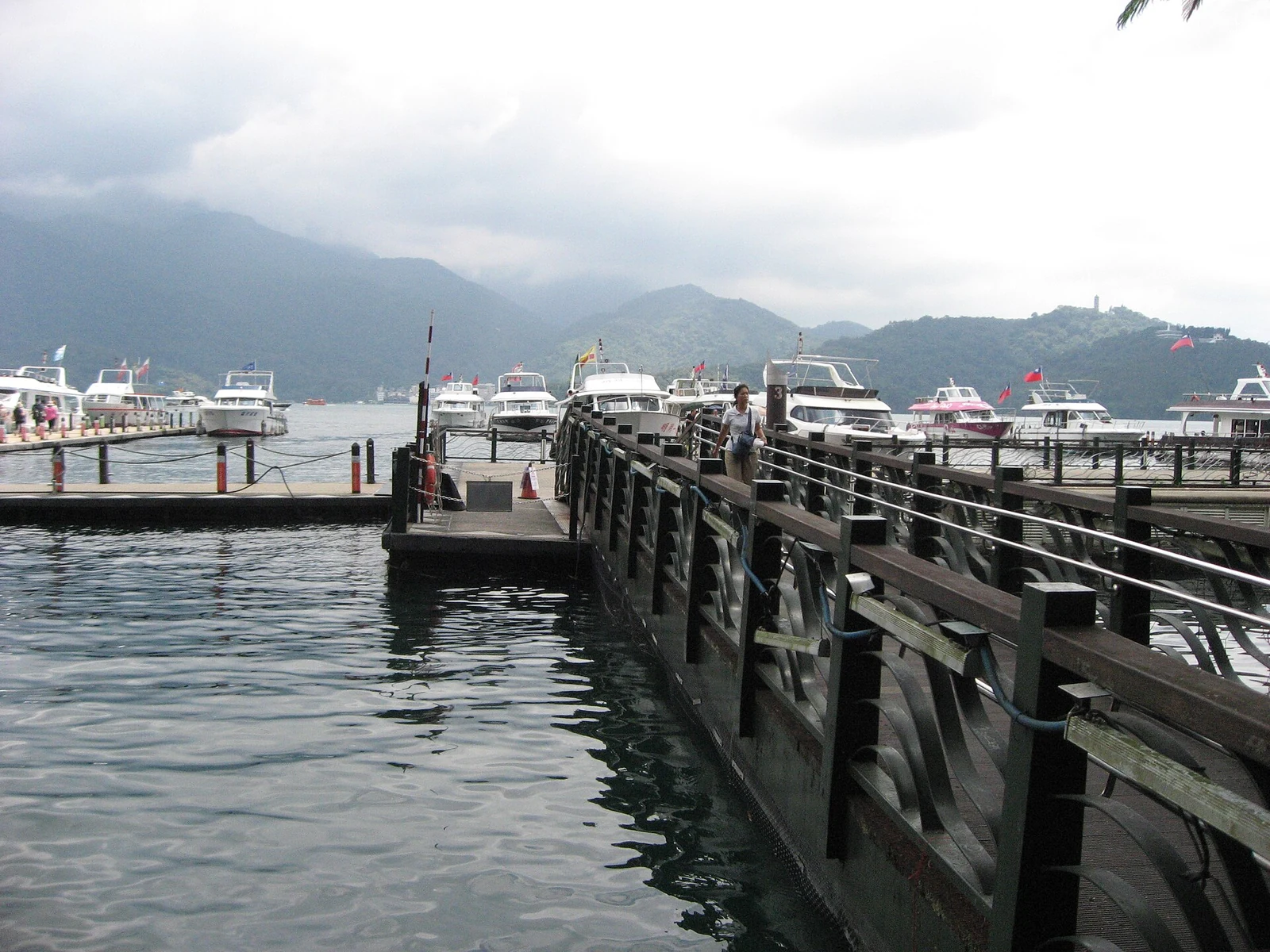

A lake made into a reservoir
The lake was originally a natural basin fed by streams, and its name refers to its shape, round in the east and crescent in the west. Work on the hydroelectric project began in 1919 and was completed in 1934. Dams raised the lake level, and water diverted from the Zhuoshui River increased the supply for generation. Temples on the old shoreline were rebuilt higher up, including Wen Wu Temple. The Jiji railway carried materials for the project. The lake is both a sacred landscape and a piece of infrastructure.
The swim and the shore
Swimming in the lake is normally forbidden, with one exception: a three-kilometre race held around the Mid-Autumn Festival. The event began in 1983 and now draws tens of thousands of entrants, aged over ten and able to swim the distance. The rest of the year the lake is circled by a road, a bike path and trails, with ferries running between Shuishe, Xuanguang and Ita Thao. The Thao run their own visitor centre and sell food and craft at Ita Thao. On the ridges above, Tzu-En Pagoda was built in 1971, and the cable car crosses to a theme park on the far side. Even on its busiest days, the lake itself remains the draw.