Xuzhou

Inside a Han king's imagined afterlife at Shizishan

Read a rock-cut royal tomb alongside jade, terracotta guards and household objects to understand Han ambition beyond death.

In the same city · Xuzhou ↗

A kingdom inside an empire

At Shizishan, the first useful distinction is political. The Chu kingdom associated with Xuzhou's Han tombs was a principality within the Han imperial order, not the earlier state of Chu familiar from Warring States history. Ancient Pengcheng, today's Xuzhou, became a centre of royal power. Members of the ruling family were buried in elaborate tombs cut into nearby hills.

That setting changes the meaning of a descent into the tomb. This was not merely an attempt to hide a body beneath the ground. It was a substantial architectural claim on the future, made possible by labour, wealth and rank. As you move through the surviving spaces, ask what kinds of activities or possessions the plan seems designed to accommodate. Let the site's interpretation identify particular rooms rather than assuming every recess has an obvious function.
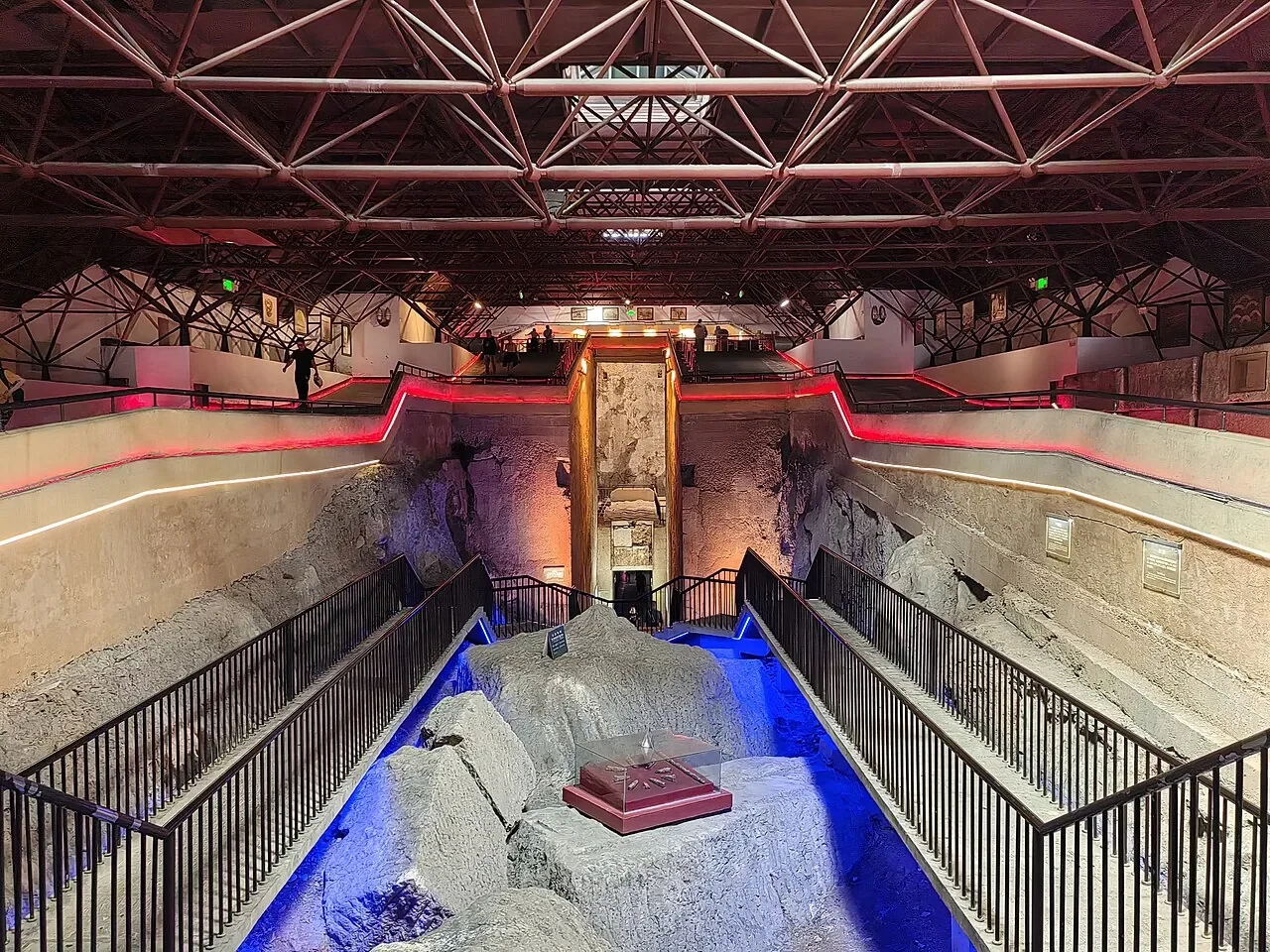
The excavated approach to the Shizishan royal tomb beneath a modern protective visitor structure.

An army does not need to be life-size

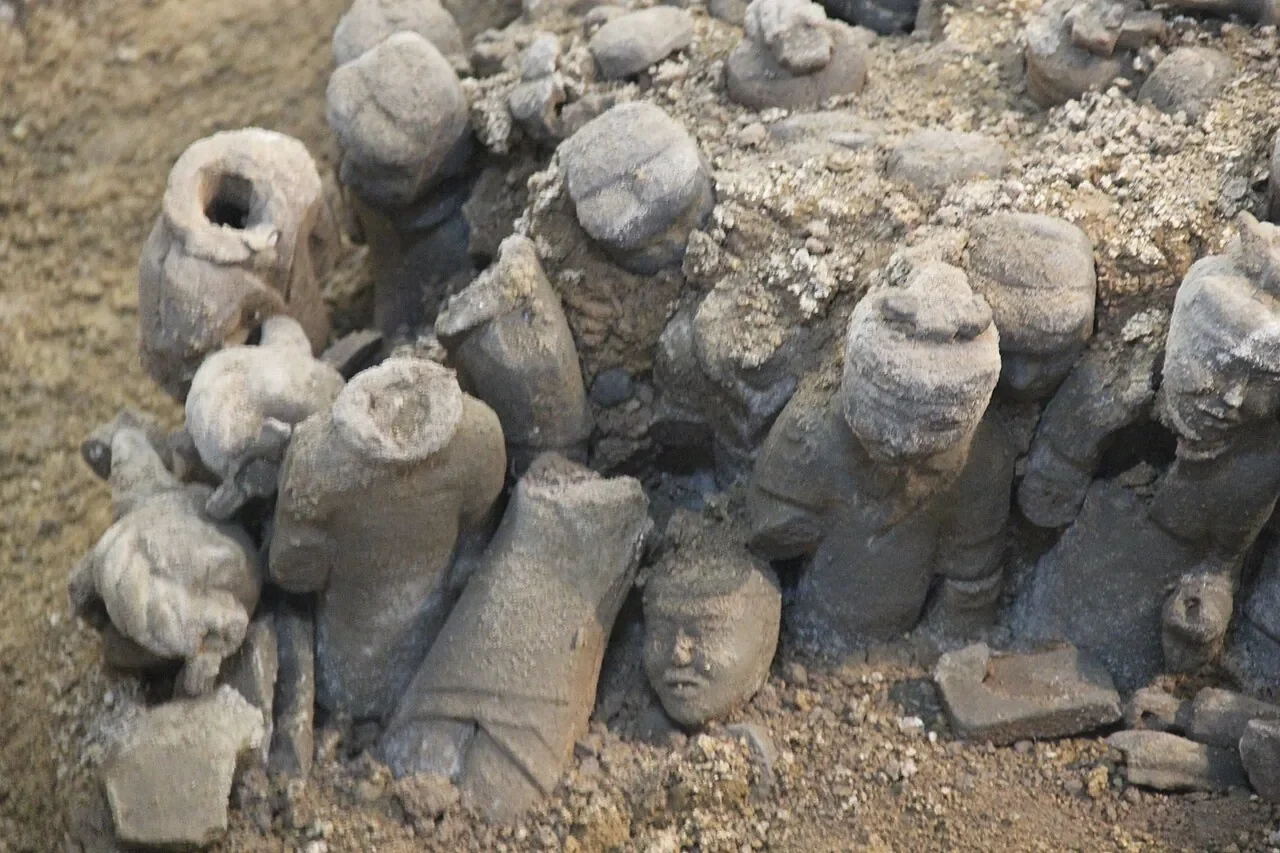
The terracotta figures associated with Shizishan make the scale of royal planning especially tangible. China Institute's exhibition material describes a mounted warrior from a nearby pit and an inscription on the horse connected with the speed and force of Chu cavalry. The figures were not casual ornaments. They participated in a provision for protection and service beyond death.

Jiangsu's account of the Han cultural site makes an important distinction about display: some damaged pits were reconstructed after their contents had been removed. A reconstructed arrangement can explain the original relationship among objects, but it should not be mistaken for an untouched discovery. Read labels for that difference. The question is not whether reconstruction is inherently less interesting; it is what kind of evidence you are looking at.

Rows of small excavated terracotta warriors remain embedded in an earthen pit in Xuzhou.
Han-period terracotta figures in Pit 2 at the King of Chu tomb complex in Xuzhou.

Jade as a body, not a jewel

Among the great finds associated with Xuzhou's royal tombs is the gold-thread jade burial suit excavated in 1994–95. China Institute's catalogue-related account records 4,248 jade pieces. That number matters less as a record than as a prompt to imagine shaping, perforating and assembling an entire covering for a human body.

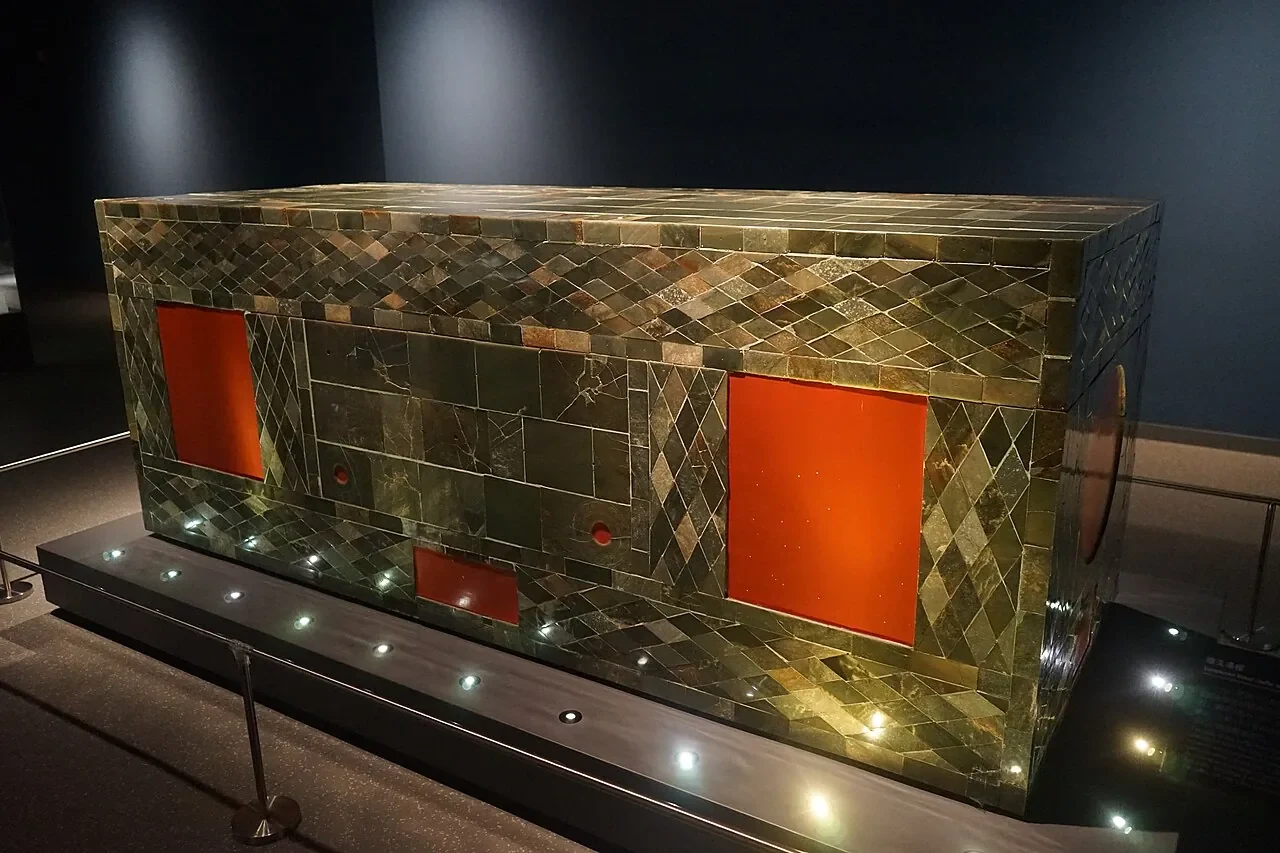
Seen from a distance, the suit can resemble armour. Close attention reveals another ambition: expensive materials organised around a hope of bodily preservation and continued existence. The tomb offers the setting for that hope; the objects explain its texture. Treat the tomb and Xuzhou Museum as complementary parts of the enquiry, and use the museum's labels to distinguish originals from replicas. Neither a room without its objects nor an isolated treasure fully conveys the project.

The reconstructed jade-inlaid lacquer coffin excavated from Shizishan, displayed in a museum.

Who keeps the king comfortable?

Royal eternity also needed ordinary tasks. Xuzhou Museum's collection includes painted figures from Beidongshan, a different royal tomb excavated in 1986, representing officials and guards. Their presence is a useful comparison, not a licence to attribute every figure in a gallery to Shizishan. Keep the findspot attached to the object as you look.

Across the royal-tomb material, vessels, attendants and performers complicate the idea that burial art concerns only solemn ritual. The imagined continuation of privilege required food, company, service and entertainment. It is worth reversing the usual visitor's gaze: instead of asking only who the ruler was, ask who had to work to make that ruler's afterlife imaginable. The makers themselves are often less visible than the person commemorated.

Shizishan becomes most powerful when these scales meet: a hill altered by excavation, a miniature guard, an individual jade tile. Together they reveal an extraordinary effort to organise what could not be controlled. The archaeology shows the provisions people made. It does not tell us that their hopes were fulfilled.

Continue exploring · Shizishan Chu King's Tomb ↗
Photo credits and rights
  1. The excavated approach to the Shizishan royal tomb beneath a modern protective visitor structure.Yumeto · CC BY-SA 4.0 Photo source ↗ Rights information ↗ Resized and converted to WebP.
  2. Han-period terracotta figures in Pit 2 at the King of Chu tomb complex in Xuzhou.Gary Todd from Xinzheng, China · CC0 1.0 Photo source ↗ Rights information ↗ Resized and converted to WebP.
  3. The reconstructed jade-inlaid lacquer coffin excavated from Shizishan, displayed in a museum.Huanokinhejo · CC BY-SA 4.0 Photo source ↗ Rights information ↗ Resized and converted to WebP.