Huai'an

Qingjiangpu: how a water-control problem made a city

At Qingjiang Lock, follow Chen Xuan's canal intervention from imperial grain transport to towlines, bypass channels and urban life.

In the same city · Huai'an ↗

The obstacle before the city

Imagine a grain boat reaching a point where the channel does not simply continue. Cargo movement depends on water levels, awkward connections and the effort required to haul vessels across barriers. This was the problem confronting the early Ming administration around Huai'an. As political power shifted towards Beijing, dependable transport from the south became an imperial necessity.

Local historical accounts identify Chen Xuan, the official responsible for grain transport, with the opening of the Qingjiangpu channel in 1415. Using an earlier watercourse, the intervention reduced the difficulties boats faced near the Huai River connection. Together with a series of locks, it helped create a more workable route. Qingjiangpu's later urban life followed this engineered opportunity. Water was not merely a pleasant setting for a town; managing it helped produce the town.
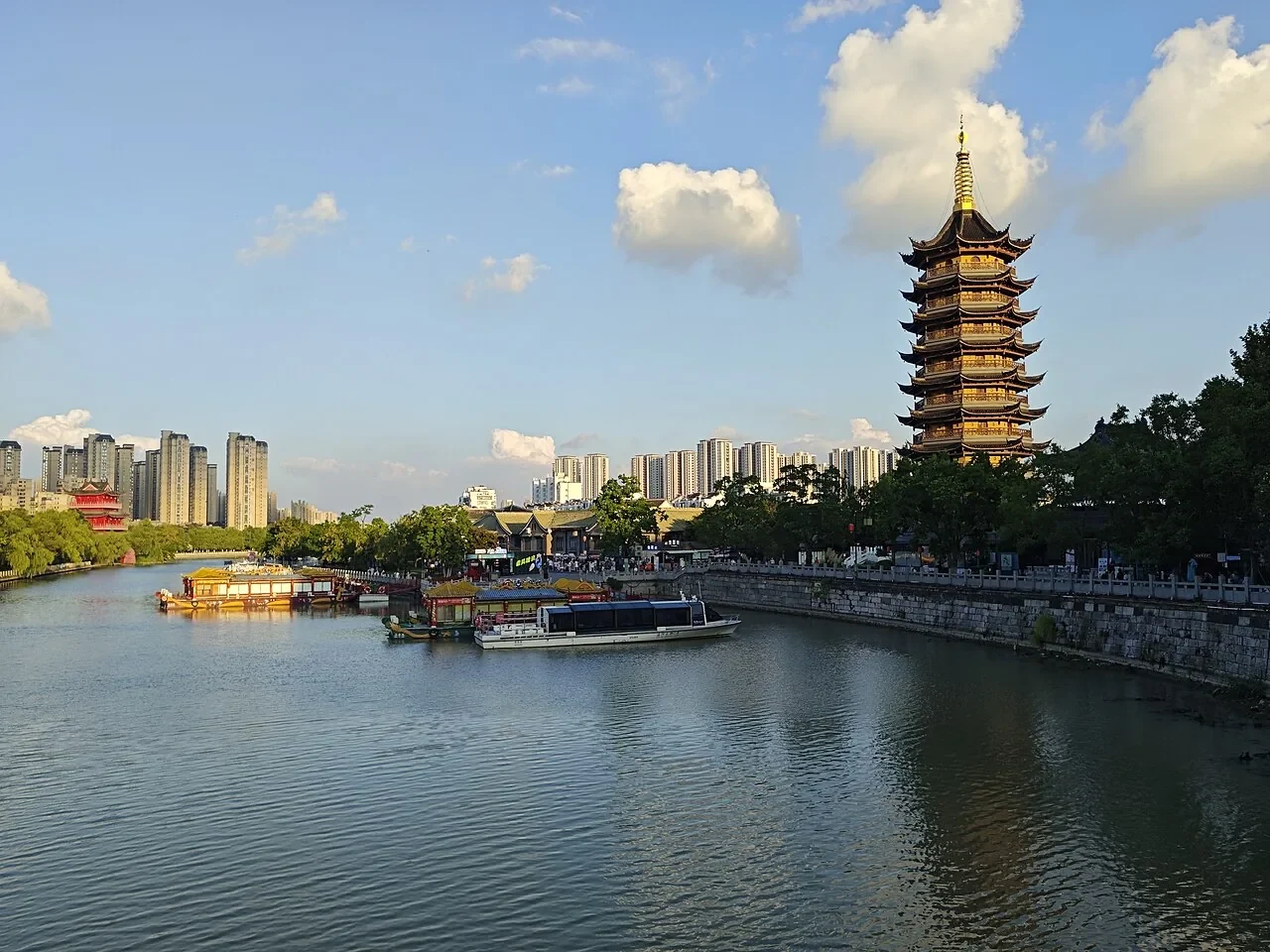
Boats on the Qingjiangpu waterfront beside a tall pagoda under a partly cloudy sky.
The Qingjiangpu waterfront in Huai'an, photographed in July 2025.

A canal is a system, not a line

UNESCO describes the Grand Canal through the institutions and infrastructure that enabled grain and strategic materials to move across the empire. This wider context matters at Qingjiang Lock. A channel alone could not guarantee delivery. Locks, banks, storage, taxation and official supervision all contributed to the movement of goods.

At the surviving lock, concentrate on the narrowing of space. A broad stretch of water has to pass through a much tighter opening. That physical fact is a way into the site's history, even before you know the names of particular structures. Local accounts describe dangerous currents and the enormous effort sometimes required to haul loaded vessels upstream. The stonework should therefore suggest exertion as much as engineering elegance.

Chen Xuan was not the last to intervene

The solution needed further adjustment. A local history of Zhongzhou explains that, during the Wanli period, the river official Pan Jixun had a U-shaped bypass channel and a further lock constructed near Qingjiang Lock to ease difficult passage. The land enclosed within the bend became Zhongzhou. This is an especially useful piece of urban geography: a shape in the modern waterfront can be read as the consequence of a practical intervention.

Do not assume that one successful construction solved the canal permanently. Rivers carry sediment; currents change; structures need repair. Huai'an's importance came partly from having to manage these unstable relationships repeatedly. A timeline of officials becomes more meaningful when attached to the particular problem each was trying to change.

Put the workers back into the view

A memoir published by Huai'an's local-history organisation describes towmen helping boats against the current and workers using hauling mechanisms at the lock. It also recalls a bridge that could be opened for passage. Such recollections should be read as testimony to particular remembered periods, not automatically extended across every century of the canal. They nevertheless restore the bodily effort missing from a smooth waterfront panorama.

Look again at a bank or crossing and imagine the competing needs it had to accommodate: movement along the water, passage across it, and labour at its edge. A hydraulic structure was also a place where different kinds of traffic met. The story is consequently urban and social, not only technical.

Today's landscaped canal offers a calmer experience, with a different relationship between water and daily work. Enjoy that present without projecting it backwards. Qingjiangpu is compelling because it makes a large historical claim visible at a small scale: imperial administration depended on local channels, and those channels depended on people. The surviving lock lets the journey from capital policy to a strained towline become imaginable.

Continue exploring · Qingjiang Lock and the Li Canal ↗
Photo credits and rights
  1. The Qingjiangpu waterfront in Huai'an, photographed in July 2025.Cz2018764171 · CC BY-SA 4.0 Photo source ↗ Rights information ↗ Resized and converted to WebP.