From the journal

A Garden Pavilion Becomes a Theatre at Norbulingka

Kangsong Silnon’s theatre story unfolds in Norbulingka, a 36-hectare garden residence organized around three principal palaces.

In the same city · Lhasa ↗
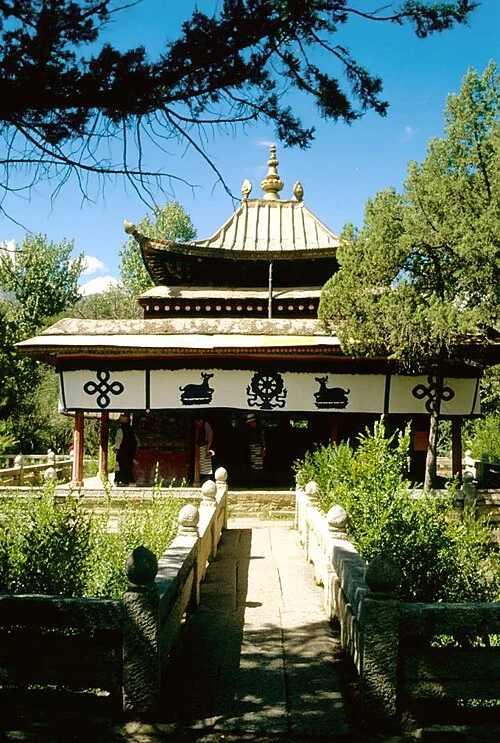
A building is approached through the planted grounds of Norbulingka.
Norbulingka’s planted grounds and a garden building, photographed in 1999.

A pavilion acquires an audience

The story of a theatre does not always begin with a purpose-built stage. At Norbulingka, the official historical description of Kangsong Silnon begins with a small Chinese-style wooden pavilion. It was later altered into a building for watching theatre, and an open space suitable for performance was added to its east.

That sequence matters. The change was not simply a new name on an old building. A performance requires a relationship between those who act and those who watch. Altering the pavilion and arranging open ground beside it reshaped how a part of the garden could be used.

A theatre within a summer residence

Norbulingka’s historical functions included residence, religious ceremony and government work. Kangsong Silnon belonged within that larger world. Nearby buildings had different purposes, and the theatre occupied a place within the social and ceremonial life of the summer residence.

The proximity of these activities is more revealing than treating the pavilion as an isolated attraction. A garden could be a place of formal reception and also accommodate a lengthy performance. Its open spaces were useful precisely because they allowed activities to gather around buildings that were modest in size compared with the Potala.

Norbulingka was built in the 1740s and expanded for more than two centuries. A 2024 historical account describes a 360,000-square-metre garden with 374 rooms, four gates and the eastern gate as its main entrance. It names three principal palaces: Gesang, Golden and Daden Mingjiu.

Kangsong Silnon stands within this broad residence. Its theatre pavilion and open performance ground belonged to a garden of many buildings, entrances and courtyards.

The garden as a cultural setting

The association between Norbulingka and performance continues through the wider cultural memory of Lhasa’s summer season and Shoton. Tibetan opera brings narration, music, movement and costume into a shared event. A planted setting and an audience area offer a different experience from looking at an object inside a museum case.

Kangsong Silnon gives this performance history a particular architectural focus. It is a small architectural story about adaptation: a pavilion, a changed use, an audience and an area of ground. Through those elements, the larger summer residence becomes a place that was listened to as well as looked at.

Continue exploring · Norbulingka ↗
Photo credits and rights
  1. A second 1999 view gives the garden a different scale from Lhasa’s hilltop palace.LBM1948 · CC BY-SA 4.0 Photo source ↗ Rights information ↗