From the journal

Three Streets and Two Lanes in Nanning’s Merchant City

Nanning’s historic streets, lanes and meeting halls reflect the commercial life shaped by river trade.

In the same city · Nanning ↗

The name is already a small map

Three Streets and Two Lanes identifies five routes: Xingning Road, Minsheng Road and Jiefang Road, together with Jinshi and Yinshi, the Golden Lion and Silver Lion lanes. The three roads and two lanes are distinct routes within the same historic neighbourhood, not interchangeable examples of an “old street.”

The Yong River supplies the larger frame. A 2013 Nanguo Morning Post account links the district’s commercial growth to waterborne trade, particularly after Nanning opened as a trading port in 1907. Goods moved from boats to streets, buyers, shops and households, making the waterfront part of a network of commerce rather than scenery behind a shopping district.
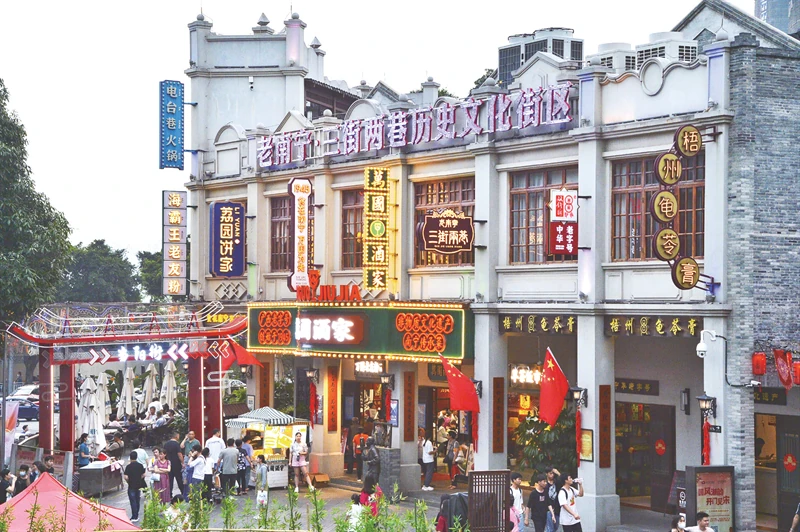
Visitors pass illuminated food-shop signs on arcaded storefronts in Nanning’s Three Streets and Two Lanes.
Shops and everyday visitor life in Nanning’s renewed Three Streets and Two Lanes district.

Different routes did different work

The 2013 newspaper account gives the routes distinct historical roles. Goods landed at Minsheng Wharf and were stacked along Minsheng Road for wholesale trading. Xingning Road acquired arcaded commercial buildings during its transformation into a shopping street in the 1920s and 1930s.

Jiefang Road accommodated specialist trades and merchant-funded meeting halls. Jinshi Lane was associated with wealthy households, while Yinshi Lane had a recreational role. Arcades, trade buildings, halls and domestic lanes formed different parts of the commercial neighbourhood.

A merchant hall kept a home town close

Xinhui Academy adds a social map to the street map. Nanning Daily’s 2022 heritage account identifies its founders as merchants from Xinhui in Guangdong, whose businesses included dried citrus peel and palm-leaf fans. They pooled resources for a native-place association hall. Commercial discussions shared the building with education, gatherings, celebrations and ritual. The name ‘academy’ therefore captures only part of its work.

Its decoration expressed a shared presence as well as the merchants’ aspirations.

The hall now has a different kind of voice

A March 2026 China Culture Daily report, published on the Ministry of Culture and Tourism’s website, describes Xinhui Academy as the home of the Nanning Opera Museum. It dates the hall’s beginnings to 1736 and documents displays of costumes, props and historic photographs alongside performances of Yongju and Cantonese opera. These are distinct theatrical traditions; the report identifies both as nationally recognised forms of intangible cultural heritage.

The academy’s reuse as the Nanning Opera Museum places displays and performances of Yongju and Cantonese opera within the former communal hall, giving the building a continuing public use.

Repair and reuse in the merchant city

Nanning Daily records Xinhui Academy's reconstruction in 1843, the movement of its front section during road widening in the early 1930s, wartime damage in 1942 and an inscription recording a 1948 repair. Each event changed the building while its association with the city continued.

Elsewhere in the district, the former Nanning Chamber of Commerce building recalls an organisation established in 1907 and a hall adapted for business meetings in 1915. The merchant city grew through successive acts of building, repair and reuse by the people who worked there.

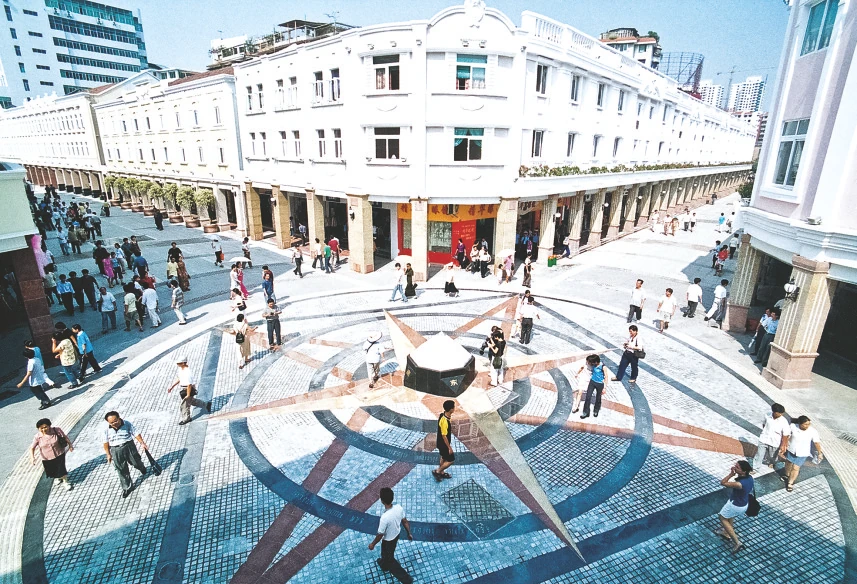
Pedestrians cross a patterned circular plaza between white arcaded buildings.
Minsheng Road and Xingning Road pedestrian streets after their 2001 redevelopment, in a photograph supplied by the Nanning Local Chronicles Office archive.
Continue exploring · Three Streets and Two Lanes ↗
Photo credits and rights
  1. Shops and everyday visitor life in Nanning’s renewed Three Streets and Two Lanes district.Nanning Evening News / Nanning Civilisation Office; Photo: 黄维业 (Huang Weiye) · Rights information Photo source ↗ Resized and converted to WebP; full composition retained.
  2. Minsheng Road and Xingning Road pedestrian streets after their 2001 redevelopment, in a photograph supplied by the Nanning Local Chronicles Office archive.Nanning Local Chronicles Office archive; via Nanning Evening News / Nanning Civilisation Office · Rights information Photo source ↗ Resized and converted to WebP; full composition retained.