From the journal

Reading the Layers of the Ruins of St. Paul’s

The surviving façade of the Church of Mater Dei is a carved surface shaped by Chinese and European visual traditions, and the remnant left by the fire of 1835.

In the same city · Macao ↗
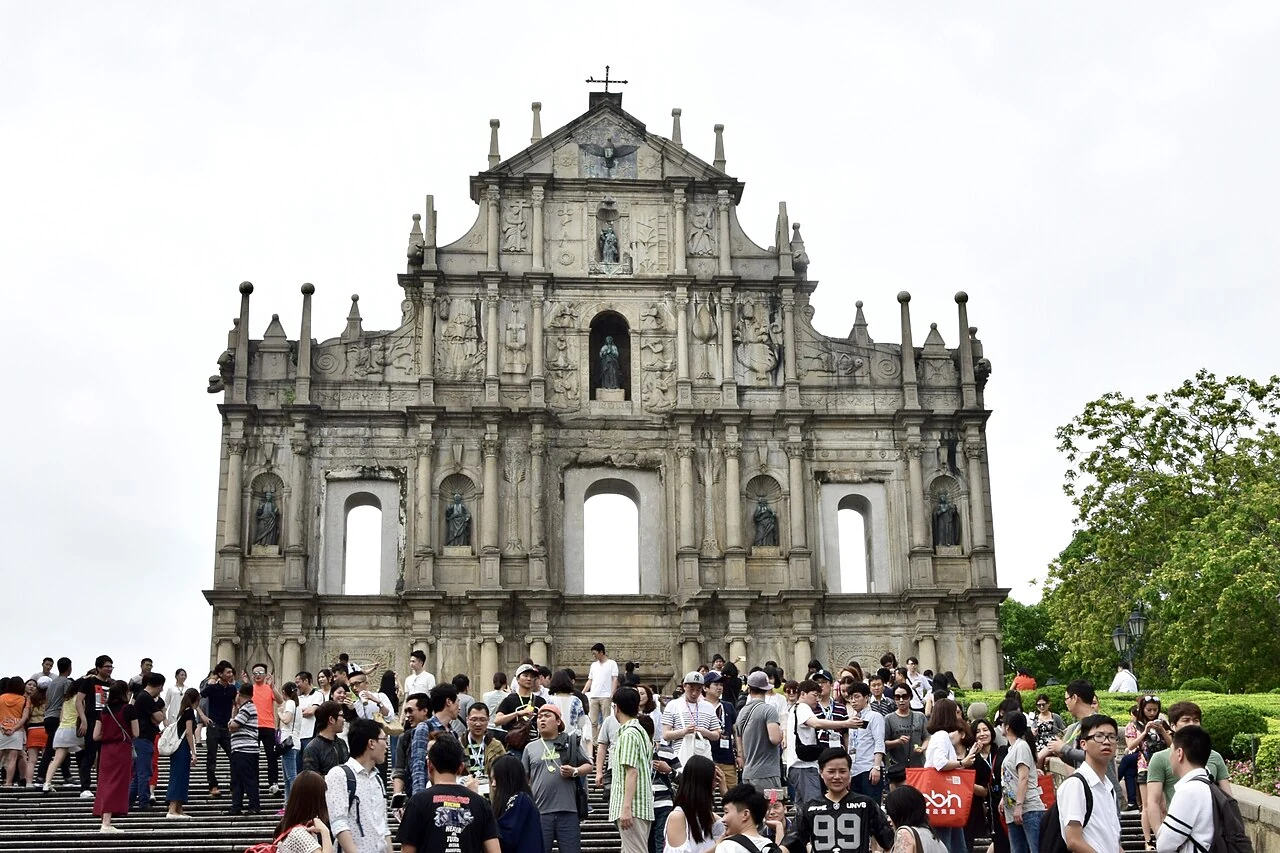
The surviving stone façade of the Church of Mater Dei at the Ruins of St Paul’s in Macao.

The front wall of Mater Dei

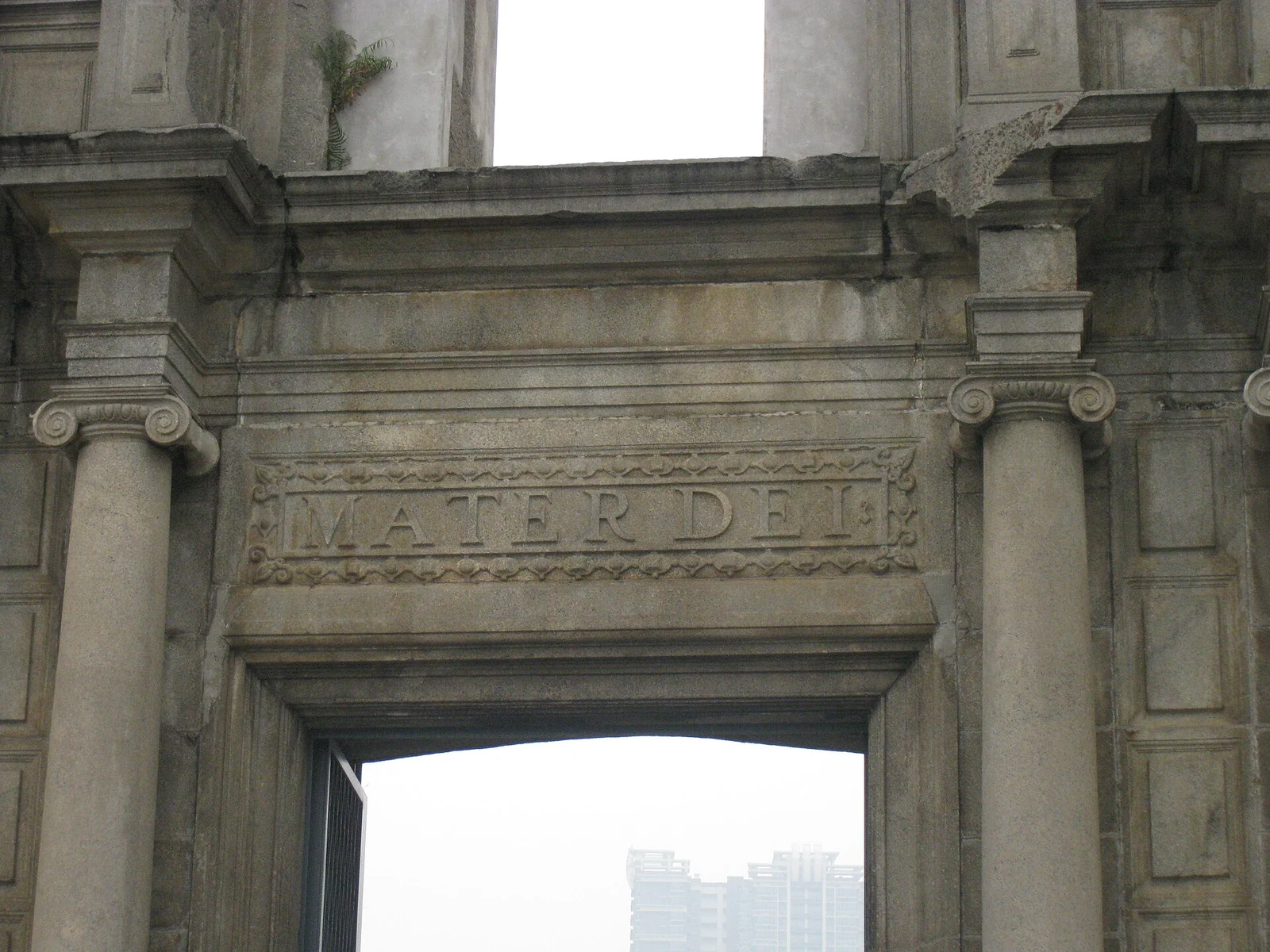
The Ruins of St. Paul’s are the surviving front wall of the Church of Mater Dei. Building began in 1602 and was completed between 1637 and 1640, with the façade finished last. In Latin, Mater Dei means “Mother of God”; the name still appears on the central entrance, tying the carved stone to its original dedication.

The church and the attached College of St. Paul formed a much larger Jesuit complex. When fire swept through the site in 1835, the front wall, much of the foundations and the stone steps remained. The familiar name “大三巴牌坊” came later, when local residents compared the façade’s shape to a Chinese ceremonial gate.
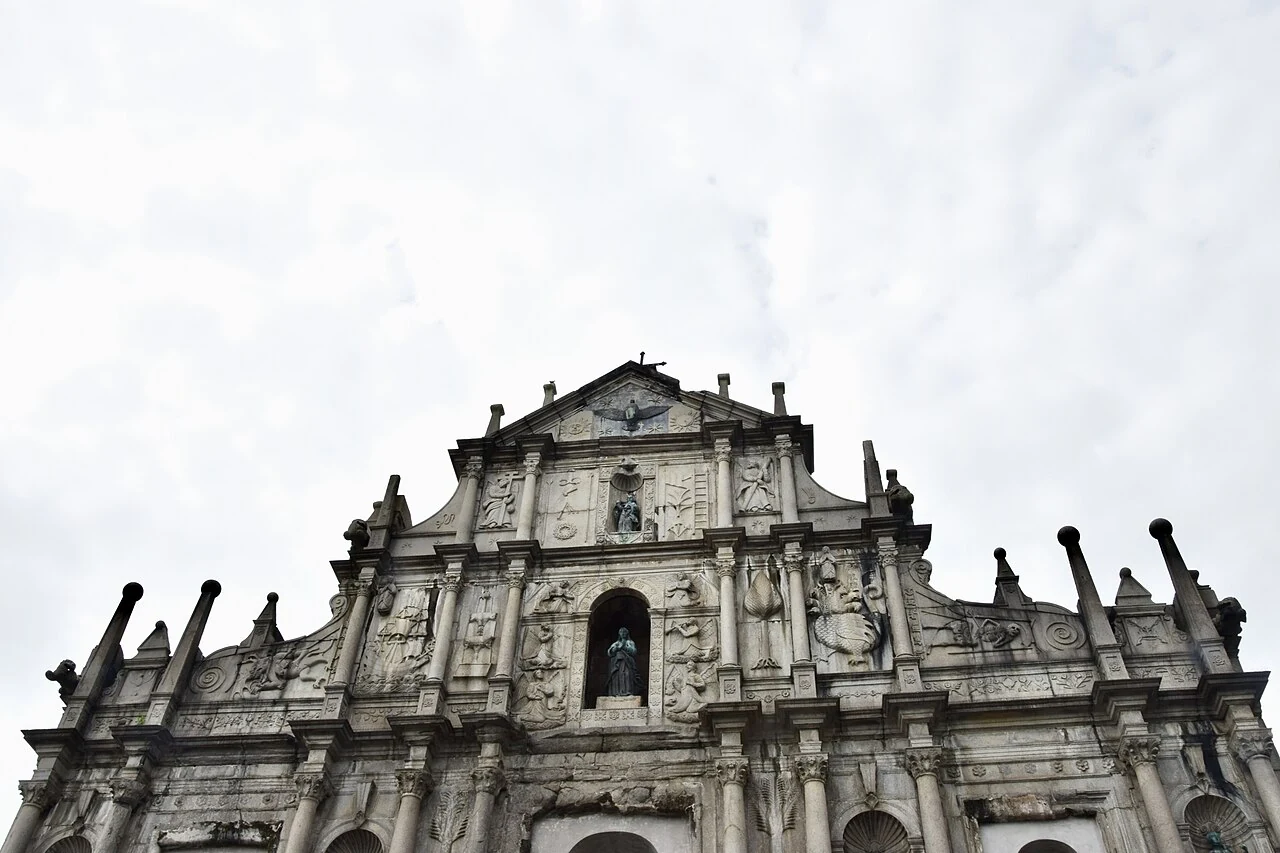
The surviving stone façade of the Church of Mater Dei at the Ruins of St Paul’s in Macao.

Letters, roses and saints

At ground level, three doorways open beneath ten Ionic columns. Above the smaller side doors, carved letters spell IHS, the Jesuit emblem; over the central entrance, “MATER DEI” identifies the church. The words are part of the architecture, set where a person entering would meet them.

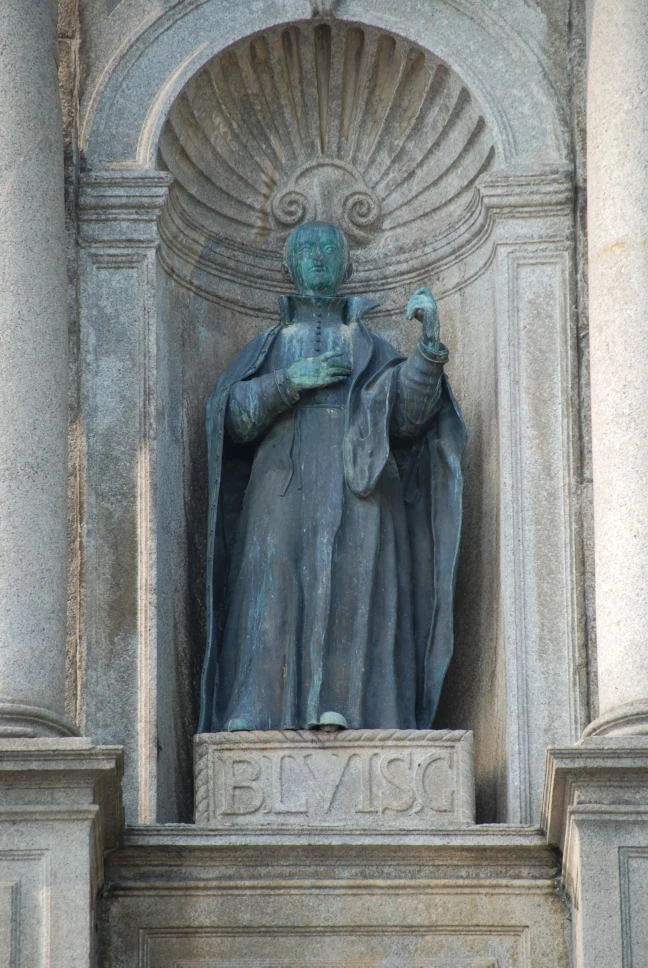
The second tier repeats the three-part rhythm with Corinthian columns and three windows. Seven carved roses decorate the lintel above each window; palm trees flank the central opening, and bronze statues of four Catholic saints occupy niches beside the outer windows. From the plaza, this level reads as a carefully ordered row of openings, foliage and figures.

A bronze saint in a niche on the St Paul’s façade.
Stone lettering above an opening in the St Paul’s façade.
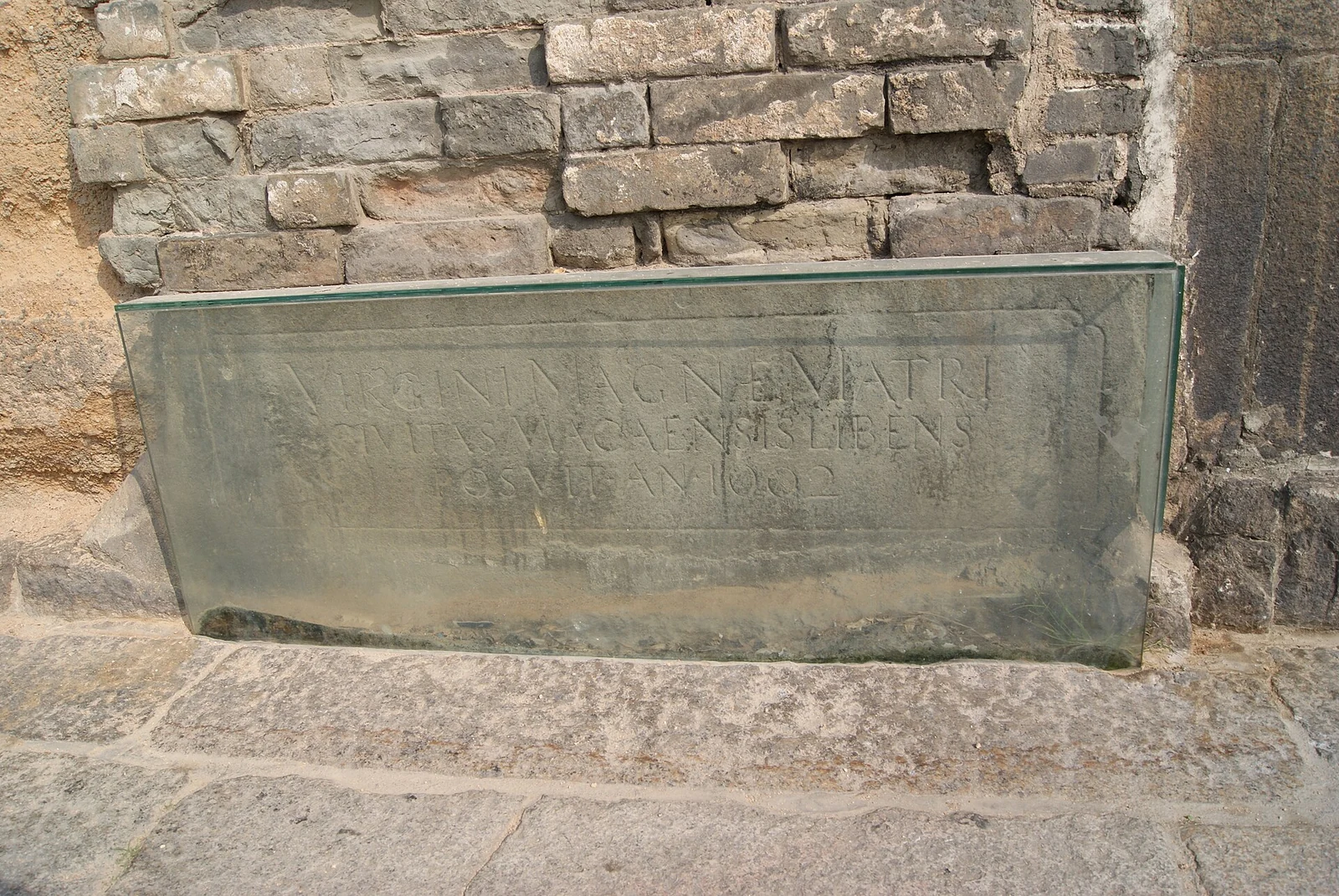
A foundation inscription preserved beside the St Paul’s ruins.

A Chinese inscription and a ship at sea

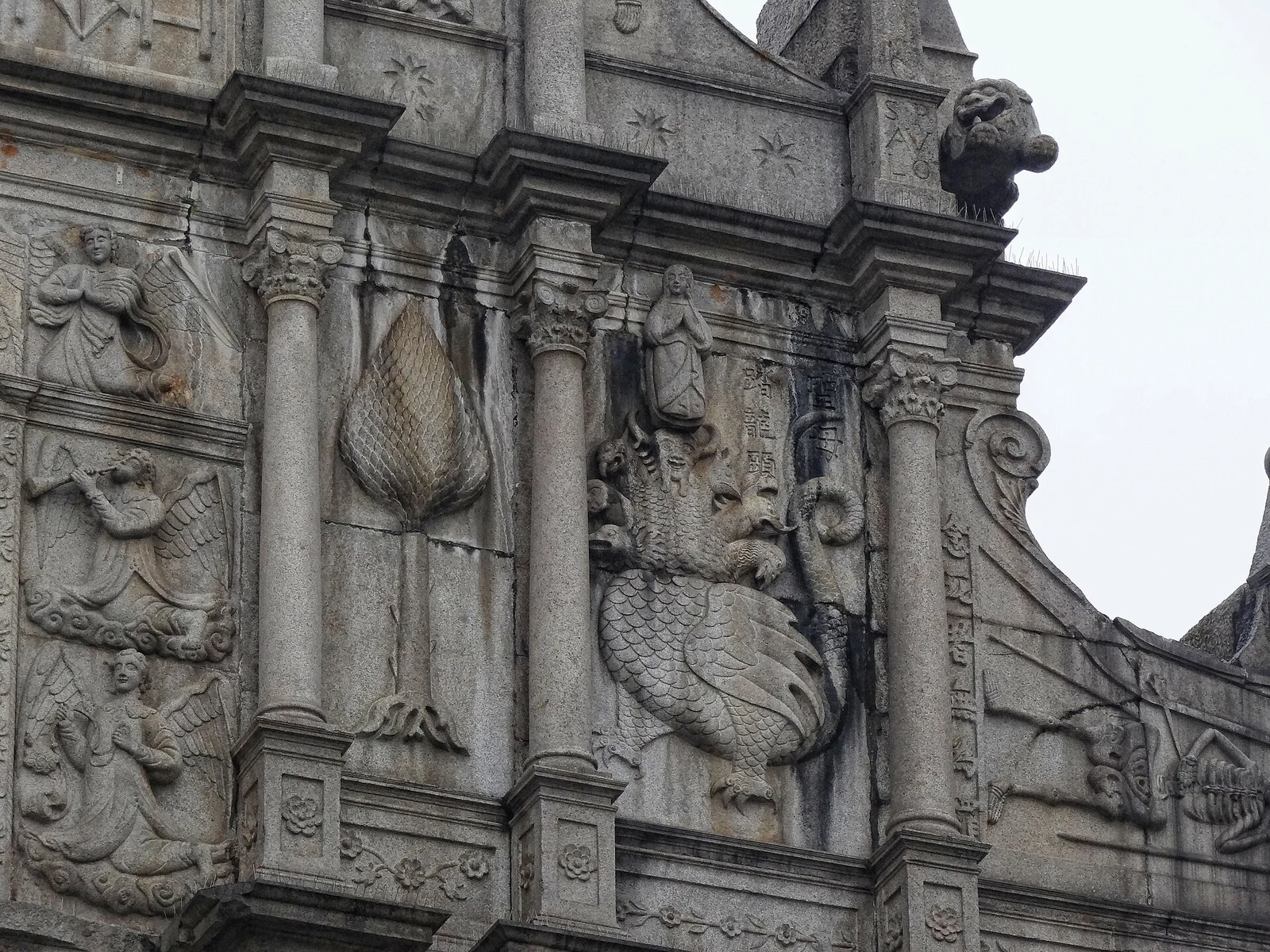
The third tier is the most densely carved. In its central niche stands the Virgin Mary, framed by angels. To one side, a tree of wisdom rises beside a seven-headed creature and the Chinese inscription “聖母踏龍頭”—the Virgin treading on the dragon’s head. On the other side, a fountain and a European sailing ship sit below an image of Mary as Star of the Sea.

At the outer edge of the third tier, a skull and a demon flank Chinese inscriptions about death and temptation. Stone lions project from the sides of this level as rain spouts. The carvings bring Chinese writing, Catholic symbols and maritime imagery onto the same surface, each in a distinct place within the design.

Carved figures and Chinese lettering on the St Paul’s façade.

From the Passion to the copper dove

The fourth tier centers on a shrine to Jesus, surrounded by reliefs of the instruments of the Passion. Angels and columns frame the niche, drawing the eye upward from the more crowded scenes below. The fifth and final tier narrows into a triangular pediment, where a copper dove represents the Holy Spirit beneath the cross.

The entire granite façade rises 25.5 metres and spans 23 metres. Its five levels draw inward toward the top, turning a broad wall into an ascending composition. The stonework is Baroque in its overall form, while Chinese lettering, chrysanthemums and other Eastern references give this church front a particular Macao character.

Continue exploring · St. Paul's Ruins ↗
Photo credits and rights
  1. Ank Kumar / CC BY-SA 4.0 · CC BY-SA 4.0 Photo source ↗ Rights information ↗
  2. The surviving stone façade of the Church of Mater Dei at the Ruins of St Paul’s in Macao.Ank Kumar / CC BY-SA 4.0 · CC BY-SA 4.0 Photo source ↗ Rights information ↗
  3. A bronze saint in a niche on the St Paul’s façade.jetsun / CC BY-SA 3.0 · CC BY-SA 3.0 Photo source ↗ Rights information ↗
  4. Stone lettering above an opening in the St Paul’s façade.deror_avi / CC BY-SA 3.0 · CC BY-SA 3.0 Photo source ↗ Rights information ↗
  5. A foundation inscription preserved beside the St Paul’s ruins.Jacklee . / CC BY-SA 3.0 · CC BY-SA 3.0 Photo source ↗ Rights information ↗
  6. Carved figures and Chinese lettering on the St Paul’s façade.Bjørn Christian Tørrissen / CC BY-SA 4.0 · CC BY-SA 4.0 Photo source ↗ Rights information ↗