From the journal

Why Liuzhou Remembers Liu Zongyuan

Liu Zongyuan’s brief final posting, long literary reputation and a repeatedly renewed shrine meet in Liuzhou’s landscape of remembrance.

In the same city · Liuzhou ↗

Four years, then centuries of remembering

Liu Zongyuan’s time as an official in Liuzhou was brief compared with the life of his memorial. The municipal biography published by Yongzhou dates his Liuzhou tenure from 815 until his death in 819. His career had already been shaped by the failure of political reform and demotion, giving the final posting a sharper outline than the later image of a writer calmly taking his place in local history.

Later generations built lasting relationships with Liu’s name long after his four years in Liuzhou. The contrast between a short period of service and centuries of commemoration begins Liuzhou’s story of remembrance.
The city gives remembrance a place

Liuzhou Museum identifies the shrine’s foundation as 822 and its earlier name as Luochi Temple. Established after Liu’s death, the memorial belongs to the history of how the city received and remembered him, as well as to his own life.

A shrine gives repeated attention a location. Written accounts can gather around its name, and remembrance becomes part of public space. Its foundation date shows that this history began soon after Liu’s death, while the stories and meanings attached to the site continued to grow.

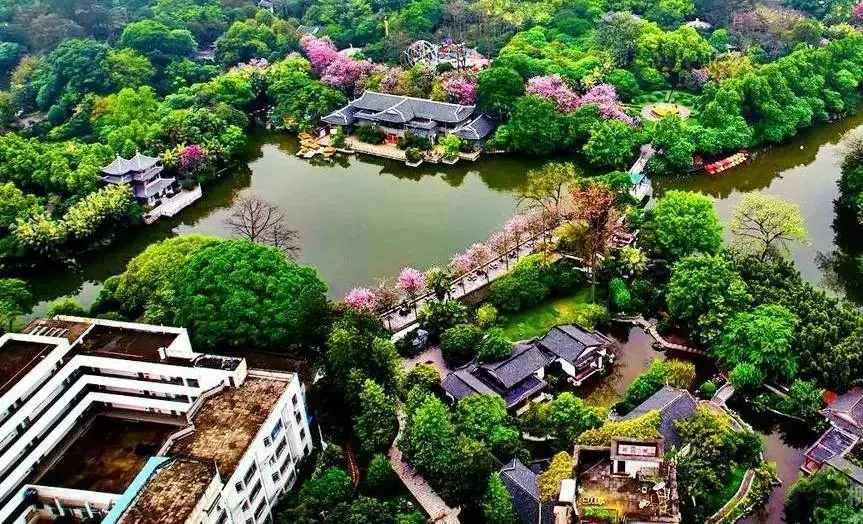
An aerial view of a tree-filled park with a pond, bridges and tiled pavilions.
Liuhou Park in Liuzhou, the wider memorial garden setting around Liuhou Shrine.
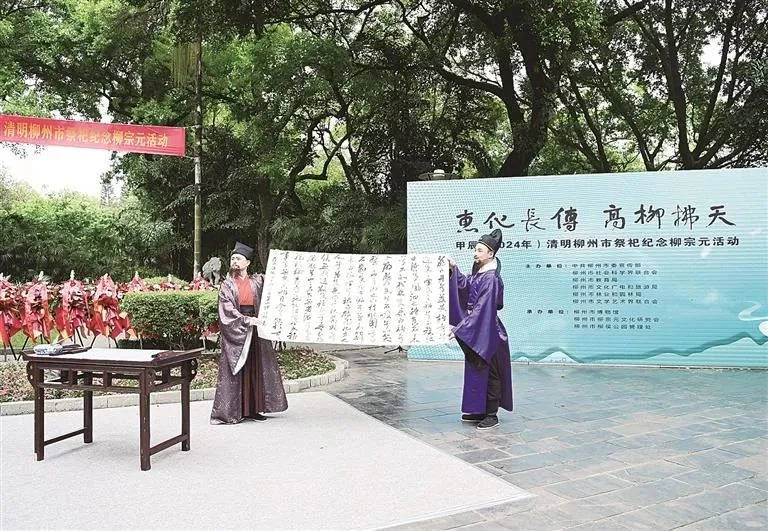
Two participants in ceremonial robes display calligraphy during a memorial ceremony.
A traditional memorial ceremony for Liu Zongyuan at Liuhou Shrine on 3 April 2024.

A cenotaph is a different kind of presence

The museum lists Liu’s cenotaph, Luochi Pond and associated pavilions among the site’s features. A cenotaph is a memorial tomb, giving remembrance a physical presence within the shrine landscape.

The surrounding landscape gives remembrance several forms. An inscription concentrates attention on words, while an open space or a view lets it move differently. Together, these objects and spaces make the complex more than an illustrated biography: it is an arrangement through which later generations have returned to Liu’s memory.

Rebuilding a place of remembrance

The museum’s English account records that the shrine was rebuilt in 1988 using an image in a Qing gazetteer published in the twenty-ninth year of Qianlong. The Tang-period foundation, the later gazetteer image and the 1988 rebuilding belong to different dates. Today’s halls reflect the 1988 rebuilding, informed by a Qing gazetteer image.

Reconstruction preserves a commemorative role while also recording how a later generation understood the earlier site. The structures changed over time while the memorial continued its role in Liuzhou.

Texts carry the story beyond the shrine

Liu’s literary reputation and the inscriptions gathered around his memory lead naturally to further reading. The Lizi Stele is a particularly revealing example: Liu is commemorated through Han Yu’s writing and Su Shi’s calligraphic model. Public memory was made through other people’s work as well as through Liu’s own achievements.

Continue exploring · Liuhou Shrine ↗
Photo credits and rights
  1. Liuhou Park in Liuzhou, the wider memorial garden setting around Liuhou Shrine.Liuzhou Marathon; via Liuzhou Civilisation Office · Rights information Photo source ↗ Resized and converted to WebP; full composition retained.
  2. A traditional memorial ceremony for Liu Zongyuan at Liuhou Shrine on 3 April 2024.Liuzhou Daily, via Liuzhou Civilisation Office · Rights information Photo source ↗ Resized and converted to WebP; full composition retained.