
From the journal

Three Reputations on One Stone

At Liuhou Shrine, the Lizi Stele brings Liu Zongyuan, Han Yu and Su Shi together across time through remembrance, writing and carving.

In the same city · Liuzhou ↗
An aerial view of a tree-filled park with a pond, bridges and tiled pavilions.
Liuhou Park in Liuzhou, the wider memorial garden setting around Liuhou Shrine.

Three names, three stages of transmission

The Lizi Stele at Liuhou Shrine is celebrated through three famous names. Liu Zongyuan is the person commemorated; Han Yu supplied the literary text; Su Shi supplied the calligraphic model. They belonged to different periods and did not gather around the stone together. The monument brings these figures together through successive acts of literary and artistic transmission.

That separation makes the object more interesting. The stele connects people across time through the work of later makers and patrons, who brought an admired text and an admired hand into a new material setting. It speaks with several kinds of authority at once: the reputation of the person remembered, the force of the words and the visual standing of the script.
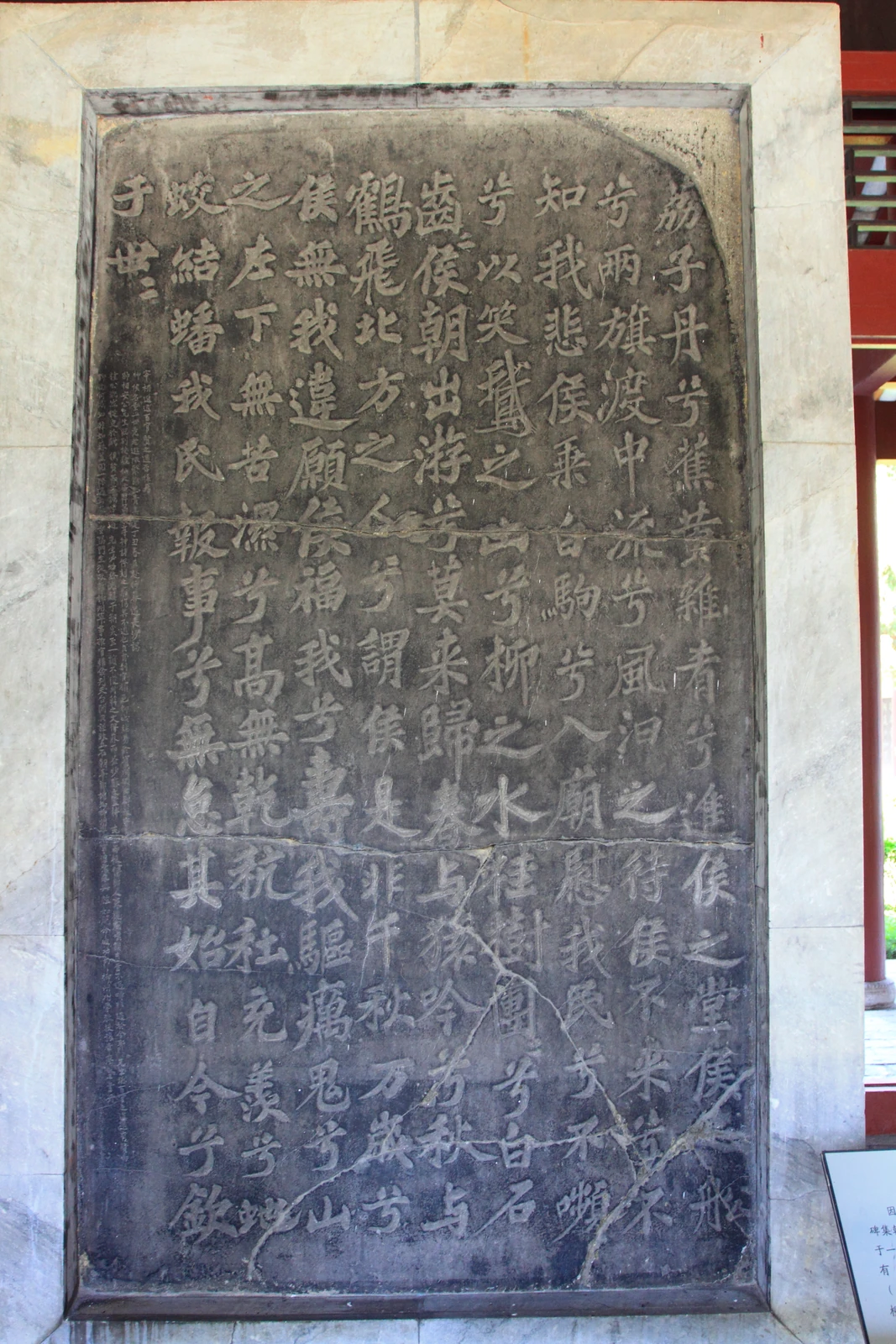
A poem within a longer memorial

Scholar Peng Yuping’s account, published through Guangdong’s cultural-history institution, identifies the inscription as the ritual poem at the end of Han Yu’s account of the Luochi temple. The familiar name Lizi comes from the poem’s opening reference to lychees. The stone contains this concluding poem, not the whole prose memorial.

The genre shapes the language. A text made for remembrance or ritual addresses a different occasion from a biography or administrative record. Its words may express grief, praise or an invitation to imagine the honoured dead. Recognizing the poem’s place within the longer memorial helps explain what kind of work the monument performs.

The handwriting and the carving have different lives

The same scholarly account dates the stone to 1217, bringing together a commemorated Tang official, a Tang writer’s poem and a Song calligrapher’s model. A handwritten model and an inscription carved from that model are distinct stages in the object’s history.

Carving made a hand’s movement durable, sized and positioned for a new setting. The carver’s material work can disappear behind the famous calligrapher’s name, yet without that translation there would be no stone surface to encounter. Composition, calligraphic model and carving each contribute to the stele as an object and as evidence of transmission.

The Lizi Stele with carved Chinese characters at Liuhou Temple in Liuzhou.
The Lizi Stele at Liuhou Temple, Liuzhou, photographed in 2012.

Spacing is part of the writing

Even without reading Chinese fluently, the inscription can be approached as a visual field. The spacing of characters, the balance between dense and open forms and the organization of vertical lines shape how the writing occupies the stone. These features belong to calligraphy as both language and visual form.

A memorial made from acts of remembering

Liuzhou Museum places the Lizi Stele among a wider collection of inscriptions at the shrine. Remembrance accumulates through different periods and different kinds of evidence. The shrine’s history spans many periods, while the stele brings several makers and reputations into view.

Continue exploring · Liuhou Shrine ↗
Photo credits and rights
  1. Liuhou Park in Liuzhou, the wider memorial garden setting around Liuhou Shrine.Liuzhou Marathon; via Liuzhou Civilisation Office · Rights information Photo source ↗ Resized and converted to WebP; full composition retained.
  2. The Lizi Stele at Liuhou Temple, Liuzhou, photographed in 2012.Zhangzhugang · CC BY-SA 3.0 Photo source ↗ Rights information ↗ Resized proportionally and converted to WebP; full composition retained.