From the journal

Jiaya Carpets: Amdo Patterns, Wool and an Unbound Edge

The national intangible-heritage record locates Jiaya weaving in Huangzhong and describes its fibers, linked knots, thick pile and traditional edge finish.

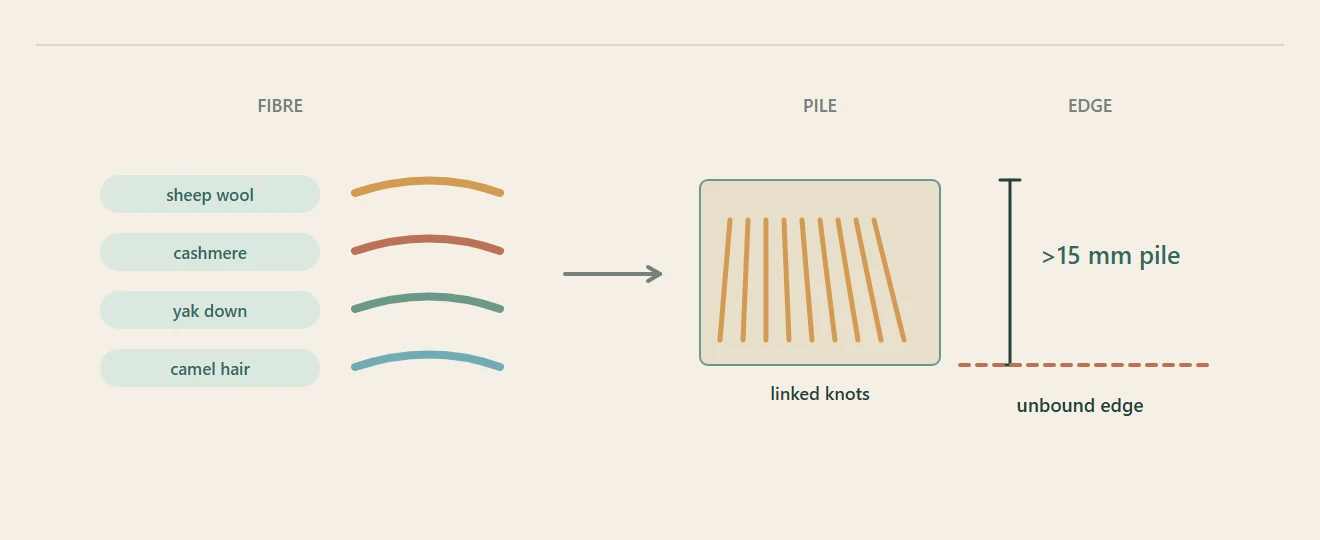
Reported carpet construction: animal fibres, linked knots, pile over 15 mm and an unbound edge. Original editorial diagram; illustrative, not a photograph or measured site plan.

A village tradition in Amdo

Jiaya carpets take their name from Jiaya village in Huangzhong, southwest of Xining. The national intangible-heritage record lists Jiaya and nearby Shangxinzhuang among the main production places. It places the tradition within Amdo Tibetan weaving and distinguishes it from Kham, associating the latter with the Yushu area. In the record’s description, Amdo design brings Tibetan and Han visual elements together.

The same entry makes a useful distinction between the place that applied for the project and the organization responsible for its protection: Huangzhong County is the listed application area, while Huangzhong County Cultural Center is the protection unit. The project entered the national representative intangible-heritage list in 2006. Its official name is Jiaya Tibetan carpet weaving technique, connecting a village place-name to a wider craft region.

Fiber, pile and finish

The carpet begins with animal fibers: Tibetan sheep wool, cashmere, yak down and camel hair. The heritage entry describes low-temperature yarn dyeing and carpet washing, followed by a linked-knot technique that produces a pile more than 15 millimetres thick. One detail sits at the edge: the traditional finish leaves it without binding thread.

Together these features describe a textile through its construction. The wool and other fibers supply the yarn; dyeing gives it color; linked knots build the surface; and the unbound edge leaves the border’s finish visible. The record also notes a range of carpet types, but its clearest material account is this progression from fiber to pile and edge. It offers a way to look closely at a Jiaya rug without reducing it to pattern alone.

Continue exploring · Xining ↗
Photo credits and rights
  1. Reported carpet construction: animal fibres, linked knots, pile over 15 mm and an unbound edge. Original editorial diagram; illustrative, not a photograph or measured site plan.© 2026 IFreeing · Rights information Photo source ↗ Proportionally resized and converted to WebP without cropping. No objects were added, removed or reconstructed.