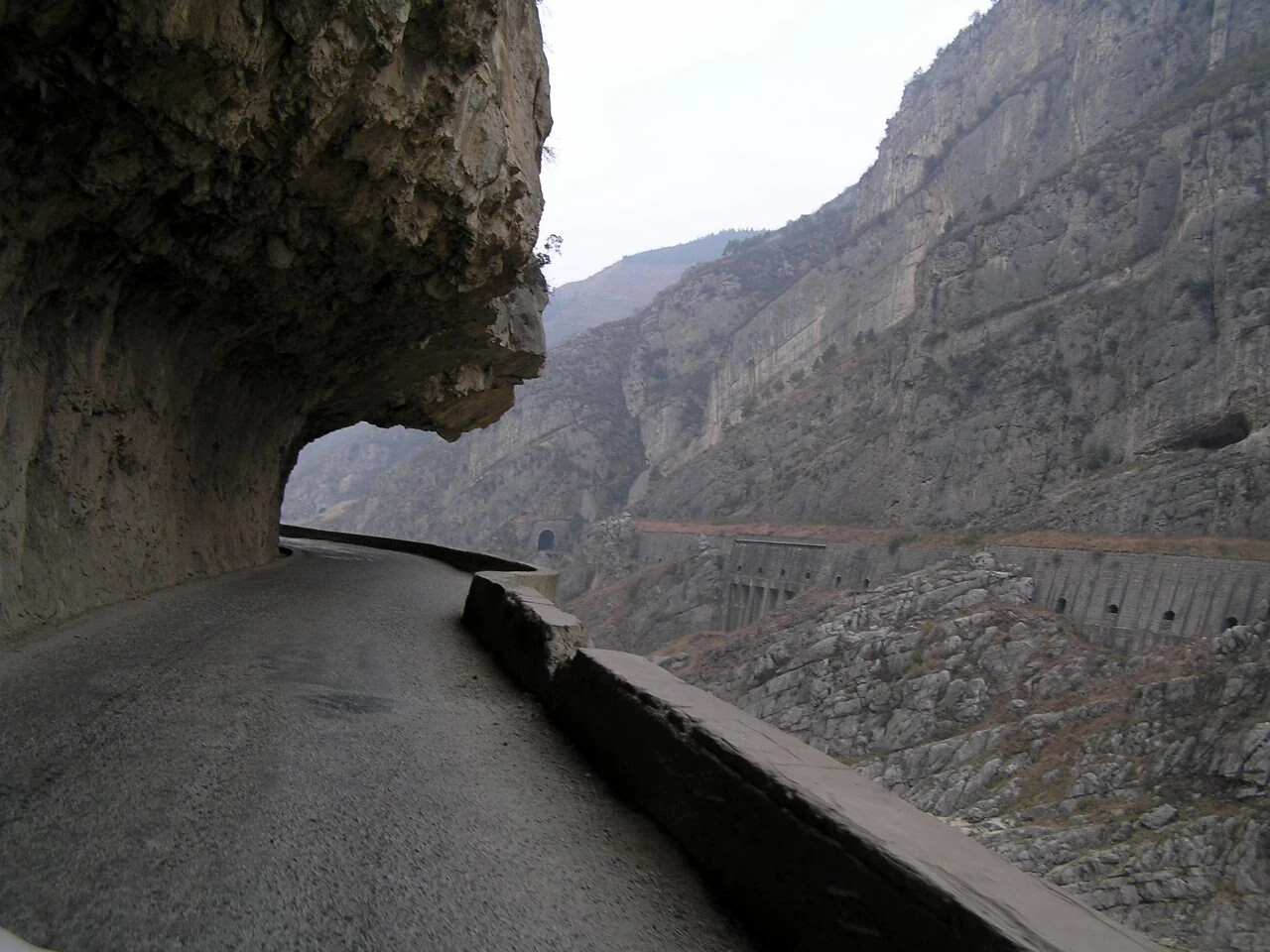
Square holes
The first evidence of the old road is a row of square holes in the cliff, cut at an even height above the Jialing. They held the beams of a plank road, a walkway pinned to the rock where there was no bank to build on. The holes are empty now, and that is what makes them readable: you can see the line they follow, the way it keeps its level, and the places where the rock forced it up or down. Mingyue Gorge is a section of the Jialing gorge in Chaotian, Guangyuan, and the cliff has been used as a road for a long time. The holes are the road's handwriting, left after the timber rotted or was carried away.
A museum of methods
The site presents itself as a museum of Chinese roads, and the phrase is more exact than it sounds. Within a short distance the gorge shows several solutions to one problem: how to move people and goods along a river with no flat land. The plank road is the oldest visible answer, cut and pegged into the cliff. The modern highway is the newest. Each route has its own engineering and its own way of dealing with the water. A museum usually collects objects. This one collects methods, and the collection is the gorge itself. That is why the site reads as an argument rather than a display, and why the highway is the latest sentence in it.
One narrow corridor
Modern roads and the Baoji-Chengdu railway run through the same gorge. That coexistence is the site's real subject. The railway needed a grade, the highway needed width, the river kept its channel. The result is a narrow corridor where several kinds of route are stacked, and where the sound of a train or a truck arrives before the thing itself. Standing on the walkway you hear traffic you cannot see, and then it appears on the opposite side of the gorge. The old road is not preserved in isolation. It is preserved in the middle of the traffic that replaced it. The gorge is narrow enough that a train and a truck can be heard in the same breath.
Reading a corridor
This is a place to read rather than to admire. The cliff gives the vertical dimension, the river the horizontal, and the roads the argument. Old and new are visible together, which is rare: most heritage sites remove the infrastructure that made them obsolete. Here the infrastructure is the exhibit's neighbour, and the neighbour is loud. The walkway is short, and the visit is mostly looking across and down. What stays is the proportion, the thin line of the plank road against a cliff that has not changed, and the ease with which a modern road takes the same space. Nothing here is arranged for a photograph, which is why the place is remembered as a sound.