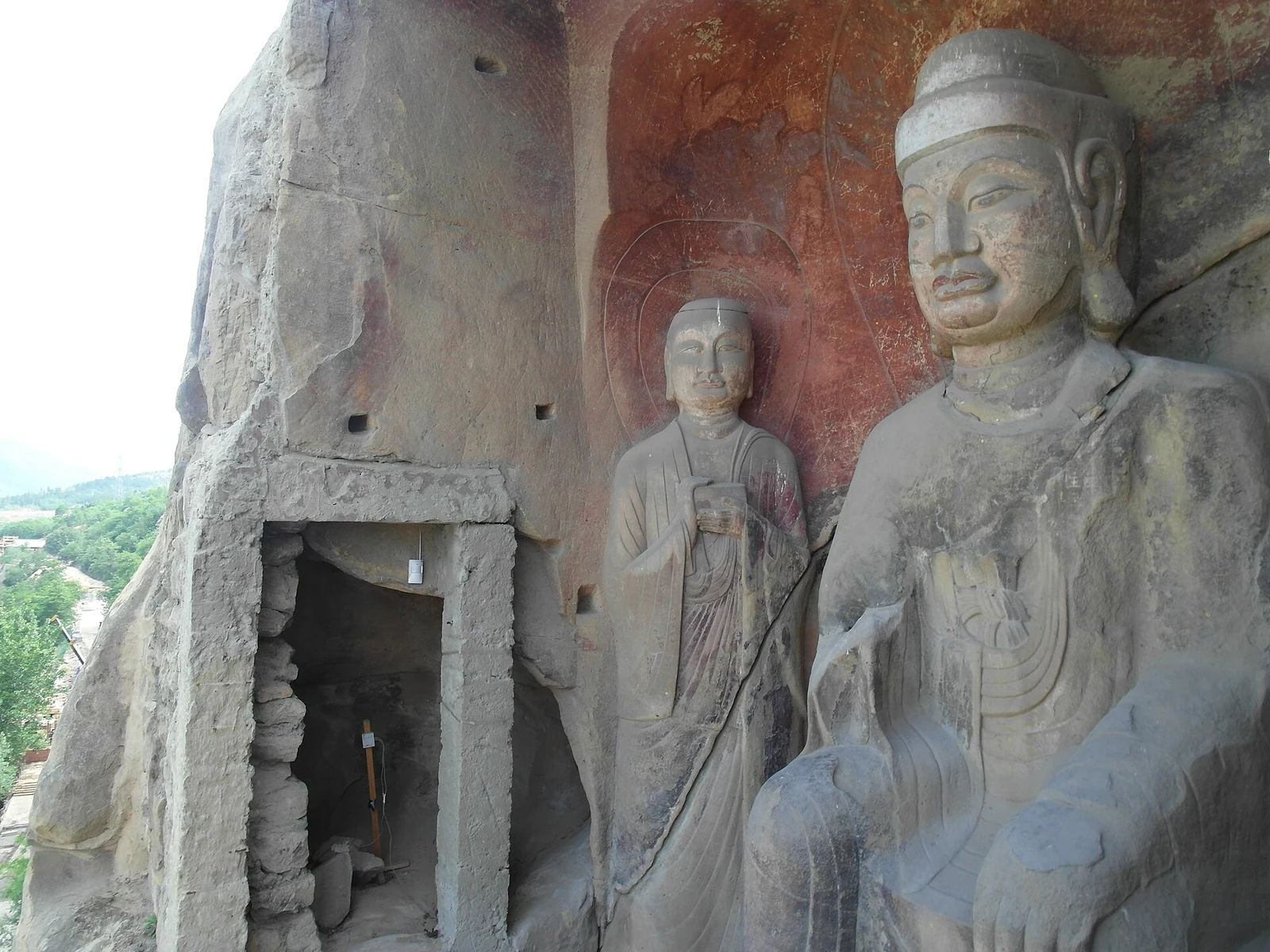
The face in the rock
The cliff stands above the Jialing River with its face cut into niches. From a distance the openings read as texture; closer, each one is a shallow room with a figure inside, carved over several dynasties rather than in one campaign. The site is a national key cultural relic, and it sits close to two old routes: the river below and the Sichuan-Shaanxi road that ran beside it. That position explains both its wealth and its fragility. Carvings made at a crossing are exposed to everyone who crosses. For centuries the traffic was the point; now the traffic is the danger. Rock, water and traffic are three parts of one arrangement, and the carvings sit in the middle of it.
Not one campaign
Nobody carved Qianfo Cliff in one go. The niches belong to different dynasties, which is why faces differ in proportion, dress and depth: a workshop's habits change with its patrons. The name means a thousand Buddhas, and it is a name, not a census. The site's importance is not the number of figures but the fact that the cutting continued, that the cliff was treated as a place to keep adding to. Seen that way the rock is a record of decisions made by people who commissioned a niche and paid for the work, and the record is legible mainly through style rather than through any single inscription. A count would flatten that into a number, and the number would say nothing about why the cutting continued.
A line on a plan
In 2025 a national highway project was adjusted to avoid the cliff. The road was moved in order to protect the carvings. This is the kind of conservation decision that rarely becomes visible: no object was restored, no gallery was built, a line on an engineering plan changed. The cost is real, paid in gradients, cuttings, land and money. But the logic is simple. A road can be designed around a rock face; a rock face cannot be redesigned around a road. The adjustment turns the cliff from an obstacle into a constraint the project had to respect. Engineers call this avoidance. It is a design choice like any other, and it leaves no monument behind.
Two things at once
What a visitor sees is therefore two things at once: the carved cliff and the road that is not in front of it. A path along the site brings the figures close; the highway gives the reason they are still there. It is worth standing where the old Sichuan-Shaanxi road ran and looking at the river, because the traffic that once passed below is now part of the argument for keeping the place quiet. Qianfo Cliff is not a museum of Buddhism. It is a demonstration that infrastructure can be made to yield, and that yielding leaves a trace you can see from the road. From the road the cliff is a grey wall with a shadow in it; from the path it is a room.