From the journal

When a Mountain Became a Page

Duxiu Peak’s famous inscription connects landscape praise with examination ambition and a much longer literary conversation.

In the same city · Guilin ↗
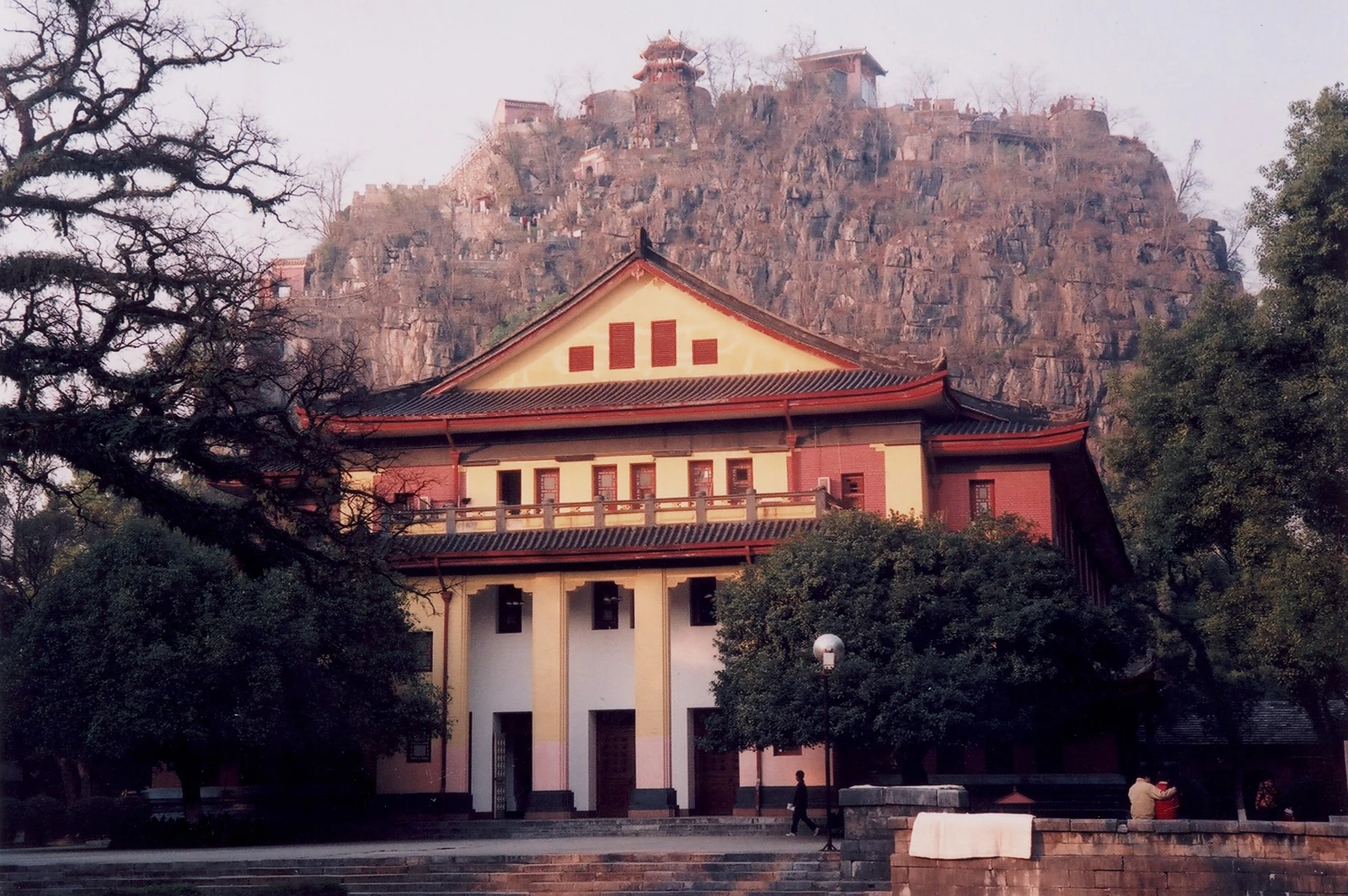
Duxiu Peak rises behind a large building and courtyard in Guilin.
An undated archival view of Duxiu Peak in Guilin.

The sentence before the slogan

The declaration that Guilin's mountains and waters are the finest under heaven is now inseparable from the city's public identity. The Southern Song official Wang Zhenggong used the line in a poem encouraging examination candidates, linking landscape praise with scholarly ambition.

The poem is associated with Dushu Yan, or Reading Cave, at the foot of Duxiu Peak. Within the surrounding poem, praise of a place also encourages the people gathered there. Its later life as a city slogan grew from this more particular literary setting.

A recovered surface changes a history

Guilin Evening News recounts the inscription's discovery during cleaning and maintenance in 1983, when lettering became visible beneath deposits and vegetation. Familiar words acquired a newly recovered physical setting.

The carved surface can be examined, transcribed and compared with written accounts. It connects the widely circulated saying with a particular author and place, giving the words a material history alongside their life in public use.

Wang did not invent admiration for Guilin

Literary scholar Mo Daocai offers a wider genealogy of the idea. In an essay published through Guangxi Normal University, he argues that Liu Zongyuan’s Tang-period writing helped establish the conception of Guilin’s scenery as exceptional. Liu’s texts concerning Zizhou Pavilion placed the landscape within a broad comparison of places under heaven. Mo reads Wang’s later formulation as part of that inherited literary conversation.

Scholars attribute the phrase to Liu’s influence, while the exact seven-character line is Wang’s. The distinction is the interesting part. A memorable phrase can be newly formulated while drawing on older ways of seeing. At Duxiu, the stone preserves a particular expression; scholarship helps reconstruct the ideas that made such an expression meaningful. Authorship and intellectual ancestry answer different questions.

A peak within a changing institution

Duxiu stands inside the Jingjiang princely compound, whose later uses included the Guangxi examination establishment and a university campus. A university-library account of historian Zhou Changshan's lecture places its literary associations alongside those institutional lives. It recalls Yan Yanzhi's association with the hill, Wang's examination poem and Xu Xiake's later visit to the princely site.

The rock remained as the compound's purposes changed. Scholarly distinction, princely authority and modern education gathered around the same landmark in different periods. Duxiu became a durable reference point within these successive institutions.

Words occupying a stone surface

An inscription gives language a position on stone: at a cave entrance, on an exposed face or beside a path. Text, title, date and signature organise the surface in different ways.

Weathering affects how readily the lettering can be read, while transcriptions carry its words into print. The inscription at Duxiu joins a literary sentence to the mountain itself, keeping the setting of the poem within the history of its celebrated line.

Continue exploring · Duxiu Peak ↗
Photo credits and rights
  1. An undated archival view of Duxiu Peak, Guilin. The foreground building’s identity and the photograph’s capture date are unconfirmed; no rock inscription is legible.Michael Wood · CC BY-SA 2.0 Photo source ↗ Rights information ↗ Resized and converted to WebP; full composition retained.