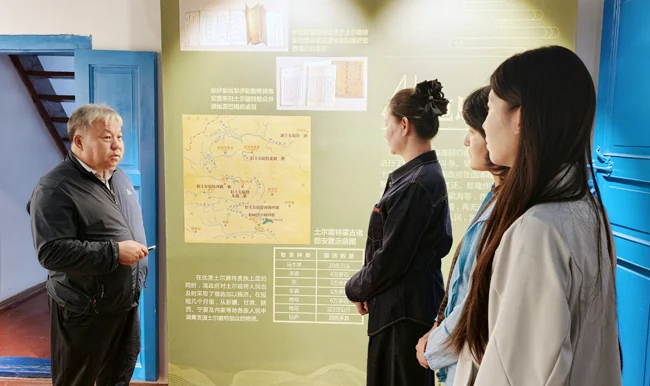
The account the prefecture government published is compact. In 1771, the thirty-sixth year of the Qianlong reign, the Torghut leader Ubashi led about 170,000 people out of the Volga region and east across Central Asia. Pursued, and short of food in a hard winter, about 70,000 reached Qing territory. The numbers come from the museum's curator, quoted in the government's own feature, and they are round. After the arrival the people were settled on four routes, east, west, south and north. The southern group crossed the icy Tianshan passes and reached the Kaidu River valley around Hejing. That is how the Torghut came to be in this prefecture, and the museum tells it with a route map on the wall.
From the journal
The road back across the mountains
In 1771 the Torghut left the Volga under Ubashi and crossed Central Asia to Qing territory. About seventy thousand of some hundred and seventy thousand arrived. Bayingolin keeps that journey in a mansion museum and a stage play.
What the account says
A residence that became a museum
In the centre of Hejing county town stands the Manhan Wangfu, finished in 1919 as the residence of Manchukzhab, the twelfth Torghut khan, and the political and cultural centre of the banner. It is an axial, hall-style compound in Chinese building order, with Russian touches in the detail: brick walls, carved door and window surrounds, bracket work under the eaves. In 2013 the State Council listed it as a national protected site. It now holds ten exhibition rooms, on the return, on local artefacts, on excavated material and on intangible heritage, and the county's Donggui museum is housed in it. The building is not the event. It is a later frame around the event, and it says so by hanging the route map where a visitor meets it first.
The return on a stage
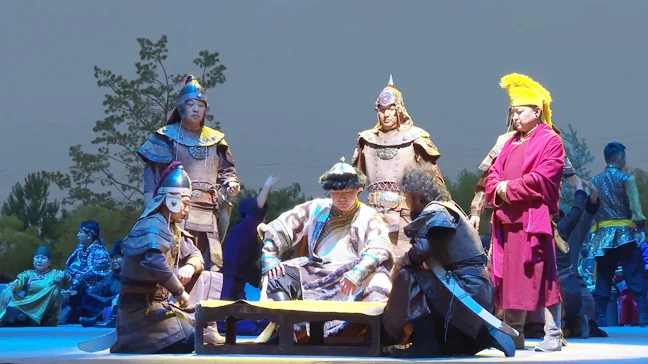
Since 2014 the return has also been a stage play. Donggui Yinyang opened that year and for a decade ran each season from early June to early October at the Torghut folk culture village in Bayanbulak. In May 2024 a reworked version opened at the Donggui ecological park in Hejing, in three parts: the rising, the great migration, the homecoming. The production folds in sawurden dance, tobshuur playing and Jangar, which is how a history becomes an evening. It is a later telling, with music and costume, and it is not a document. What it passes on is the shape of the story: a departure, a crossing, an arrival, and then a life on the Bayanbulak grassland.