From the journal

Anping Bridge: A Long Crossing between Trading Towns

Across Anping Bridge, granite slabs, shelter pavilions and repair inscriptions recover the human scale of an old coastal trade route.

In the same city · Quanzhou ↗

A line that keeps going

Anping Bridge makes distance visible. Granite slabs succeed one another across the water, and a pavilion interrupts the long horizontal view. The eye can follow the route well before the feet have travelled it. Known as Wuli Bridge, or Five-Li Bridge, it preserves in its familiar name the experience of an unusually long crossing.

The bridge connects Anhai in Jinjiang with Shuitou in Nan’an, both within the wider Quanzhou municipality. It was built in the twelfth century, with completion in 1152 according to the municipal heritage record. Its position linked Quanzhou with routes farther down the coast. A crossing between two towns therefore belonged to a much larger geography of exchange, joining the local act of getting across a bay to the movement of people and goods through southeastern China.
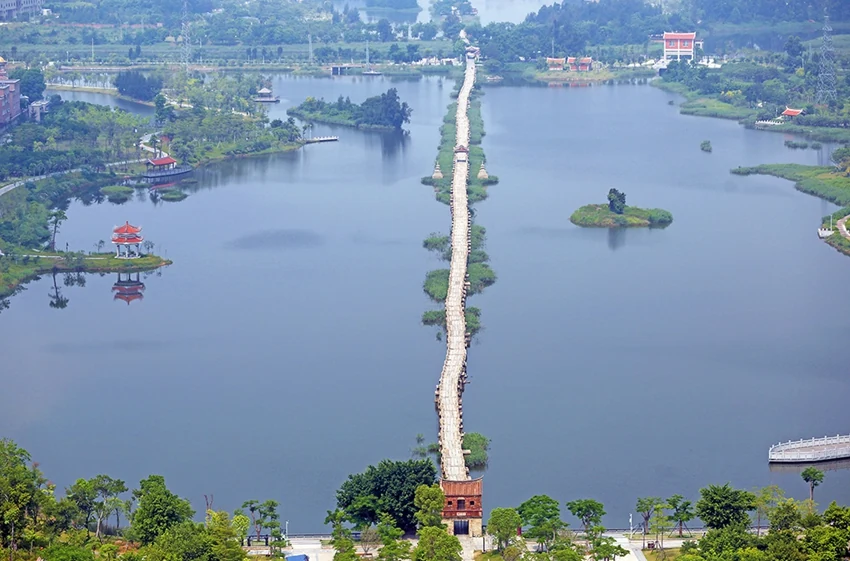
A long slender stone bridge crosses water dotted with small islands.
Anping Bridge extends across a broad waterscape.

Repetition is an engineering solution

Anping is a stone-beam bridge: long slabs span the gaps between masonry piers. The supports take several forms, including rectangular and pointed boat-like shapes, responding to conditions along the crossing. Across a great length, a clear structural idea repeats without making every part identical.

This is easy to miss in a photograph that compresses the whole bridge into a narrow stripe. Look instead at one span. Its ends rest on supports; the next span continues the route. Then let that small unit expand in the imagination across the entire crossing. The construction problem becomes tangible: obtaining stone, moving massive pieces and placing them reliably again and again. A long bridge is both a single public work and a sequence of difficult, repeated operations, each one necessary to the usefulness of the whole.

A collective work with places to pause

Official accounts associate Anping’s construction with merchants, monks, officials and local residents. The merchant Huang Hu is remembered among its initiators and died before the work was completed. The bridge thus carried a longer commitment than one person’s lifetime. Its social history is embedded in the need to continue a useful undertaking begun by others.

Pavilions and religious structures along and beside the route add another dimension. Shelter and a place to rest belong naturally to a crossing experienced on foot. Protective images and inscriptions give it a ceremonial and commemorative life as well. Near the Water Heart Pavilion, repair steles record later care for the bridge, while stone guardian figures give protection a visible form. These are not incidental decorations added to an engineering diagram. They reveal how a route became a place with responsibilities, memories and human needs.

A two-story stone pavilion with a tiled roof stands beside the water.
A bridge pavilion at Anping Bridge.

The water around the bridge has a history too

Today’s surrounding park and wetland landscape is not a frozen view of the medieval bay. Waterways, settlement and the treatment of the bridge’s surroundings have changed. The modern setting offers its own experience of open space, but the historical crossing belonged to a working coastal environment with movement and transfer at its heart.

Let the length be part of the story without turning it into a competition of superlatives. Anping’s importance does not depend on calling it the world’s longest bridge today. It lies in the sustained effort to make a long, difficult connection usable, and to keep it so over many generations. A pavilion halfway through the view captures that idea well: the builders provided for a journey that would take time, and the bridge still makes that time perceptible in stone.

A narrow bridge stretches across blue water past paired stone towers.
Anping Bridge’s stone deck, towers and shelter.
Continue exploring · Anping Bridge ↗
Photo credits and rights
  1. Anping Bridge extends across a broad waterscape.泉州市人民政府美食之都申创官方网站 · Rights status unspecified Photo source ↗ Original aspect ratio retained. Display copies resized only when needed; no enlargement, crop or retouching.
  2. A bridge pavilion at Anping Bridge.泉州市人民政府美食之都申创官方网站 · Rights status unspecified Photo source ↗ Original aspect ratio retained. Display copies resized only when needed; no enlargement, crop or retouching.
  3. Anping Bridge’s stone deck, towers and shelter.泉州市人民政府美食之都申创官方网站 · Rights status unspecified Photo source ↗ Original aspect ratio retained. Display copies resized only when needed; no enlargement, crop or retouching.