Yixing is a county-level city administered by Wuxi, with a distinct pottery identity rather than a craft corner inside central Wuxi. Dingshu is a principal setting for that tradition. Start by treating the teapot as the product of a place: local material, specialised labour and repeated exchanges between makers and users. The term zisha, commonly translated as “purple sand,” can mislead if it sends you searching for one standard purple colour. Museum accounts distinguish several clay types and a range of fired tones. Brown, red and yellow-brown surfaces belong within the story; colour alone cannot establish quality or authorship.
Wuxi
How to Read a Yixing Teapot
Look beyond the word “purple” to clay, joins, surface and authorship in the pottery city of Yixing.
In the same city · Wuxi ↗Put Yixing on its own map
Imagine the vessel before it was a vessel
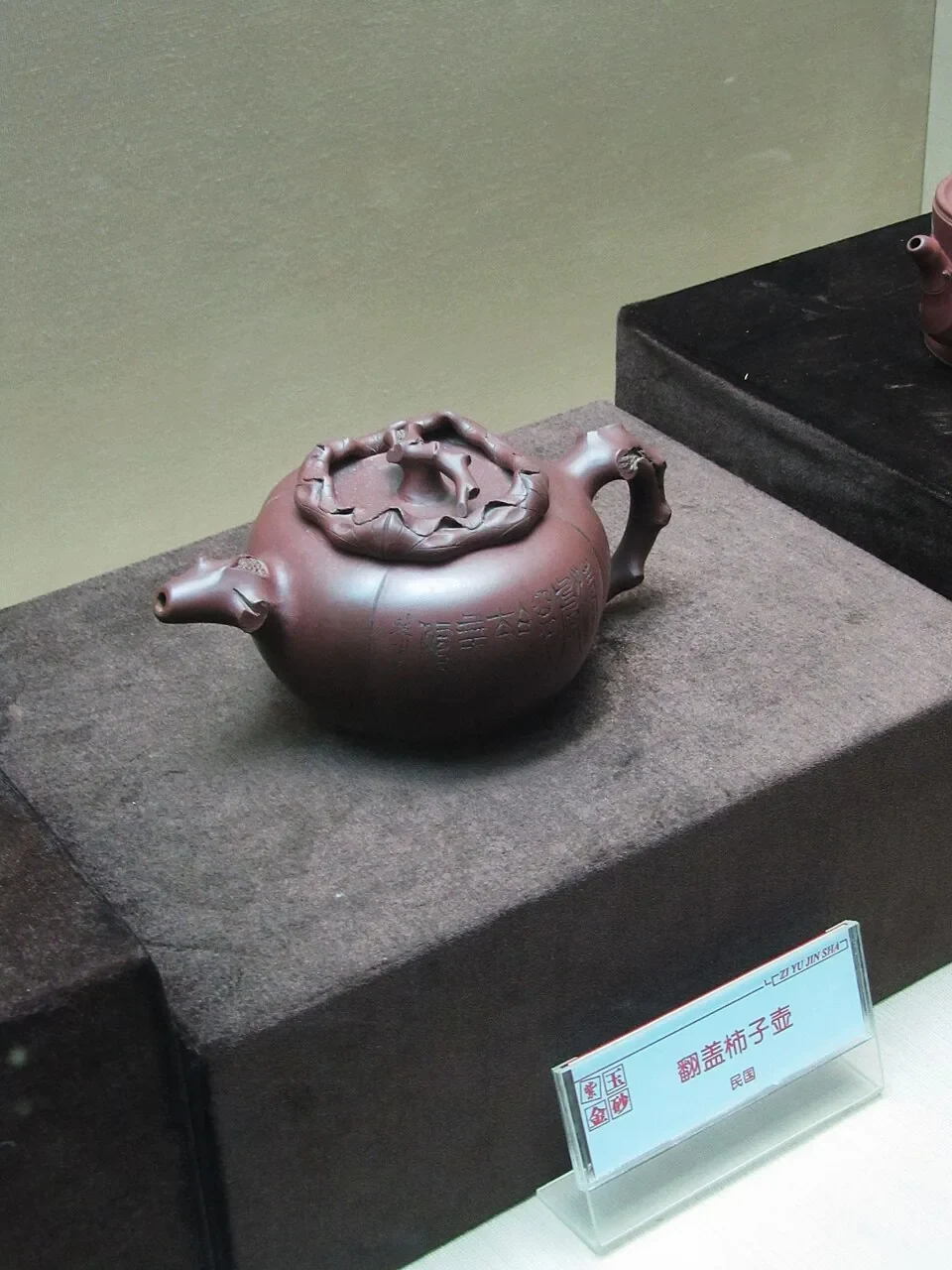
A finished pot conceals many decisions. Yixing makers can work with prepared clay sheets, using simple bamboo, wooden and metal tools. The V&A identifies slab building, moulding and applied decoration among the tradition’s techniques. Looking at a round body, imagine the work of bringing separate material into a controlled continuous shape. Then follow the joins between body, handle and spout. Do they announce themselves or disappear? This is a way of seeing, not a method of authenticating an expensive purchase. A quiet-looking surface may be the result of considerable skill, but appearance alone does not prove how an individual pot was made.
Read the parts as a system
A teapot is sculpture with a demanding job. The V&A’s history of teapots connects their development with the practice of steeping loose leaves, and includes a Yixing example dated 1625–1655. Use that functional history to examine a vessel from several directions. Compare the handle’s apparent grip with the body’s volume; follow the spout’s line; study how the lid completes the profile. Even behind glass, you can ask how the parts relate without pretending to test their performance. The point is to recover the working object beneath the prestige associated with collecting it.
Give the maker a history
Names matter when they open a history rather than close an argument. Shi Dabin and Chen Mingyuan belong to the long development of Yixing ware; Gu Jingzhou, who lived from 1915 to 1996, links that inheritance with twentieth-century teaching. In the 1950s he was among the senior artisans recruited to train a new generation. Think about what such instruction must transmit: proportions, touch, timing and the ability to correct a shape before firing. A maker’s reputation is therefore also a history of learning. When a label names someone, ask whether it identifies a documented work, a style or a later attribution.
A small surface can carry several arts
Zisha brought pottery into conversation with literature and other arts. The Hong Kong Museum of Art describes the participation of literati in a tradition combining vessel shape with poetry, calligraphy, engraving and sculpture. Read decoration at that scale. An inscription changes how a pot is held and turned; a plant-shaped detail can connect its silhouette with its surface. The V&A points to motifs such as plum blossom, nuts and seeds in its collections. Rather than counting embellishments, ask whether each one reinforces the vessel’s structure or competes with it. Restraint and complexity can both involve deliberate artistic decisions.
Use collections to sharpen, not replace, looking
Yixing’s international reach is visible in museum collections, a different kind of evidence from tourist popularity. The Metropolitan Museum of Art records a twentieth-century Yixing stoneware teapot under object number 1993.480.2a, b; its basic identification does not depend on a celebrated maker’s name. In Hong Kong, K. S. Lo’s 1981 donation helped bring the Flagstaff House Museum of Tea Ware into being. Such collections encourage comparisons across periods and forms. Carry that habit back to Yixing: record what a label actually says, separate a known material from an uncertain attribution, and let close observation come before an impressive story about value.