From the journal

Yangshuo’s Stone Bridges: Crossings and Repair

Xiangui, Yulong and Fuli bridges carry distinct histories in their stonework: Song inscriptions, a Qing railing and rebuilding after a flood.

In the same city · Guilin ↗
Fuli Bridge arches over a river with visitors above and bamboo rafts below.
Fuli Bridge near Yangshuo, identified in the photographer’s record; capture date unstated.

Three crossings in a river landscape

Xiangui, Yulong and Fuli bridges belong to the historic crossings of the Yulong area. Their stone arches connect banks and approaches within a landscape of rivers, tributaries and settlements. The reflected circle familiar from photographs begins with the practical work of carrying a path across water.

The bridges have different construction histories. Stonework, inscriptions and records of repair give each crossing its own chronology, from Xiangui's Song foundation to Fuli's rebuilding after a twentieth-century flood.
Xiangui: a date recorded in stone

The county tourism bureau's bridge survey places Xiangui near Jiuxian and dates its foundation to 1123, with rebuilding in the Southern Song Shaoxing period. It identifies inscriptions within the arch as evidence for construction and repair, and describes parallel rows of stone forming the single arch.

Foundation and rebuilding both belong to the bridge's history. The inscription ties its physical fabric to recorded work, preserving a connection between the arch and the people who built or repaired the crossing. Its Song chronology includes change as well as survival.

Yulong: stonework and later additions

The same county survey describes Yulong Bridge as Ming in origin and records a stone-railing addition in the ninth year of the Qing Tongzhi reign, corresponding to 1870. It also describes dry-laid stone construction.

The curve of the arch and the later railing belong to different parts of the structure's history. Published tourism accounts differ over dimensions, but the recorded addition gives a clear example of people returning to alter the bridge. Its survival includes this continuing attention to a useful crossing.

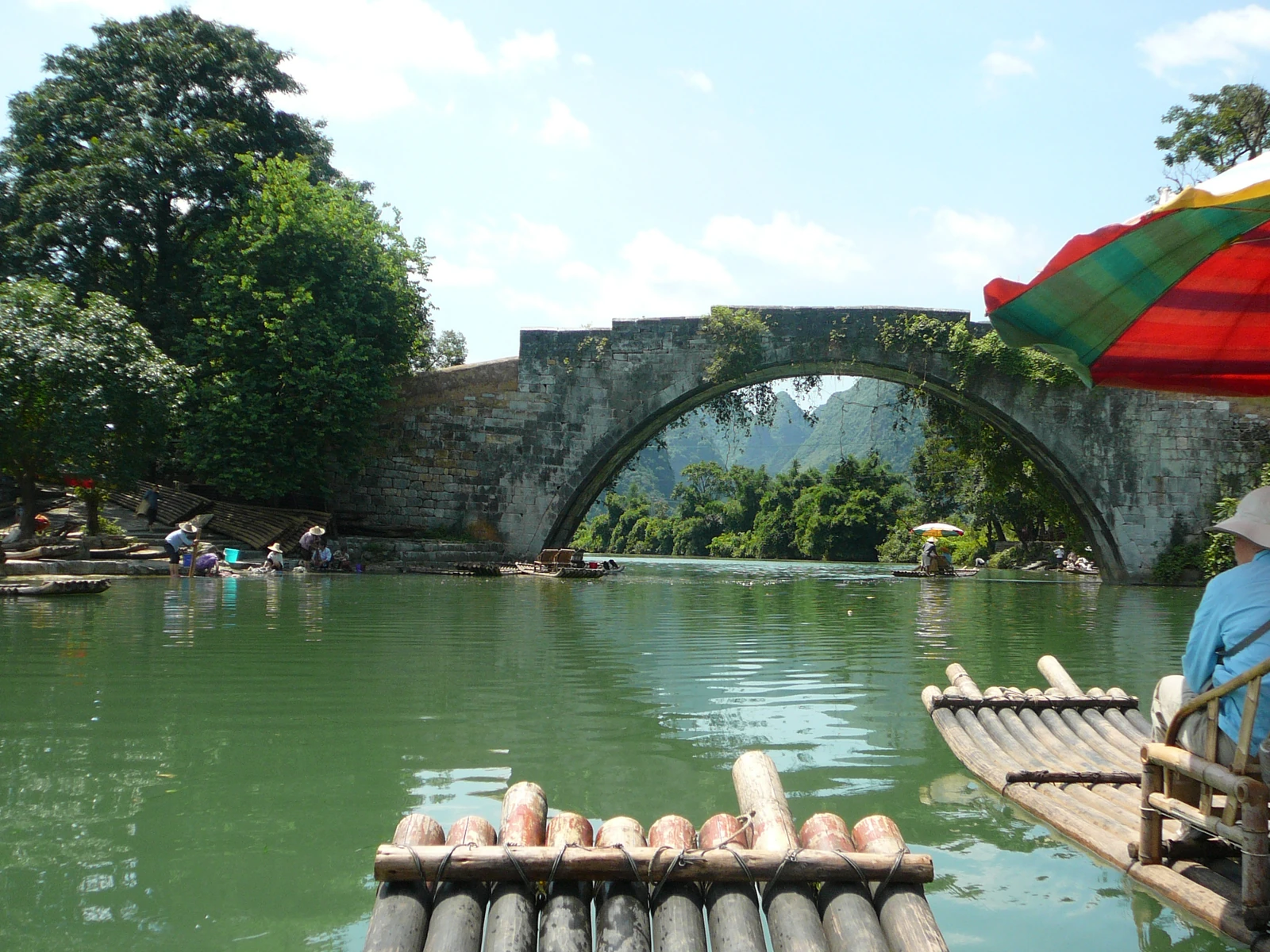
Yulong Bridge spans green water beyond the bamboo poles of a tourist raft.
Yulong Bridge near Yangshuo, seen from a bamboo raft, with activity along the riverbank. Source-reported photograph date: 2010-07-05.

Fuli: rebuilding in 1927

Fuli crosses the Wugui River. Its operator's detailed account records destruction by flooding in 1926, followed by rebuilding funded by local people in 1927. The county tourism bureau also gives the 1927 repair date.

That rebuilding is central to the present bridge's story. Re-establishing the crossing after a flood sustained a connection important to the community. Its name, location and function carried continuity through renewed fabric, leaving the twentieth-century response to damage within a landscape often described through much older dates.

Stone and the work of keeping a crossing

Across the three bridges, chronology takes several forms: an inscription, a recorded railing addition, a flood and a community-funded rebuilding. The visible arches bring those histories into the river landscape.

Their beauty includes the arrangement of stone above water, but their endurance also belongs to maintenance and renewed use. Each bridge gathers a route, a structure and successive acts of care into a single crossing.

Continue exploring · Yulong River Valley ↗
Photo credits and rights
  1. Fuli Bridge near Yangshuo, identified by the photographer. Capture date unconfirmed; the displayed 2020 metadata is not a verified capture date.Rod Waddington · CC BY-SA 2.0 Photo source ↗ Rights information ↗ Resized and converted to WebP; full composition retained.
  2. Yulong Bridge near Yangshuo, seen from a bamboo raft, with activity along the riverbank. Source-reported photograph date: 2010-07-05.Brian Sterling · CC BY-SA 2.0 Photo source ↗ Rights information ↗ Resized and converted to WebP; full composition retained.