From the journal

From Jiaya Looms to Xining’s Carpet Institutions

A village craft moved through workshops, a city training school and factory production, then entered national heritage exhibitions and contemporary carpet settings.

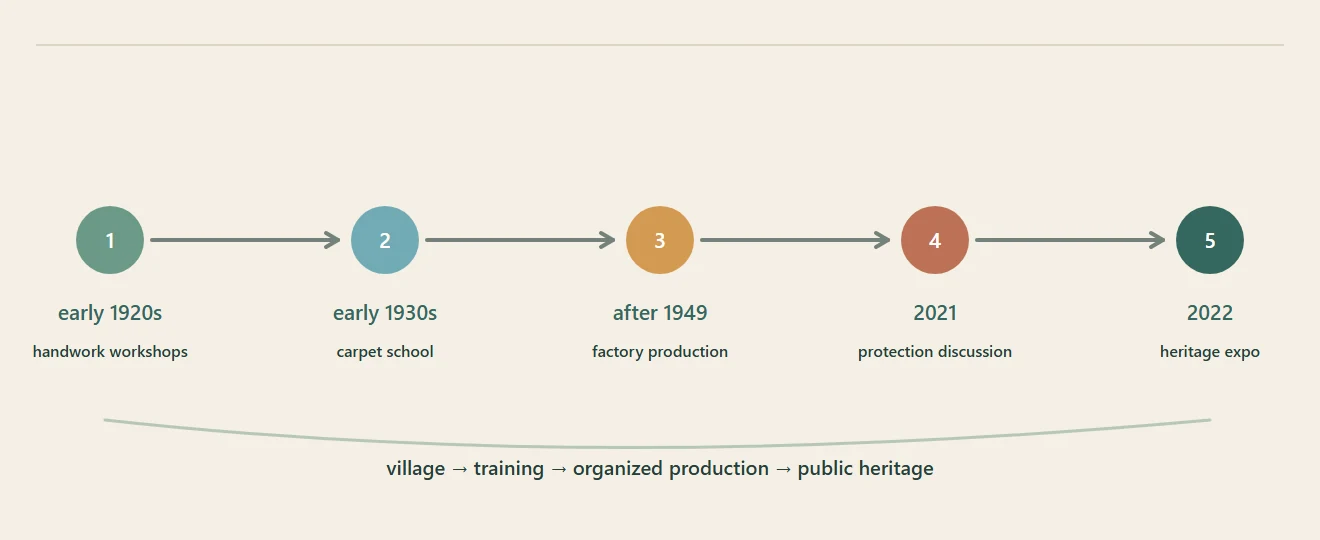
Documented carpet institutions from 1920s workshops and 1930s training to post-1949 production and later exhibitions. Original editorial diagram; illustrative, not a photograph or measured site plan.

A craft moves into the city

Huangzhong’s district history traces carpet production from Jiaya village into Xining. It dates the first handwork workshops to the early 1920s and a vocational school specializing in carpet production to the early 1930s. After 1949, the account says, a carpet factory was established in Qinghai and Jiaya weavers entered its organized production. The sequence is a history of changing scale: skills first associated with village workshops became part of city-based training and organized production.

The village name remained attached to the craft as the institutions around it changed. In the district account, production includes both village weaving and later factory branches across Huangzhong. That history helps explain why “Jiaya carpet” can point to a local tradition and to a broader industry, even when individual rugs come from different kinds of workshops.

Factories and heritage exhibitions

The craft’s institutional path continued into the twenty-first century. A Ministry of Culture and Tourism report records a 2021 visit to Qinghai Shengyuan Carpet Group, where the national-level representative inheritor Yang Yongliang discussed protection of Jiaya weaving. In 2022, Jiaya weaving appeared at the China Intangible Cultural Heritage Expo in Jinan, in a display focused on achievements in national heritage protection.

Village work, professional training, factories and exhibitions each place the craft in a different setting. The 2024 district history describes carpet production as an important part of Huangzhong’s economy, while the heritage record names Jiaya weaving as a national representative project. Together, these sources show how the craft’s public identity widened from a village practice to a regional industry and a recognized heritage tradition. The documented route passes from loom to classroom, factory floor and exhibition hall.

Continue exploring · Xining ↗
Photo credits and rights
  1. Documented carpet institutions from 1920s workshops and 1930s training to post-1949 production and later exhibitions. Original editorial diagram; illustrative, not a photograph or measured site plan.© 2026 IFreeing · Rights information Photo source ↗ Proportionally resized and converted to WebP without cropping. No objects were added, removed or reconstructed.