The exhibition “Between Three Mountains and the Huangshui: Flowers and Youth” opened at Beijing’s Prince Gong’s Mansion in November 2020. Its curator organized the show into three sections named for Lotus Mountain and Ta’er Monastery, Laoye Mountain beside the Huangshui, and Riyue Mountain on an old route. The section titles gave visitors a landscape-based route through the display. More than 400 heritage objects and over 8,000 creative products represented projects from Huangzhong, Huangyuan and Datong. The listing included Xining xiaoxian storytelling, Qinghai hua’er, Huangzhong duixiu, silver-copper making and gilding, farmers’ painting, Hehuang shadow puppetry, Chenjiatan woodcarving, Huangyuan vinegar fermentation and Zongka thangka. The range linked songs, textiles, metalwork, painting and food craft within one exhibition.
From the journal
Three Mountains and the Huangshui: A Curated Heritage Map
A 2020 exhibition at Beijing’s Prince Gong’s Mansion arranged Xining-area heritage through three named landscape sections. Its map was an exhibition framework linking places, projects and a cultural narrative.
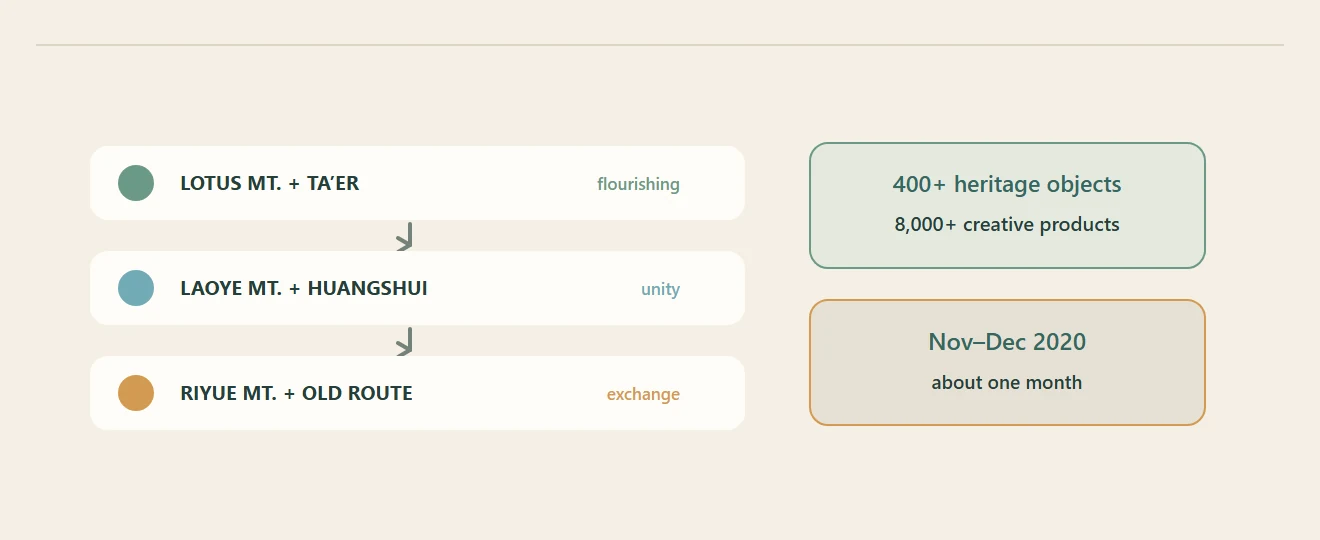
A landscape route through an exhibition
Objects, demonstrations and performance
The first section paired Lotus Mountain with Ta’er Monastery and a theme of cultural flourishing; the second connected Laoye Mountain with the Huangshui and a theme of unity; the third linked Riyue Mountain with an old route and cultural exchange. Those place names guided the visitor from one part of Xining’s heritage display to another. Static objects stood alongside dynamic demonstrations, performances and product displays, so the exhibition’s route moved between things to look at and practices shown in motion. It remained open for about a month, from late November into December 2020. The objects and projects gave the landscape names a human dimension: singers, embroiderers, metalworkers, painters and vinegar makers appeared in a shared story about cultural practice around the city. The exhibition’s three sections were a curatorial route through a broad collection.