Northwest of Yangzhou’s historic centre, Slender West Lake follows a long, narrow waterway where water, old moats and garden grounds were gradually gathered into one landscape. Its name invites comparison with Hangzhou’s West Lake; here the eye follows a channel, bends around the banks and keeps finding another framed view. The UNESCO tentative-list description traces gardens around the water to several periods, then describes how, in the mid-eighteenth century, moats and suburban villas associated with salt merchants were connected into a scenic belt. That is a useful starting point: the lake is both water and a designed sequence.
Slender West Lake
Slender West Lake: How Water Became a Sequence of Views
A narrow waterway, linked gardens, bridges and pavilions show how Yangzhou’s landscape was composed over time.
In the same city · Yangzhou ↗A waterway with a borrowed name
The bridge is also a viewing room
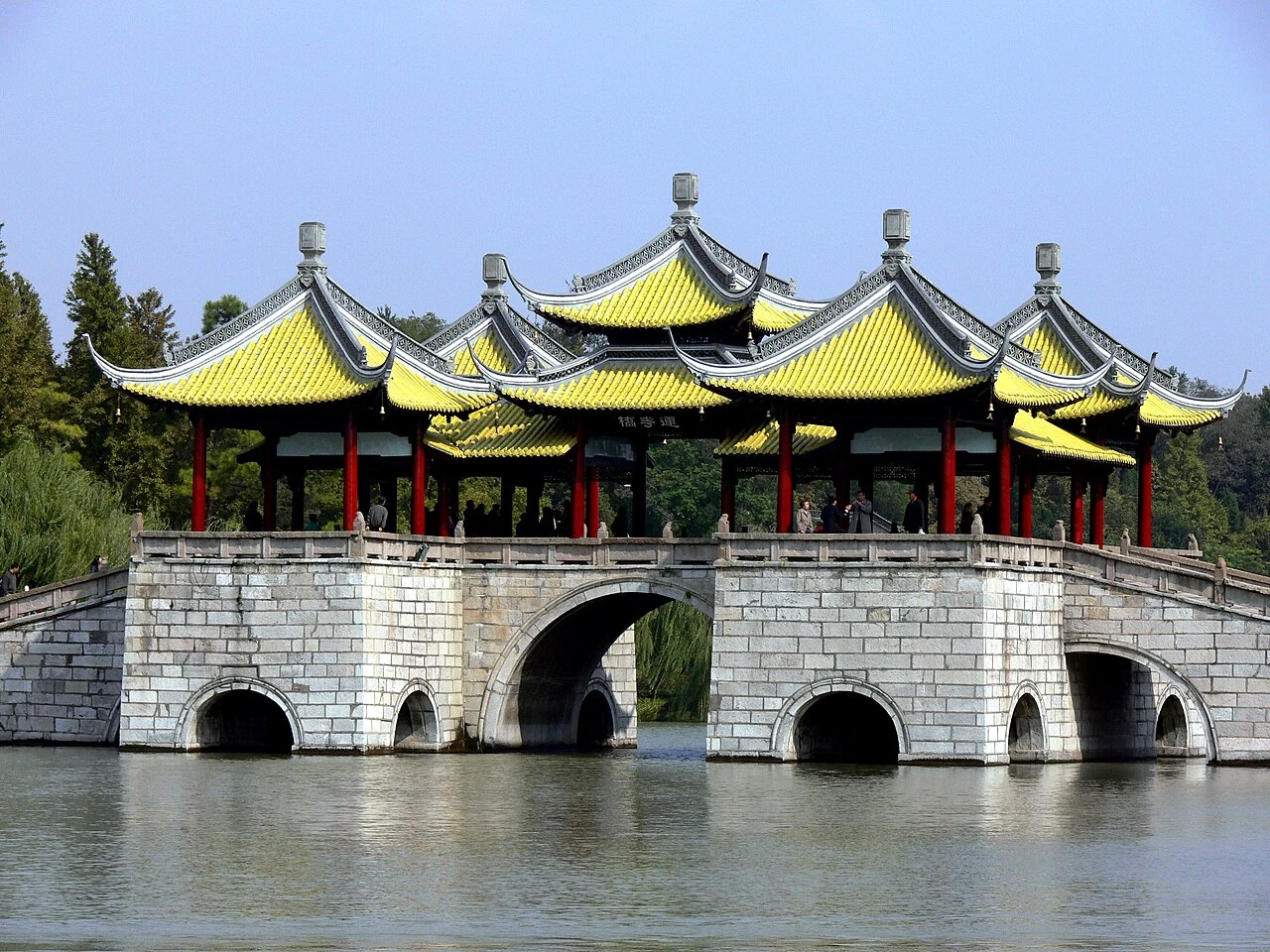
The Five-Pavilion Bridge, also called Lotus Bridge, makes that sequence visible. Five small roofed pavilions sit on a stone bridge whose openings let the water pass through. From a distance, the roofs read as a single, balanced crown; closer up, each opening divides the water into another picture. The bridge gathers several sightlines at once—to the White Pagoda, the banks and the next stretch of water—and gives visitors a place to pause inside the composition. Local accounts date the bridge to the Qianlong era, in 1757. Its layered shape, rather than a single grand span, is what makes it feel at home in a garden landscape.
A small pavilion can organize a large view
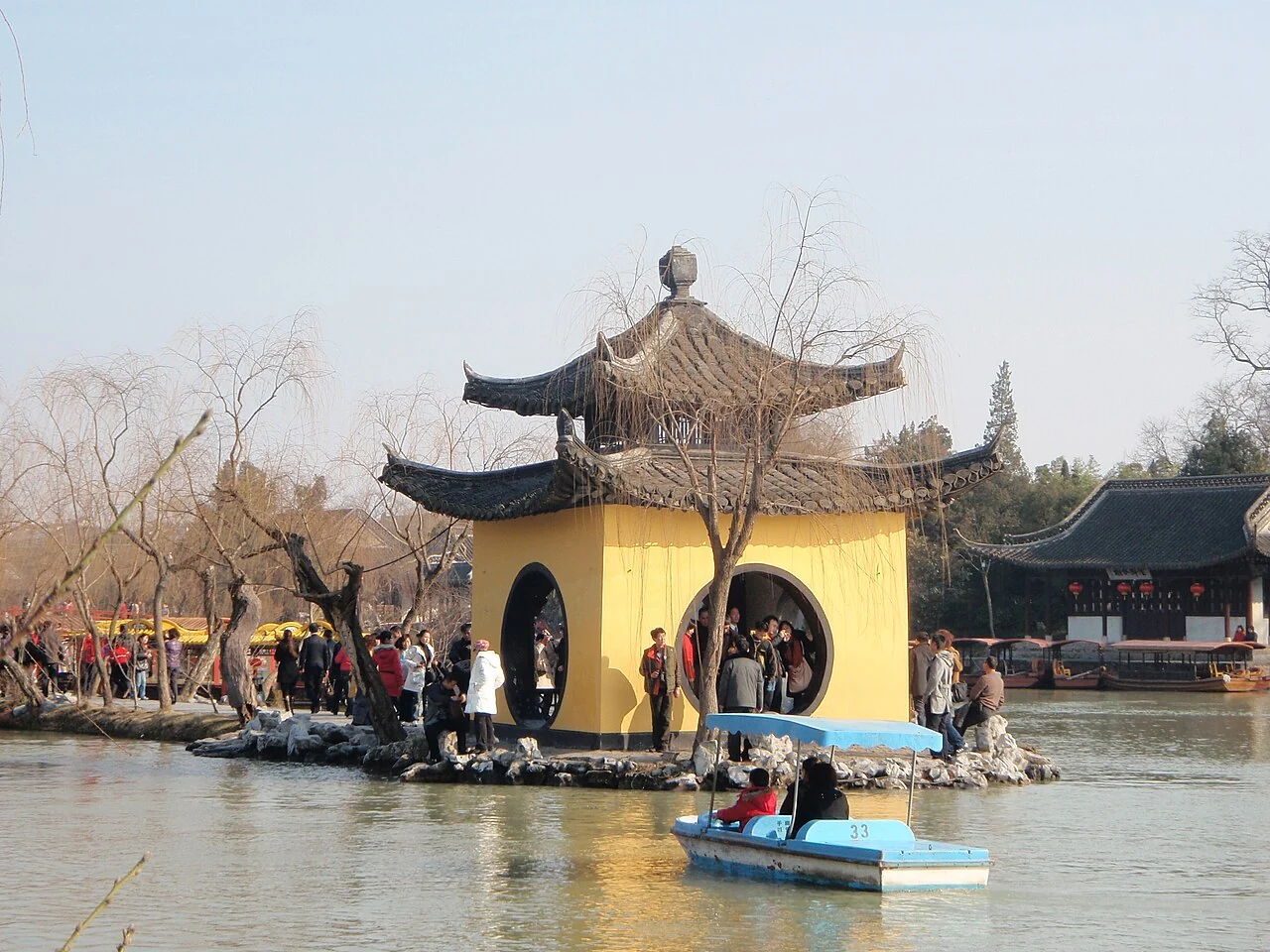
At Fishing Terrace, the architecture works on a smaller scale. Its openings frame the water and distant bridge like a set of pictures. A visitor standing there sees a selected view rather than the whole lake at once: the building edits the scene, placing water, bridge and pagoda into chosen relationships. Across the water, the White Pagoda gives the scene a vertical marker. Low banks and horizontal water meet a bridge that spreads outward, then a tower that rises. The arrangement feels calm because the elements do different jobs.

A story beside the building record
A familiar Yangzhou story says that Emperor Qianlong admired the view and remarked that it needed a white pagoda like the one at Beijing’s Beihai. Salt merchants supposedly had a model brought and raised a white tower overnight from salt sacks. It is a vivid tale about wealth, hospitality and a city eager to impress its visitor. Read it as a local story, not a construction record. The more securely documented history is already compelling: Yangzhou’s salt economy supported garden building, and the lake’s connected villas and waterways took shape through repeated additions and later repair.
A landscape assembled, damaged and renewed
The scene seen today has passed through many periods of change since the eighteenth century. Gardens flourished around the water, declined as Yangzhou’s salt trade weakened, and suffered damage during later conflict. Some places were restored in the late Qing; further restoration and reconstruction continued in the twentieth century and after. That history changes how the lake reads. A pavilion may recall an older scene while its present form belongs to later conservation. The Grand Canal is inscribed on UNESCO’s World Heritage List. “Slender West Lake and Historic Urban Area in Yangzhou” is a separate entry on the Tentative List; the two designations are distinct. Following the water from one framed view to the next reveals both the garden’s craft and the long work of maintaining it. Seen in sequence, a pavilion slows the eye, a bridge opens the water, and the pagoda fixes a distant point. The lake’s design emerges as visitors move from one carefully related view to another.