From the journal

Listening for the Many Voices of Dong Grand Song

Multipart voices, song masters and river communities give Dong Grand Song its musical and social depth in Sanjiang.

Voices sharing the musical space

Dong Grand Song is built from relationships between vocal parts. UNESCO describes multipart singing without instrumental accompaniment or a conductor. The sound comes from voices sharing the musical space, supported by learning and coordination within the ensemble.

Repertoire and performance groups vary. Familiarity, attention and shared practice allow singers to fit their parts together. What reaches an audience as a flowing whole carries the work of people listening to one another.
A musical geography along the rivers

The national heritage entry for Sanjiang locates major transmission in Meilin, Fulu and Yangxi along the Rongjiang, and also refers to Dong villages in Luocheng. The tradition has a wider geography than Chengyang's well-known bridge and village cluster.

Groups bring the learning histories of particular communities into a performance. The county name gathers those places under one administrative identity, while the river settlements retain their own musical connections. Sanjiang's singing belongs to this network of places and practitioners.

A tradition contains different kinds of song

UNESCO's account includes narrative, children's, greeting and imitative songs, among other forms. The Sanjiang register distinguishes voice groups and a range of local genres. The repertoire serves different occasions: it tells stories, welcomes people and carries the sounds and experiences of everyday surroundings into song.

The sound has teachers behind it

Both heritage accounts emphasise teaching and collective learning. The Sanjiang entry names the role of the song master, while UNESCO describes masters working with choirs of learners. Time spent hearing, repeating and remembering prepares singers to fit one part with others.

A performance is the audible result of those relationships. Recordings preserve particular renditions; teaching passes on the practice of making music together. Continuity depends on people continuing to learn, gather and sing.

Drum towers, homes and stages

UNESCO's description places the music in drum towers, homes and other public places. A stage gives it another setting, shaped by an audience, a duration and choices about presentation. Across these settings, the voices remain the work of singers whose skill grows through collective practice. The public performance is one encounter with a musical life extending beyond the venue.

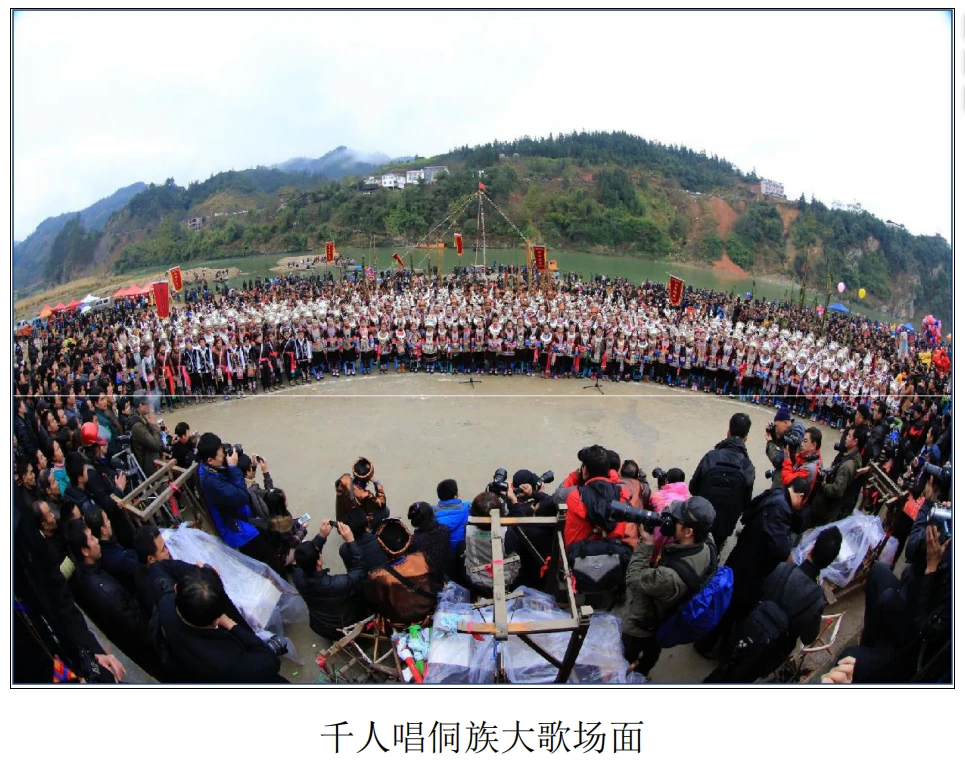
A large semicircle of singers faces an audience at an outdoor gathering.
A large Dong Grand Song gathering illustrated by Sanjiang’s official tourism operator; the original image is captioned “a thousand people singing Dong Grand Song.”
Continue exploring · Liuzhou ↗
Photo credits and rights
  1. A large Dong Grand Song gathering illustrated by Sanjiang’s official tourism operator; the original image is captioned “a thousand people singing Dong Grand Song.”Sanjiang County Culture and Tourism Information Service website; photographer not stated · Rights information Photo source ↗ Resized and converted to WebP; full composition retained.