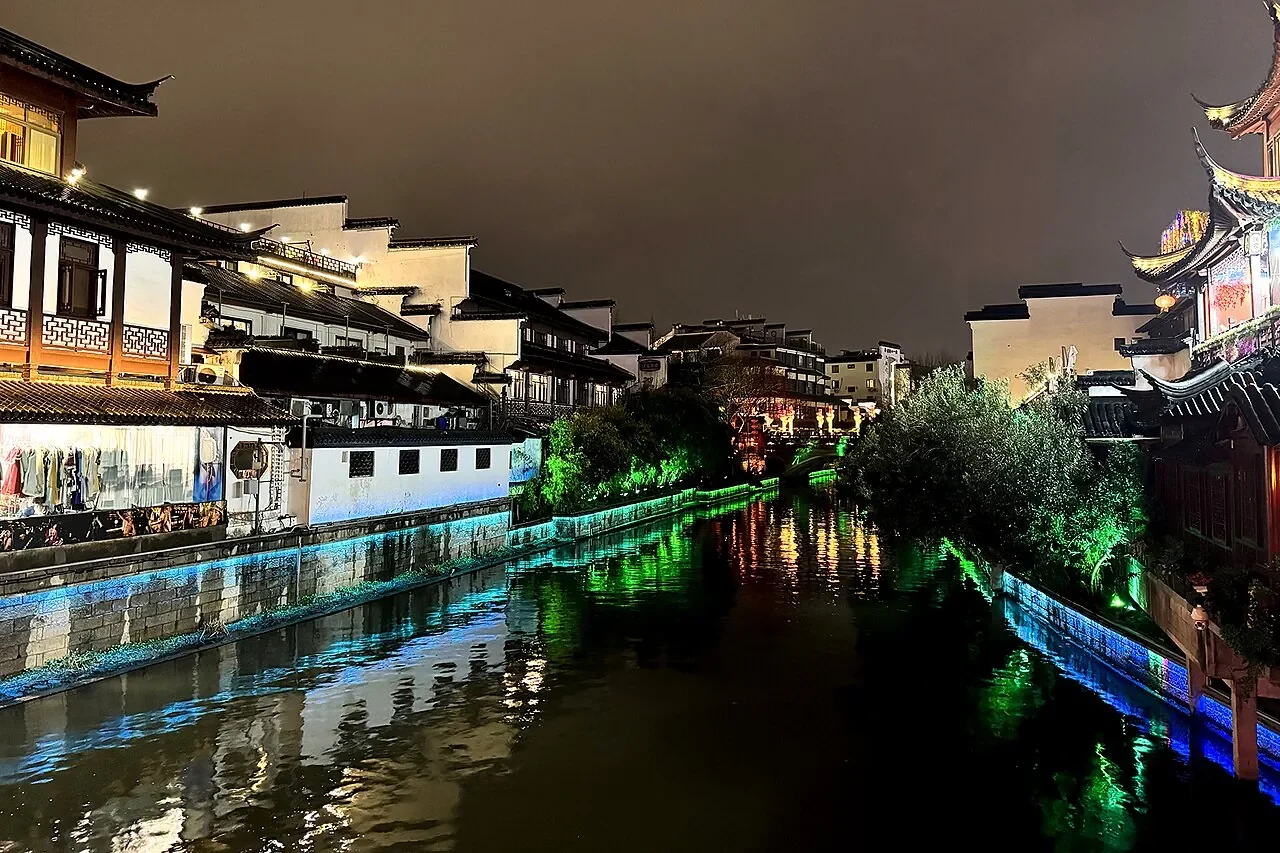
The familiar image of Qinhuai is a waterside district of bridges, lights and busy streets. Near the Confucius Temple, however, the former Jiangnan Gongyuan introduces another organising force: examinations. The compound was not a picturesque accessory to the neighbourhood. At its late-Qing height, it contained 20,644 examination cells, according to Nanjing’s local-history exhibition. Consider what that figure means spatially: a city within the city, assembled around the concentrated activity of reading and writing. The significant view is not only along the river. It is also inward, toward the institution that made scholarly achievement a route into official life.
Nanjing
Qinhuai: The City Behind the Examination
Look beyond Qinhuai’s lanterns to the examination compound, surviving tower and objects that reveal the machinery of official ambition.
In the same city · Nanjing ↗The river scene has another centre
Ambition required a system
An examination is often imagined as a solitary encounter between a candidate and a question. A compound on this scale depended on collective organisation. People had to be identified, assigned space, supervised and assessed; papers had to move through procedures before names could become results. The museum’s documented collection provides concrete ways to think about that machinery, including examination papers, designs for candidate roll-call lanterns and flags, and a final examination list from 1894. These objects do different jobs. A paper records performance; a roll-call device orders people; a published list turns judgement into public status. Read them as parts of one process rather than unrelated antiques.
Lin Zexu at the examination ground
A recognisable person brings that administration into focus. Lin Zexu, widely remembered for his later anti-opium campaign, supervised Jiangnan examinations in 1832 and 1835 while serving in Jiangsu. The local chronicles describe his efforts to address abuses in the examination system. That role changes the way to read the compound. Candidates were not the only people being tested by the institution: its credibility also depended on officials managing it. A promise that learning could lead to advancement required procedures people could trust. Lin’s involvement gives a specific historical face to that problem, without turning the whole examination tradition into a simple story of either fairness or corruption.
An ending written into the neighbourhood
The examinations were abolished in 1905. Jiangnan Gongyuan then lost the activity for which its immense arrangement had been designed. During the early Republic, much of the compound was demolished and the area became a market, while central structures including Mingyuan Tower were retained. This is why the present district cannot be treated as an intact examination campus. Commerce does not merely surround a perfectly preserved historical object: later urban life occupies space released by the institution’s disappearance. The surviving tower is powerful partly because so much around it changed. Compare the small amount that remains with the scale of the former compound described in the historical record.
The museum makes absence visible
The contemporary Imperial Examination Museum responds to that loss through a different spatial language. Much of it is underground, and a shallow pool creates a reflective relationship with Mingyuan Tower. The contrast matters: the surviving building stands above, while a new architectural container gathers the dispersed history below. The design invites reflection on what can be recovered through objects, documents and interpretation when an entire working institution cannot be restored. Do not mistake reconstructed displays for untouched examination cells. Instead, use them to ask precise questions about the original system and its evidence. Returning to the riverfront, the busy quarter becomes legible in another way: a place where official ambition once concentrated, and where urban life continued after that ambition’s institutional framework disappeared.