Zhenjiang

Jinshan: the White Snake story and the temple beyond it

Read the White Snake legend against Jinshan's hillside architecture, rebuilding history and continuing life as a Buddhist monastery.

In the same city · Zhenjiang ↗

A story brings you to the hill

A woman who is also a snake spirit challenges a powerful monk to recover her husband. Water rises around a monastery, turning a love story into a confrontation with religious authority. This is the Jinshan episode in familiar versions of the Legend of the White Snake. Its protagonists are Bai Suzhen, her husband Xu Xian, her companion Xiaoqing and the monk Fahai. The episode gives Zhenjiang a place in a story many overseas readers first encounter through Hangzhou and West Lake.

Begin with the distinction that makes the visit worthwhile: the magical flood belongs to a changing narrative tradition. The temple is a real religious institution. Neither the existence of the building nor the presence of a named cave can establish that a supernatural episode happened there. Folklore connects a story to a place; it does not supply an archaeological report.
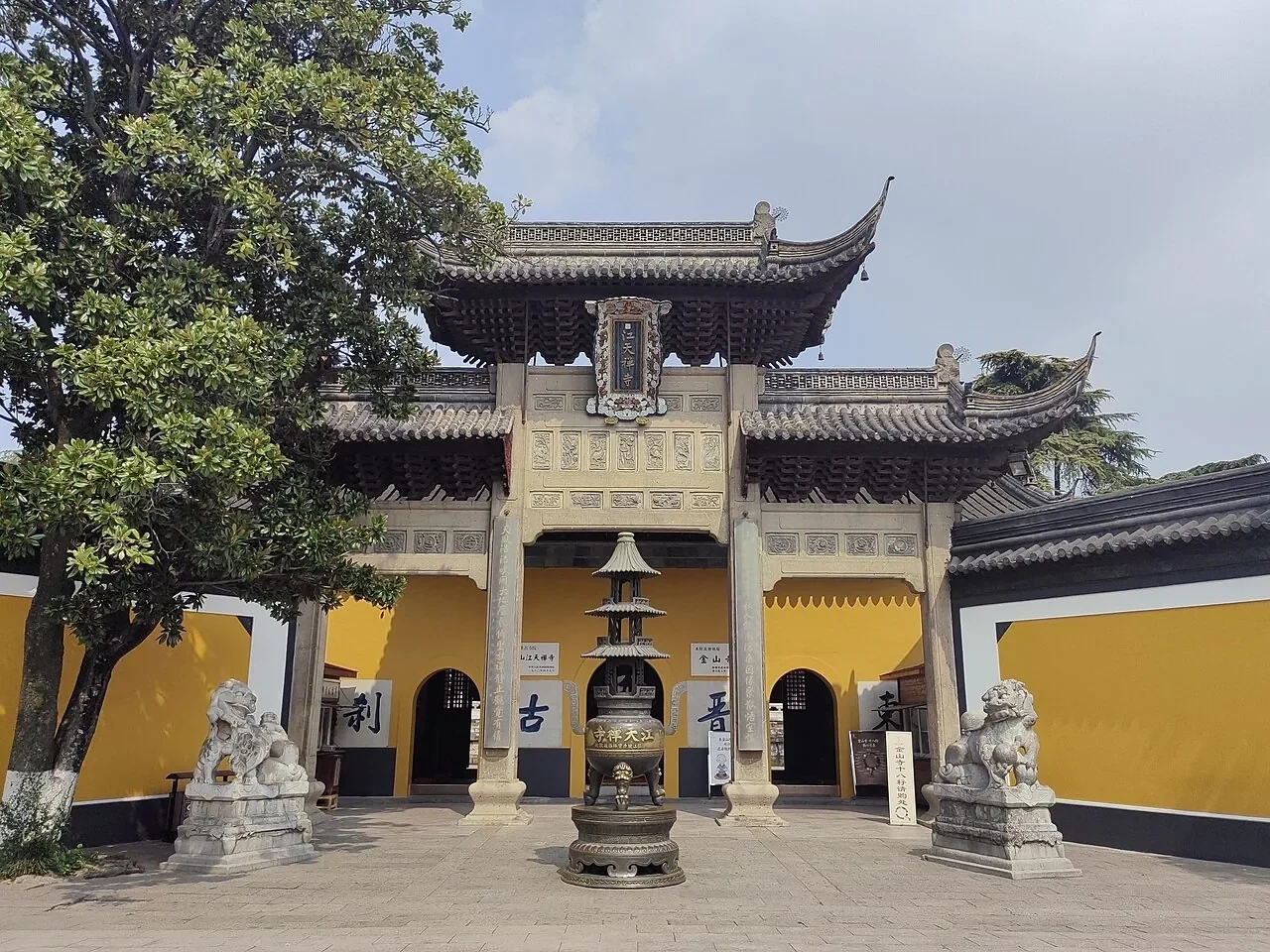
The yellow-walled entrance gateway of Jinshan Temple, with tiled roofs and stone guardians.
The entrance to Jinshan Temple in Zhenjiang, photographed in August 2024.

Look upwards, then read the dates

Jinshan's buildings follow the shape of the hill. Halls, passages and upper structures accumulate so densely that architecture seems to cover the ground beneath it. Rather than searching immediately for a single postcard angle, trace how the roofs step upward. Notice where one level becomes the visual platform for another. The monastery is easier to understand as a built hillside than as a row of separate monuments.

The temple's foundation is traditionally placed in the Eastern Jin period. That long institutional history does not make every visible beam equally old. Cishou Pagoda illustrates the difference. Jiangsu's local-history account describes a succession of earlier towers, destruction and rebuilding; the present tower was completed in 1900 after a fundraising effort led by the monk Yinru. Its seven storeys and eight-sided form belong to a specific rebuilding campaign. Reading those details turns an apparently timeless silhouette into evidence of people choosing to renew a sacred place.

Who is the villain?

A useful question to carry through Jinshan is why audiences sympathise with different characters. In popular romantic versions, Bai Suzhen's devotion makes her recognisably human even when her powers are not. Fahai becomes the obstacle between a couple. Yet a monastery cannot be understood entirely through the role assigned to its monk in a drama. ThinkChina's account explicitly distinguishes the fictional antagonist from traditions about a respected historical monk associated with Jinshan. Stories about his life also need to be read as traditions, rather than used to verify the plot.

The tension is the point. A temple can be a place of refuge and discipline for practitioners while becoming a place of separation in a romance. You do not have to settle that tension by declaring one reading the only authentic one. Listen instead for which version a guide, performance or display is telling, and what moral sympathy it asks of its audience.

Leave room for the present

Once the story is familiar, give the monastery a second look without assigning every doorway a fictional scene. The relationship between stairs, rooflines and the pagoda provides another route through it. So does the contrast between the age of an institution and the much shorter life of its physical fabric.

Remember that worship has its own purpose here. Avoid blocking entrances or treating people at prayer as characters in a theatrical setting. That small shift in attention preserves the distinction between visiting a cultural landmark and watching someone else's religious life. Jinshan is rewarding precisely because it accommodates both literary imagination and a continuing institution. The strongest memory may be neither a legend proved nor a legend disproved, but a hill whose buildings have repeatedly made room for belief.

Continue exploring · Jinshan Temple ↗
Photo credits and rights
  1. The entrance to Jinshan Temple in Zhenjiang, photographed in August 2024.Yumeto · CC BY-SA 4.0 Photo source ↗ Rights information ↗ Resized and converted to WebP.