The Gesar epic is not one book that every performer recites in the same way. UNESCO describes it as a vast oral narrative whose episodes are performed in alternating passages of prose and verse, with regional differences. The image of “beads on a string” is useful: a singer joins memorable episodes into a sequence, while the links and details can vary. The tradition tells of King Gesar, a hero who is sent to defeat monsters, challenge powerful figures and help the weak. These are the story’s mythic terms, not a chronicle of a historically verified king. That flexible form has a distinct home in Nagqu, where named singers carry the epic between towns, audiences and generations.
From the journal
Gesar in Many Voices: An Epic Told Anew
The Gesar epic travels through performance rather than a single fixed book. Its episodes, musical choices and regional versions keep the story in motion.
In the same city · Nagqu ↗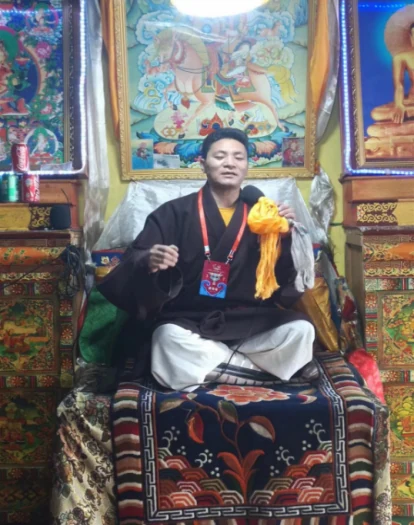
A story carried by voices
How performance shapes the tale
The performer’s body is part of the telling. UNESCO’s account notes that Tibetan masters may carry bronze mirrors and use facial expression, sound effects and gestures. These details help listeners follow a scene as it moves between spoken prose and verse. The mirror is a documented feature of some Tibetan performances; it should not be treated as a prop used by every singer. The same source describes other forms elsewhere in the tradition, including Mongolian performers accompanied by fiddles. This variety makes the epic easier to understand as a living repertoire than as a single authoritative script. A performance can preserve shared characters and episodes while still reflecting a singer’s training, audience and local conventions.
Episodes within community life
The epic is also heard in settings beyond a formal stage. UNESCO records that performances may be embedded in religious and everyday life, and that passages about Gesar’s descent into the world can be sung when a child is born. The story’s scale changes with its occasion: an episode may entertain a gathering, carry remembered knowledge or mark a family moment. A 2025 profile from the Tibet regional culture and tourism authority gives this tradition a local name and face: Zada, a recognized Gesar inheritor from Cuola Township in Jiali County, Nagqu. The profile says he has performed the epic since 2000 and joined the Nagqu City Gesar Performers Association in 2021.
A singer in motion
Zada does not stay in one performance hall. The 2025 profile says he travels periodically to counties and townships to sing for local audiences. It also describes how he gives different Gesar generals distinct expressions and vocal intonations. In that detail, performance becomes a way of making a large cast legible: the singer shifts voice and face as the story moves from one character to another. UNESCO’s description of gesture and sound effects places this skill within a wider tradition, while Zada’s profile anchors it in Nagqu today. He is reported to know more than twenty-five episodes, including stories of battles and travels. The record gives a glimpse of a working repertoire, carried from one gathering to the next.
A repertoire that keeps moving
UNESCO notes that Gesar stories have inspired thangka painting, Tibetan opera and other art forms. The epic’s life is thus not confined to the moment when a singer performs: characters and episodes can travel into images, theatre and later retellings. Listening foregrounds rhythm, voice and gesture; an image selects a scene; a written text fixes one wording. Zada’s public profile adds another part of this movement: a singer carrying episodes between communities and performing them for people who may know the story in different ways. For readers meeting the epic through Nagqu, the point is not to search for one definitive version. Shared characters make the story recognizable, while each performance gives the telling a human voice and a place in the present.