The Chamdo tourism bureau locates Zizhu Monastery on Zizhu Mountain, in Jue’en Township of Dingqing County. Its page gives an elevation of more than 4,800 metres and places the monastery about 37 kilometres from the county seat. Those figures make the mountain setting part of the account: the monastery is described through both its religious identity and its position high above the county landscape. The source is a tourism description rather than a monastery-authored history, so its measurements and framing should be attributed to that page.
From the journal
Zizhu Monastery and a Dance Held Once in Twelve Years
A Chamdo tourism account locates Zizhu Monastery high on Zizhu Mountain in Dingqing and describes a ritual dance performed on a twelve-year cycle. The claim is presented as the tourism page’s account, not a substitute for a monastery ritual calendar.
In the same city · Chamdo ↗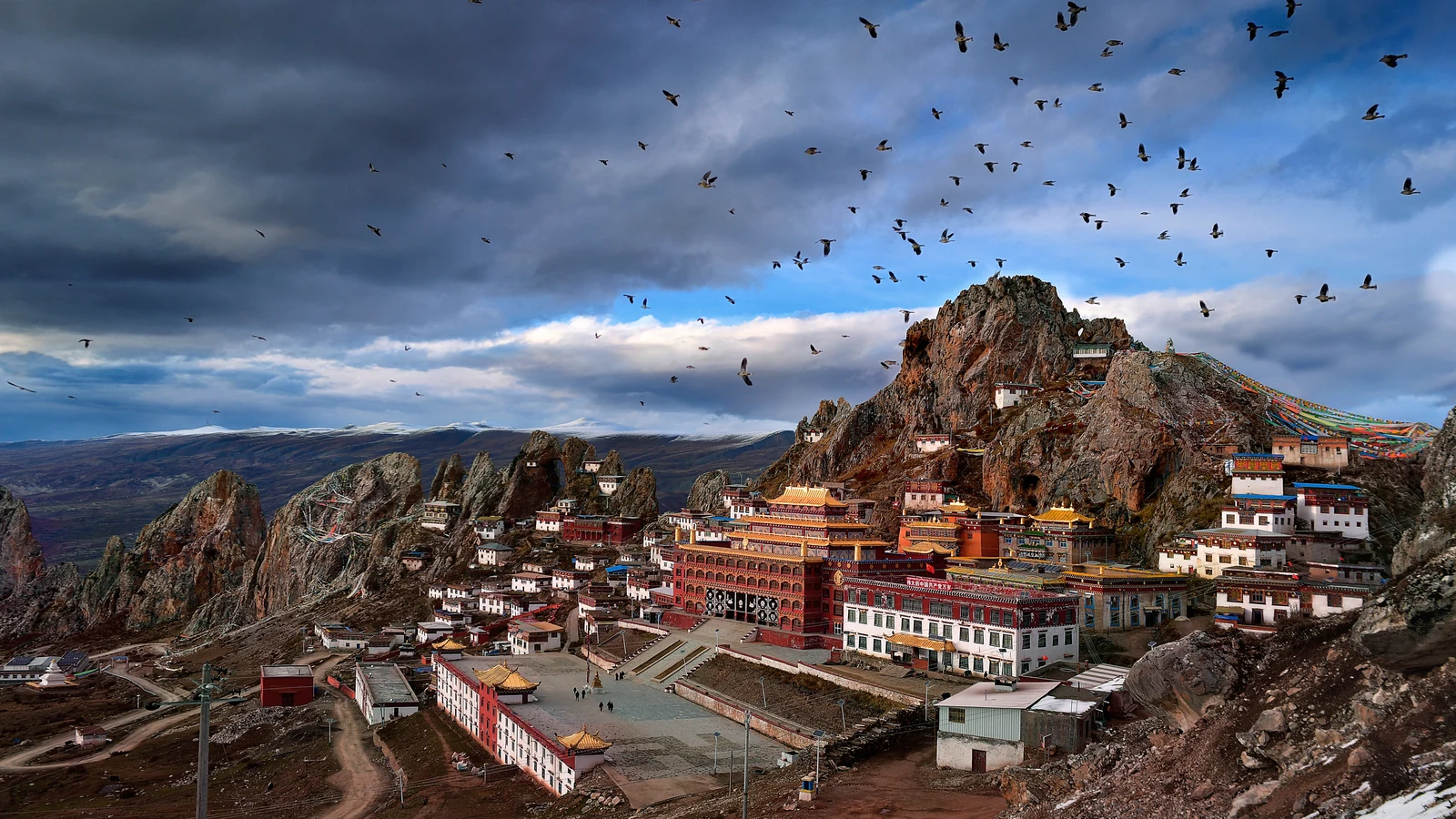
A monastery high above Dingqing
A dance on a twelve-year cycle
The same page says that a ritual dance it calls the “Dance of Bliss and Hell” takes place once every twelve years. The interval gives the performance a markedly different rhythm from an annual festival: it is described as an event whose recurrence spans a generation of ordinary visits. The source does not provide the ritual calendar, dates of past performances, or an explanation of the dance’s religious meanings. This article therefore preserves the claim as the tourism bureau presents it and avoids treating an English translation of the title as a complete account of the practice.
Keeping the account in its own frame
A visitor reading a tourism page can learn where the bureau places the monastery, how high it says the site stands, and how it characterizes the dance’s cycle. Those are useful starting points, but they are not the same as a ritual handbook or a community interview. The page does not document who may attend, how the dance is prepared, or how its name is understood by practitioners. Leaving those questions open is not a reason to flatten the monastery into scenery; it is a reason to treat the published account as one carefully bounded description of a high-altitude religious place and a rare performance.
A place between performances
The twelve-year interval, as reported, suggests that the monastery’s story cannot be reduced to the moment of a dance. Most years lie between performances, and the page gives little detail about the everyday life of the community during that span. Even so, the pairing of elevation and cycle creates a distinctive portrait: a monastery above 4,800 metres, set apart by its mountain location and by an event said to recur only once in twelve years. To understand more, one would need direct institutional or community sources. For now, the tourism bureau’s description offers a clear, dated point of entry while keeping its limits visible.