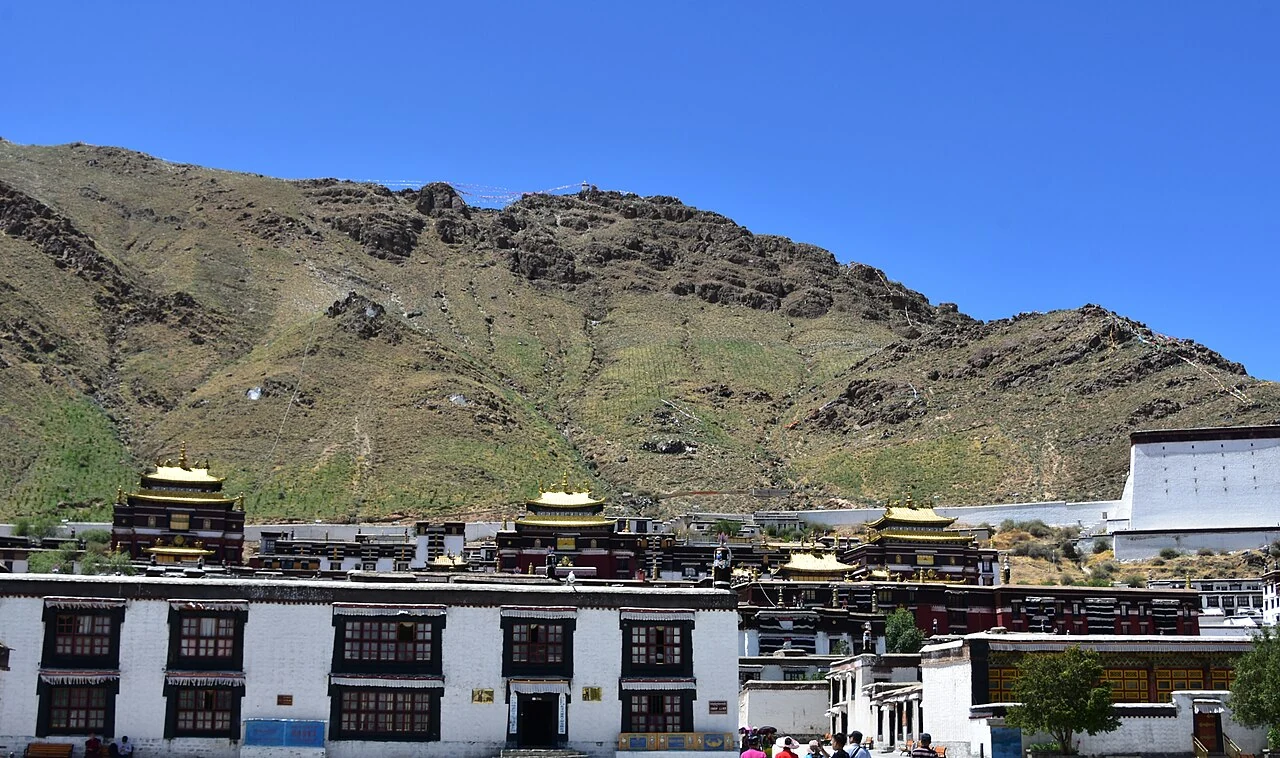
Zashilhunpo stands below Nyiseri Hill on the western side of Shigatse. China’s Ministry of Culture and Tourism records its founding in 1447 by Gendun Drup, a disciple of Tsongkhapa, and notes that the Fourth Panchen Lama, Lobsang Chökyi Gyaltsen, later expanded it. Those two acts—foundation and expansion—offer a more useful starting point than treating the monastery as a monument completed in one moment. The site’s shape reflects continuing religious and institutional life across generations. Its location on the western edge of the city makes the monastery part of Shigatse’s visible topography, with the rising hillside carrying the complex above the surrounding streets.
From the journal
Zashilhunpo, a Monastery Shaped by Successive Generations
Founded in 1447 and later expanded, Zashilhunpo’s halls and teaching colleges record a history built through successive generations rather than a single act of construction.
In the same city · Shigatse ↗A foundation on the hillside
A hall designed for collective practice
The Ministry’s description says the main assembly hall can hold 2,000 people in prayer. That capacity points to an architectural purpose: the hall is a setting for people gathering, reciting and learning together. The same account places an image of Shakyamuni at its centre and statues of Gendun Drup and the Fourth Panchen Lama beside it. Nearby Maitreya and Tara halls add other devotional spaces to this network of assembly and worship.
Learning housed within the compound
The Ministry identifies four monastic colleges, or dratsang, and describes their teaching as encompassing both exoteric and esoteric Buddhist study. Religious education is therefore part of the monastery’s institutional structure, alongside the large assembly hall and devotional spaces. The complex also includes memorial halls for successive Panchen Lamas. Together, study, worship and commemoration give the compound several roles in the religious life of Shigatse.
Architecture as institutional memory
The dates 1447 and the later expansion by the Fourth Panchen Lama describe two different moments in Zashilhunpo’s growth. Read together, they make the hillside complex a record of an institution shaped over generations, rather than a monument completed in one campaign. Its changing form reflects a religious community that continued to add to the place it used.