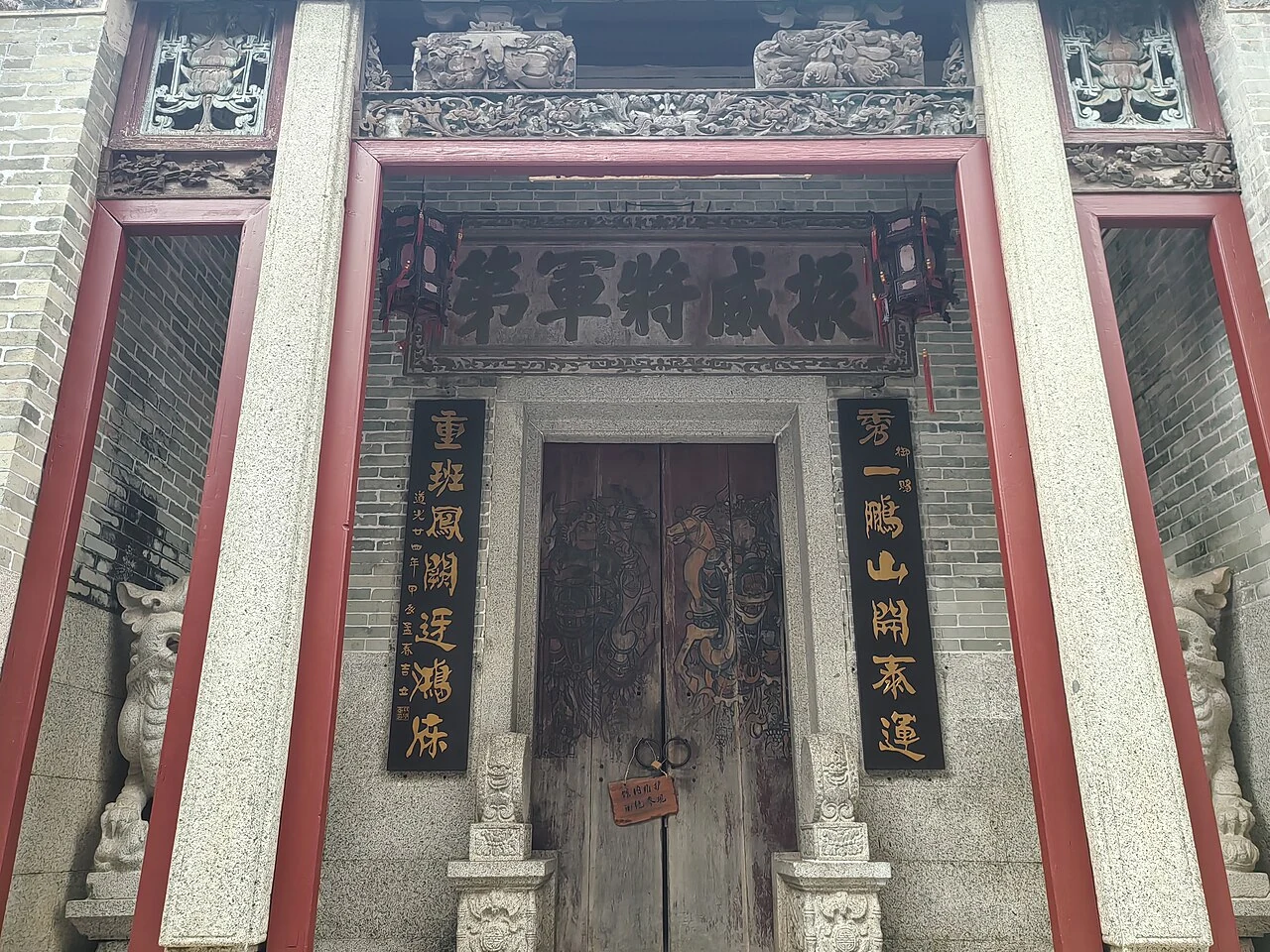
A general’s name above the entrance
Within Dapeng's defensive walls, houses gave military office a domestic address. Lai Enjue's residence on Laifu Lane bears the title Zhenwei Jiangjun Di—the mansion of General Zhenwei. Built in 1844, it belonged to a man who rose to command the Guangdong naval force. The honorific above a doorway carried a public career into the town's residential streets.
Other senior officers also had homes within the settlement, including Liu Qilong, commander of the Fujian naval force. The names preserved on these residences make the fortress more than an outline of walls. Rank and family life occupied rooms and courtyards inside it.
A school within the family world
Yiwenlou, also on Laifu Lane, adds a different purpose to this group of buildings. Built in 1846, the two-storey brick-and-timber structure has a courtyard at its center and three-bay rooms on either side. Stone forms the lower part of its walls, with grey brick above and tiled roofs overhead.
The Lai family used Yiwenlou as Chonglan Shushi, a school for its descendants. Education therefore had a dedicated place close to the residences of military officers. Today the building accommodates exhibitions and cultural uses, carrying that older space for learning into another part of the town's life.
Three ranges, two courtyards
The late-Qing Dai family residence offers another way to understand a house from its plan. Three successive ranges of rooms are separated by two courtyards. Its construction combines stone foundations, timber framing and tiled roofs; large bricks pave the floor. The entrance is especially substantial for a domestic building in the fortress.
These details give each house a different identity. A titled entrance records an officer's status, a family school sets aside space for study, and the Dai residence organizes rooms through successive courts. Together they reveal a settlement built to accommodate households as well as coastal defense.
