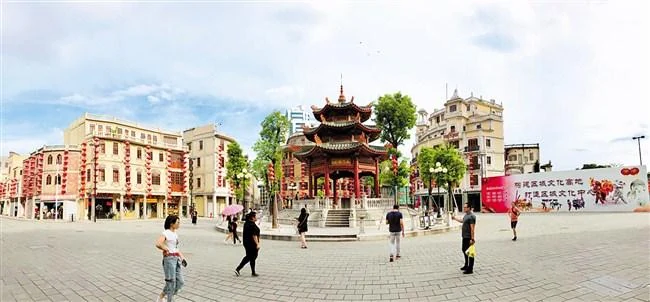
A pavilion at the center of the streets
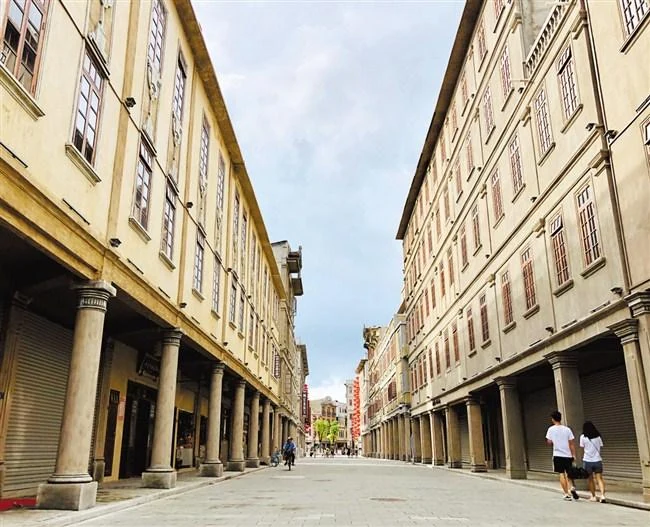
In Shantou’s Small Park district, streets radiate from a central point in a fan-like pattern. The Sun Yat-sen Memorial Pavilion stands near the center, with arcade streets extending outward. Their covered walkways shade pedestrians and shelter them from rain; storefronts open directly onto the flow of people. “Small Park” names both the central landmark and the surrounding historic district in Jinping.
A municipal historical account dates the pavilion to 1934. The surrounding streets developed as Shantou grew into a port and commercial center. Pavilion, shops and civic buildings form one connected urban field, and each street opens toward another part of the district.
The arcade as a public threshold
Arcades make the street more than a line between buildings. A covered walkway runs along the shopfronts, giving people a continuous sheltered route while commerce unfolds beside them. The form joins private interior and public movement: a store opens toward the street, while pedestrians can pass without stepping into the rain or midday sun. The city’s building inventory describes a mixture of traditional Chaoshan forms, arcade shop-houses and modern commercial structures.
That mixture helps the district resist a single-style reading. The arcade is a regional architectural type, but each building reflects different uses and periods. Offices, stores, restaurants and civic landmarks sit within walking distance. The city’s transport bureau names several of these buildings and locations; its historic bus-service dates are not current travel instructions, but the source helps establish the district’s urban layout.
A port city built into a street plan
Shantou opened as a treaty port in 1860, and Small Park grew into an important commercial area. The pavilion and radial streets show how public space and business could be organized around a recognizable center. Nansheng Department Store, the former customs clock tower and the old post office each add a different layer to that urban story. The port brought together local merchants, overseas Chinese investment and foreign firms, while the street fronts translated that activity into everyday movement.
Small Park is more than a photogenic junction. Its shape offers a way to read Shantou’s connection to trade: streets lead outward, covered arcades support dense commercial life, and landmark buildings anchor the shared route. The port history is visible not only in a harbor or museum, but in the pattern of the streets themselves. Walk the spokes and the district’s central idea becomes clear: commerce, shelter and civic identity gathered around a public point.