From the journal

Huashan’s Red Figures and Bronze-Drum World

Bent legs, raised arms and painted drum forms connect Huashan’s red cliff figures with the bronze-drum culture of ancient southern China.

In the same city · Chongzuo ↗
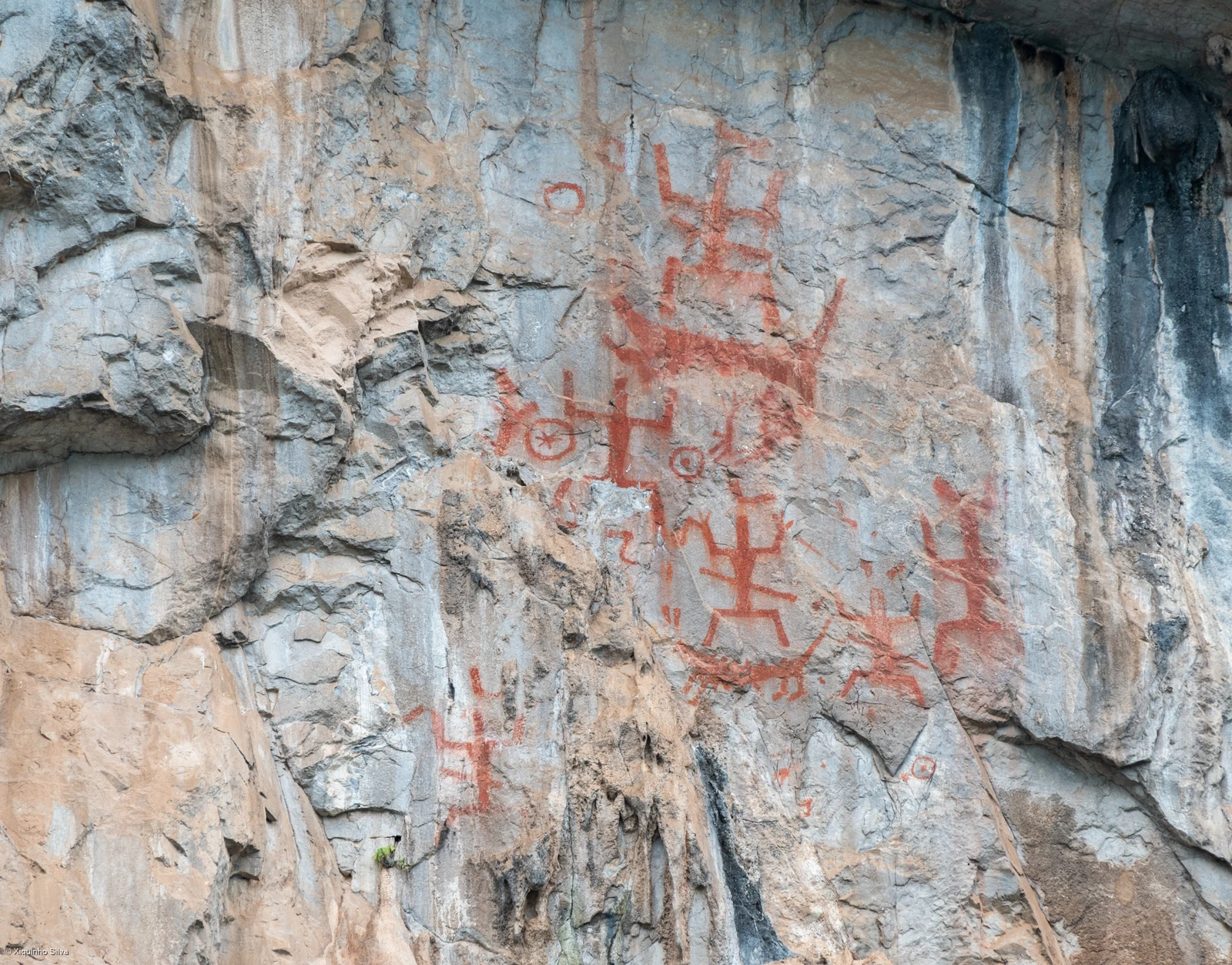
Groups of red-painted human figures spread across a pale, uneven rock surface at Huashan.
A wide detail of Huashan’s rock paintings in Ningming, Chongzuo, photographed on 10 June 2023.

Forms and meanings on the cliff

Red figures with bent legs and raised arms occupy Huashan's cliffs. Their poses, scale and relationships with nearby marks form the visible basis of scholarly interpretations, including ritual, social and ancestral readings.

The paintings bring a repeated vocabulary of bodies and objects into a large rock surface. Meanings remain debated, while the relationships within the compositions give the images their distinctive form.
Bodies are repeated, but not identical

The ICOMOS assessment records front-facing and side-facing human forms, often with bent legs and raised arms, in a considerable range of sizes. Associated animals and weapons have been interpreted as clues to distinctions in status. Those readings draw on patterns across the art and comparisons with other evidence.

Repetition suggests a visual convention, but not necessarily one fixed translation for every gesture. Some bodies dominate groups; others share an orientation with neighboring figures. A small mark may belong to a body or represent a separate object. Variation within the repeated forms is part of the paintings’ visual language.

Why drums enter the explanation

UNESCO associates the imagery with the bronze-drum culture of ancient southern China. Representations identified as drums connect the paintings with a wider material world. The paintings are generally attributed to the Luoyue and dated broadly between the fifth century BCE and the second century CE.

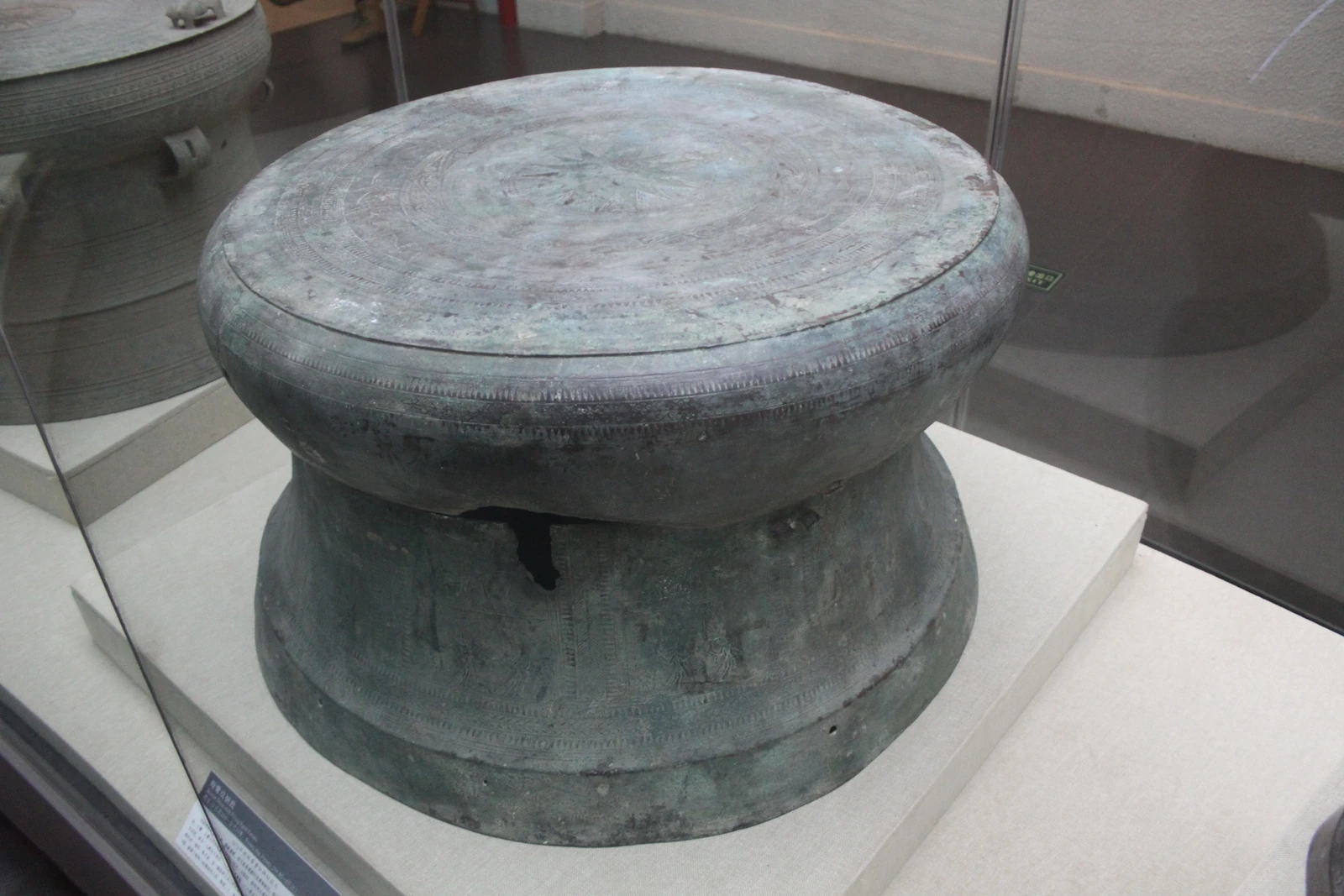
An excavated bronze drum can be studied for its material, manufacture and form. A painted drum also has a place in a composition: the people beside it, its apparent scale and the objects around it all shape its role in the image. Museum encounters with bronze drums can therefore enrich the context for Huashan, although resemblance alone does not identify every circular shape on the cliff.

A large bronze drum with concentric decoration stands in a museum case.
Comparison: a Western Han bronze drum at Guangxi Museum in Nanning, photographed on 17 March 2011; identification follows the photographer’s record.

Preparing red paint for rock

Scientific research has examined Huashan's pigments and binding media through microscopy and spectroscopy. A study catalogued by the Smithsonian's Museum Conservation Institute investigated organic binding materials and proposed vegetal ingredients.

The analysis connects the striking red surface with the practical work of preparing paint that could adhere to rock. Pigment, binder and stone form a material relationship whose survival is itself part of the paintings' long history.

Repeated forms, open meanings

Raised arms, bent legs, repeated groupings and associated objects give the paintings a striking visual vocabulary. Researchers have proposed ritual, social and ancestral meanings for these forms, drawing on the images and comparisons with other evidence. The poses and materials can be described closely; the occasions and meanings behind particular figures remain open to further study.

Huashan’s tall cliff rises above a green river with a small raft near the bank.
Huashan cliff and its river setting in Ningming, Chongzuo. Source-reported photograph date: 2023-06-10.
Continue exploring · Ningming Huashan Rock Art ↗
Photo credits and rights
  1. A wide detail of Huashan’s rock paintings, Ningming, Chongzuo. The photograph does not establish the interpretation or exact age of individual figures. Source-reported photograph date: 2023-06-10.xiquinhosilva · CC BY 2.0 Photo source ↗ Rights information ↗ Resized and converted to WebP; full composition retained.
  2. Comparison: a Western Han bronze drum at Guangxi Museum in Nanning, photographed on 17 March 2011; identification follows the photographer’s record.Gary Todd · CC0 1.0 Photo source ↗ Rights information ↗ Resized and converted to WebP; full composition retained.
  3. Huashan cliff and its river setting in Ningming, Chongzuo. Source-reported photograph date: 2023-06-10.xiquinhosilva · CC BY 2.0 Photo source ↗ Rights information ↗ Resized and converted to WebP; full composition retained.