From the journal

Hepu Han Beads: Materials, Making and Exchange

Scientific study of Hepu’s Han tomb beads traces varied materials and skilled making while leaving individual routes uncertain.

In the same city · Beihai ↗

Small objects can preserve large connections

A bead occupies little space, yet its material, shape, perforation and archaeological context preserve evidence of manufacture, use and burial.

Research published in 2023 on gem and jade ornaments from Hepu’s Han tombs examines materials and manufacturing characteristics to consider origin and movement.
Minerals and fossil resin

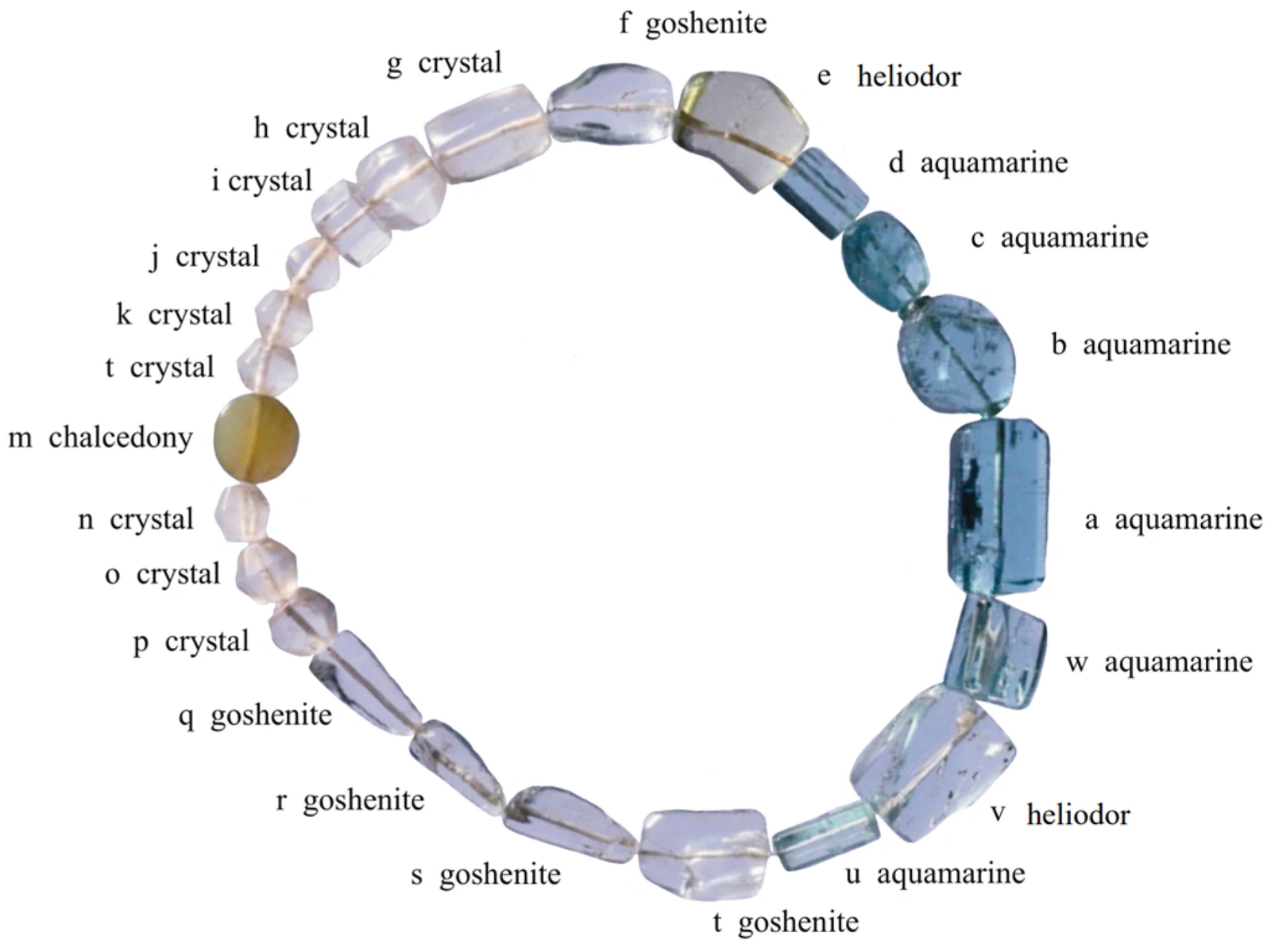
The study identifies materials including beryl, garnet, agate, quartz, turquoise and amber. Mineral substances sit beside fossil resin in this varied group of ornaments.

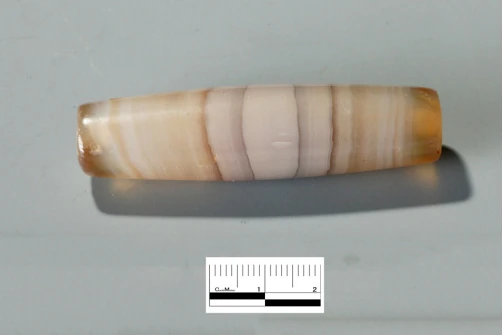
Laboratory analysis distinguishes materials whose appearances can overlap. Translucency, banding, polish and irregularities around a perforation add visible features to the material record, connecting substance with the work of shaping it.

A strand of translucent blue, yellow and clear beads is surrounded by material labels in an academic figure.
Han-period gemstone beads from Hepu in Figure 1 of Zheng and Guo (2025), with material labels following Xiong (2015).
An elongated cream and brown banded agate ornament beside a centimetre scale.
A banded agate ornament from Hepu’s Han tomb finds, identified and illustrated in Guizhou Provincial Museum’s report.

Making is a separate part of the journey

Raw material can move before it is cut, drilled or polished; a finished object can move again afterward. The source of a substance and the place where an ornament was made belong to separate stages in its history.

A perforation turns a small piece of material into something that can be strung. Each bead holds a sequence of skilled actions within a tiny form, bringing labour into the same story as long-distance exchange.

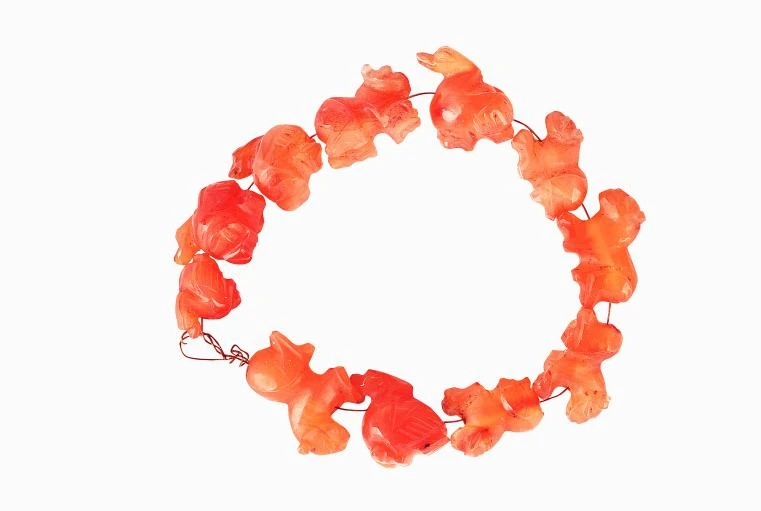
Orange agate animal ornaments arranged on a red thread against white.
Agate animal ornaments from Tangpai, Hepu, arranged on a thread in Chengdu Museum’s exhibition account. Collection: Guangxi Zhuang Autonomous Region Museum.
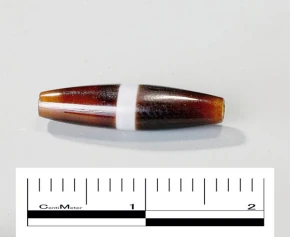
An elongated reddish-brown bead with a white cross-like pattern beside a centimetre scale.
An etched carnelian bead illustrated in Guizhou Provincial Museum’s report on Hepu Han tomb finds.

Connections across several networks

Hepu research considers connections with South Asia, Southeast Asia and inland China. Comparison with beads from northern Guangxi also draws attention to regional river networks.

Glass finds represent multiple manufacturing traditions and possible source regions. Attributions draw on chemical composition, manufacturing traces, form and comparisons with securely identified examples. Some origins remain possible rather than settled, while the wider patterns reveal several networks of circulation.

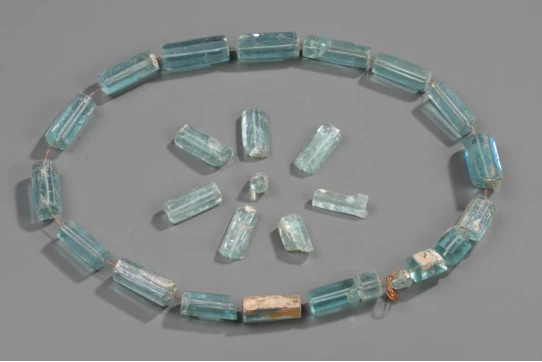
Pale blue glass ornaments with hexagonal cross-sections arranged in a ring and loose group.
Hexagonal glass ornaments excavated in 2003 from Fengmenling tomb M26, Hepu, illustrated in Guizhou Provincial Museum’s lecture report.

The last journey was into a burial

Before a bead entered an excavation record or a museum, it became part of a burial context. That final ancient placement matters. The object is evidence not only of circulation but of a local decision to include it with the dead. Its meaning at that moment may have differed from its meaning where it was made.

A tomb number, date or assemblage drawing restores relationships that a jewel-like presentation can hide. The bead’s story spans material and tool marks, funerary use and wider networks; each scale supports different inferences.

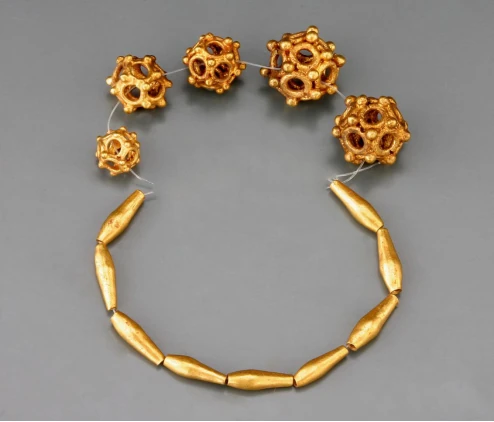
Openwork gold beads and elongated gold ornaments arranged on a grey background.
Gold ornaments excavated in 1993 from Beichajiang Yandui tomb M4, Hepu, illustrated in Guizhou Provincial Museum’s lecture report. The tomb reference restores a burial context to objects often discussed chiefly as evidence of long-distance connections.
Continue exploring · Hepu Han Heritage ↗
Photo credits and rights
  1. Han-period gemstone beads from Hepu in Figure 1 of Zheng and Guo (2025), with material labels following Xiong (2015).Yanyan Zheng and Guikun Guo, Arts 14(6),147, Figure 1 / CC BY 4.0 · CC BY 4.0 Photo source ↗ Rights information ↗ Resized and converted to WebP; full composition retained.
  2. A banded agate ornament from Hepu’s Han tomb finds, identified and illustrated in Guizhou Provincial Museum’s report.Guizhou Provincial Museum, lecture report on Hepu Han finds · Rights information Photo source ↗ Resized and converted to WebP; full composition retained.
  3. Agate animal ornaments from Tangpai, Hepu, arranged on a thread in Chengdu Museum’s exhibition account. Collection: Guangxi Zhuang Autonomous Region Museum.Chengdu Museum official website; collection: Guangxi Zhuang Autonomous Region Museum · Rights information Photo source ↗ Resized and converted to WebP; full composition retained.
  4. An etched carnelian bead illustrated in Guizhou Provincial Museum’s report on Hepu Han tomb finds.Guizhou Provincial Museum, lecture report on Hepu Han finds · Rights information Photo source ↗ Resized and converted to WebP; full composition retained.
  5. Hexagonal glass ornaments excavated in 2003 from Fengmenling tomb M26, Hepu, illustrated in Guizhou Provincial Museum’s lecture report.Guizhou Provincial Museum, lecture report on Hepu Han finds · Rights information Photo source ↗ Resized and converted to WebP; full composition retained.
  6. Gold ornaments excavated in 1993 from Beichajiang Yandui tomb M4, Hepu, illustrated in Guizhou Provincial Museum’s lecture report. The tomb reference restores a burial context to objects often discussed chiefly as evidence of long-distance connections.Guizhou Provincial Museum, lecture report on Hepu Han finds · Rights information Photo source ↗ Resized and converted to WebP; full composition retained.