Gyantse sits along the Nyangchu, a tributary of the Yarlung Tsangpo that flows east to west before turning north near the town. A heritage account describes the town as lying between Yadong, Lhasa, Shigatse and Zedang, on a route linking the Yadong border area with several regional centres. From above, the river’s bend helps explain why this hillside town became a place where movement through the valley and local authority met.
From the journal
Gyantse Dzong and the Town Below
Built above the Nyangchu Valley, Gyantse Dzong joined administration, worship and defence in one hillside complex that still preserves traces of its former functions.
In the same city · Shigatse ↗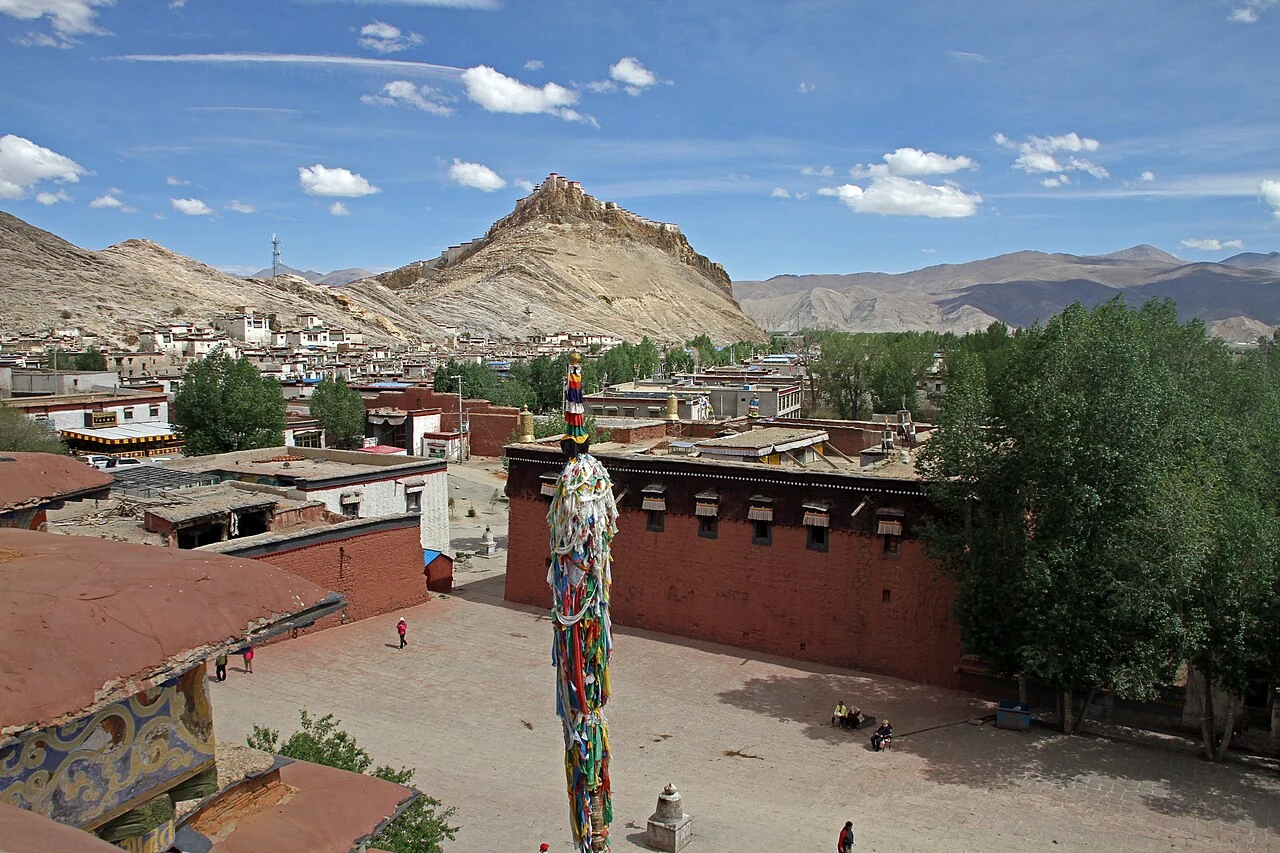
A town where the river changes direction
A fortress above the valley
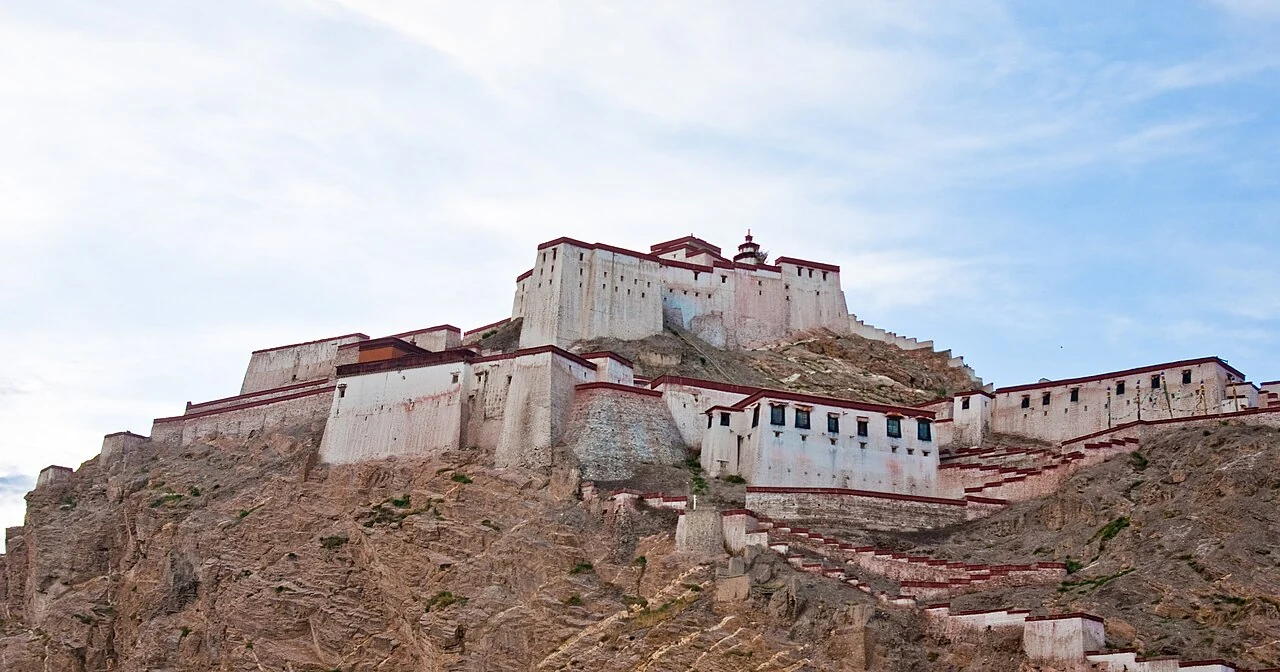
The same account dates an early palace-fortress on Gyantse Dzong to 967 CE. It says Banguozan, a descendant of a Tibetan king, built it to govern the Nyangchu Valley. The name “dzong” evokes a fortified seat, and the hilltop position makes the relationship between building and landscape clear: walls and towers look over the valley they once helped administer. Later expansions enlarged the complex, carrying its governmental role into subsequent periods.
Government rooms, shrines and stores
Gyantse Dzong preserves an unusual range of spaces associated with a former administrative seat. The heritage record lists government offices, a scripture hall, a Buddhist shrine, a prison, enclosing walls, watchtowers and storehouses. These rooms reveal how one hilltop complex brought several functions together. Officials worked and met there; religious spaces sat alongside the administrative ones; walls and towers gave the compound a defensive form. The remains can be read as an architectural record of how a town’s local government occupied space. The list makes the compound’s organization tangible: worship, record-keeping, custody and defence all had a place on the ridge. A storehouse and a prison are as much part of this civic landscape as the shrine and assembly rooms, giving the fortress a practical, inhabited scale.
The Dzong and the 1904 fighting
In 1904, British forces crossed the Nyangchu and surrounded Tibetan troops at the Dzong and in the town, according to the heritage account. The attack placed the fortress within a wider conflict and made the hill and streets below part of the same story. Gyantse’s history is therefore visible at two scales: the defended seat on the ridge and the inhabited town connected to it. Today, the surviving walls and rooms keep those different layers close together—river geography, local administration and a battle that reshaped the site’s memory. The valley route and the hilltop seat meet in this episode: the river crossing was a line of approach, while the Dzong was the focal point above the settlement. The streets below were part of the same contested town.