A weight before a face
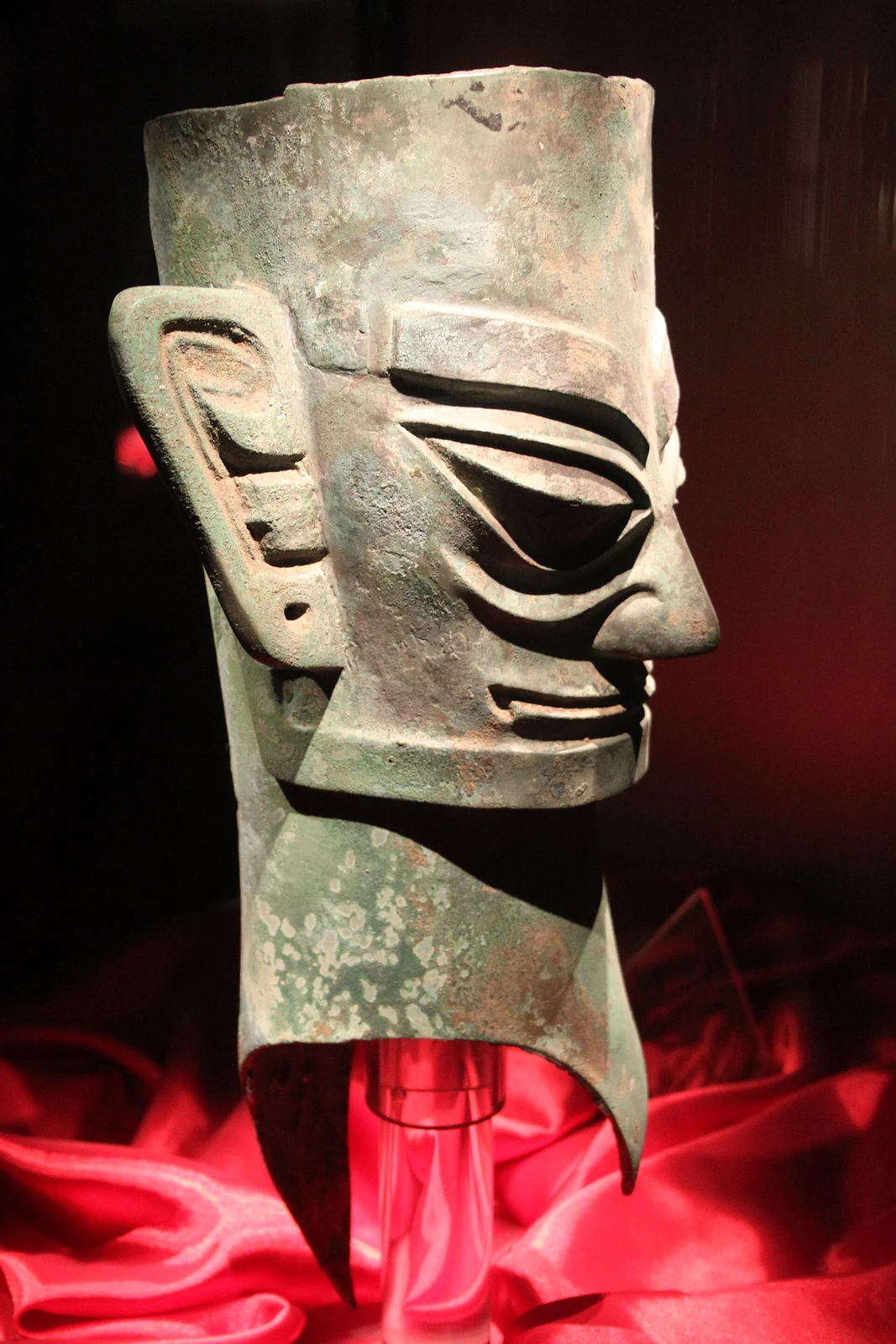
The number that stays is 65.5 kilograms. A mask that heavy cannot be held up in front of a face for long. It has to be set on something, or carried by several people, or fixed to a frame. The dimensions are just as awkward: 131 centimetres wide, 71 high and 66 deep, wider than the shoulders of anyone who might stand behind it. Museums tend to show such things at eye level, on a plinth, with the label to one side. This object was not made for that height. It was made to sit above a crowd, or to be lifted in a procession, and the bronze is thick enough for either. The weight sits in a few places, so whoever moved it had to know where to hold.
Eyes like cylinders
The eyes are the part that will not settle. They project from the face on short cylinders, so the gaze does not focus on anything near; it goes out and past. The mouth is wide and straight, the ears are large and squared off, the nose is broad. None of this is a likeness. A portrait has to record one particular face, with its asymmetries and its age. This face has none of that. It is symmetrical, general, and built to be seen from a distance, where a smaller and more accurate head would simply disappear into the cliff or the crowd. The face is a set of decisions about proportion, and proportion is what survives when a culture's meanings do not. What it asks for is distance.
Mounted, not worn
The mask was probably mounted or carried rather than worn, and its size explains the reasoning. A performer inside it would be blind to both sides and unable to balance the weight. A frame or a litter would do that work, with the mask as the front of something larger. The depth of 66 centimetres is the other clue: a mask for a face needs a few centimetres of clearance, not two thirds of a metre. That reading changes how the object looks. It is not a costume but a facade, a face for a structure or a procession. The ears, wide and flat, look as though they were made to be gripped or tied, though nothing about their use is certain. A litter, a frame, a wall: it would work on any of them.
The pit, the date, the face
It came out of a pit at Sanxingdui, in Guanghan, Deyang, at a site dated to about 4,800 to 2,800 years ago. The pit was a deposit, not a display, so the mask was buried where it could not be looked at. That gap is where interpretation starts. A face made to be seen, then put under the ground. That is a long span for one kind of object, and a reminder that Sanxingdui names a place and a period rather than a single moment. Explaining all this without turning it into a mystery is the work: a ritual object, a ritual deposit, a face that was never a portrait and was never meant to be read as one person.