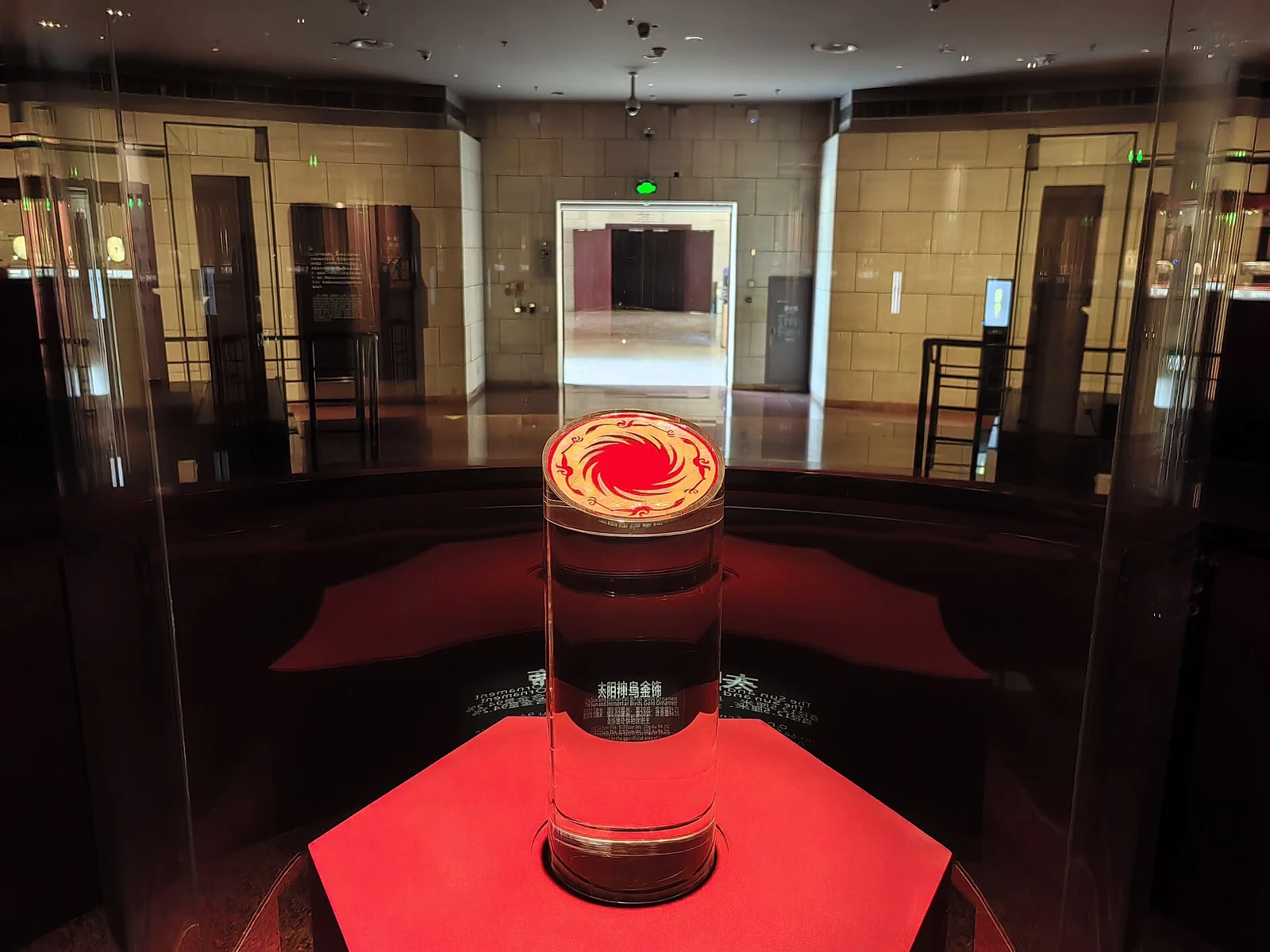
Thin enough to flex
The ornament is a disc of gold with four birds set around a sun. It is 94.2 percent gold and only 0.2 millimetres thick, thin enough that a careless hand could bend it. The birds are cut in profile, their wings and tails forming a ring of movement. Archaeologists recovered it at Jinsha in 2001, in a site that had already been disturbed by construction. The object is small, but its proportions are exact: the sun sits at the centre, and the four birds divide the circle into equal parts.
More than one object
Jinsha is not a single find. The site holds workshops, burials, a river channel and a large number of gold, jade, bronze and ivory objects. Its excavators describe it as the first major archaeological discovery of China's twenty-first century. The gold disc became the public face of that work, and in 2005 its design was chosen as the China Cultural Heritage emblem. That decision turned a small object into a sign used at museums and heritage sites across the country.
A museum in the dark
The Jinsha Site Museum closed on 5 December 2025 for its first comprehensive upgrade and is scheduled to reopen on 30 April 2027. The closure covers the park, the excavation hall and the exhibition hall. The gold ornament travelled to Beijing in 2026 for an exhibition at the National Museum, and the museum keeps an online panorama open while the building is shut. A visitor planning a Chengdu trip should check the reopening date rather than assume the galleries are available.