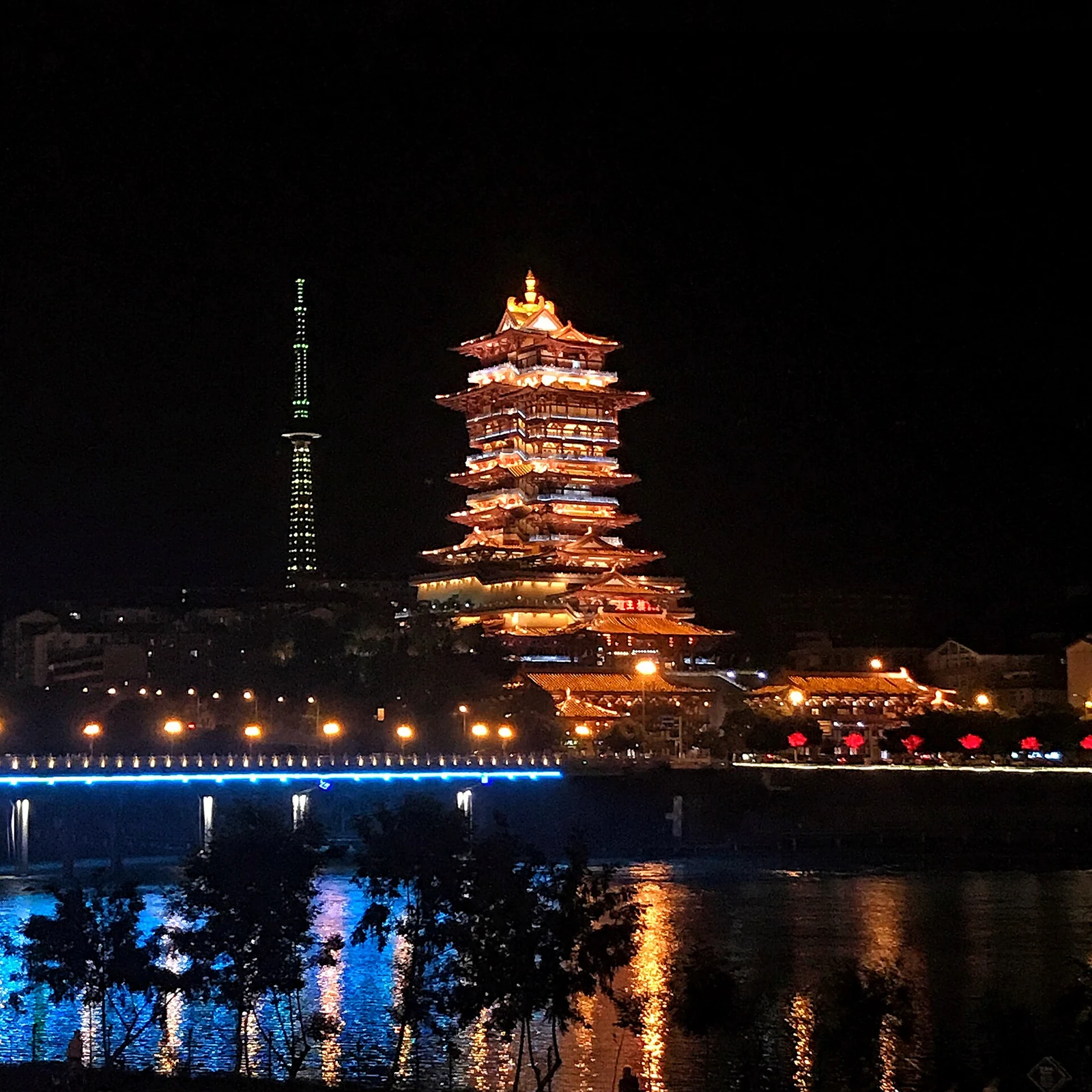
From the far bank
The tower is best measured from the far bank of the Fujiang, where the whole profile fits in one look: 99 metres, fifteen storeys, 22,200 square metres of floor. Up close the scale breaks into a hybrid of forms: pavilion, terrace, tower, cabinet and pagoda, combined in one building rather than copied. The original was built for Li Zhen, Prince of Yue, a Tang prince who governed Mianzhou; the Tang tower was destroyed and rebuilt many times. The present one was begun in 2001, paused in 2005, resumed in 2007 and opened in 2013. The dates are not a scandal. They are the ordinary biography of a building a city decided to have.
A floor for each subject
Inside, the climb is a sequence of subjects. One floor takes Li Zhen and the Tang court; another takes Tang culture more broadly; another the figures of Mianzhou; another old photographs of the city; another poetry; another famous towers. The arrangement is didactic and it works, because each floor is small enough to finish. The stairs and landings do the actual work: they keep the visitor moving upward and turn the visit into a route with a height. The exhibition cuts local history into portions, one per level, and the visitor joins them again on the way down. Nothing here is interactive; the building trusts a visitor to read a label and then look up.
What a rebuilt tower is for
A rebuilt tower does not raise the question of whether it is old. It is not. The question is what the rebuilding is for. Yuewang Tower answers three times at once: it marks a Tang prince's connection to Mianzhou, it gives the city a vertical landmark on the river, and it provides rooms designed for showing the local past. A preserved timber tower would do none of those things as well. Height and floor area are what make the exhibition and the observation deck possible. Whether that compensates for the loss of the original is a judgement the building cannot make for you. In that sense the tower is a museum that happens to have a view.
The top
At the top the tower stops being a building and becomes a position. The Fujiang runs below, the city spreads on the far side, and the observation deck is the one room where the height is not about the tower. This is also where the argument about authenticity goes quiet. A view does not care whether the stairs are Tang or 2013. It cares whether the river is where it should be, and it is. The old photographs in the exhibition floors show a city that had no tower of this size. Standing above them, the new tower looks less like a fake than a decision about the skyline. Downstairs the exhibits explain the tower; upstairs the tower explains the city.