The well
Inside the gate the path turns around a low stone well. The Su family well is the object at Sansu Shrine that a visitor is asked to read as a fact rather than a reconstruction. Su Shi lived in this house for twenty-six years, and his essays remember the house, the old well, the lychee tree and the garden. That list is short and domestic, and it is why the shrine can be organised around a well rather than around a statue. The well itself is small, easy to pass, unmarked by anything dramatic. A writer's childhood is usually made of ordinary objects, and the shrine has kept one of them in place while the buildings around it were replaced.
House into shrine
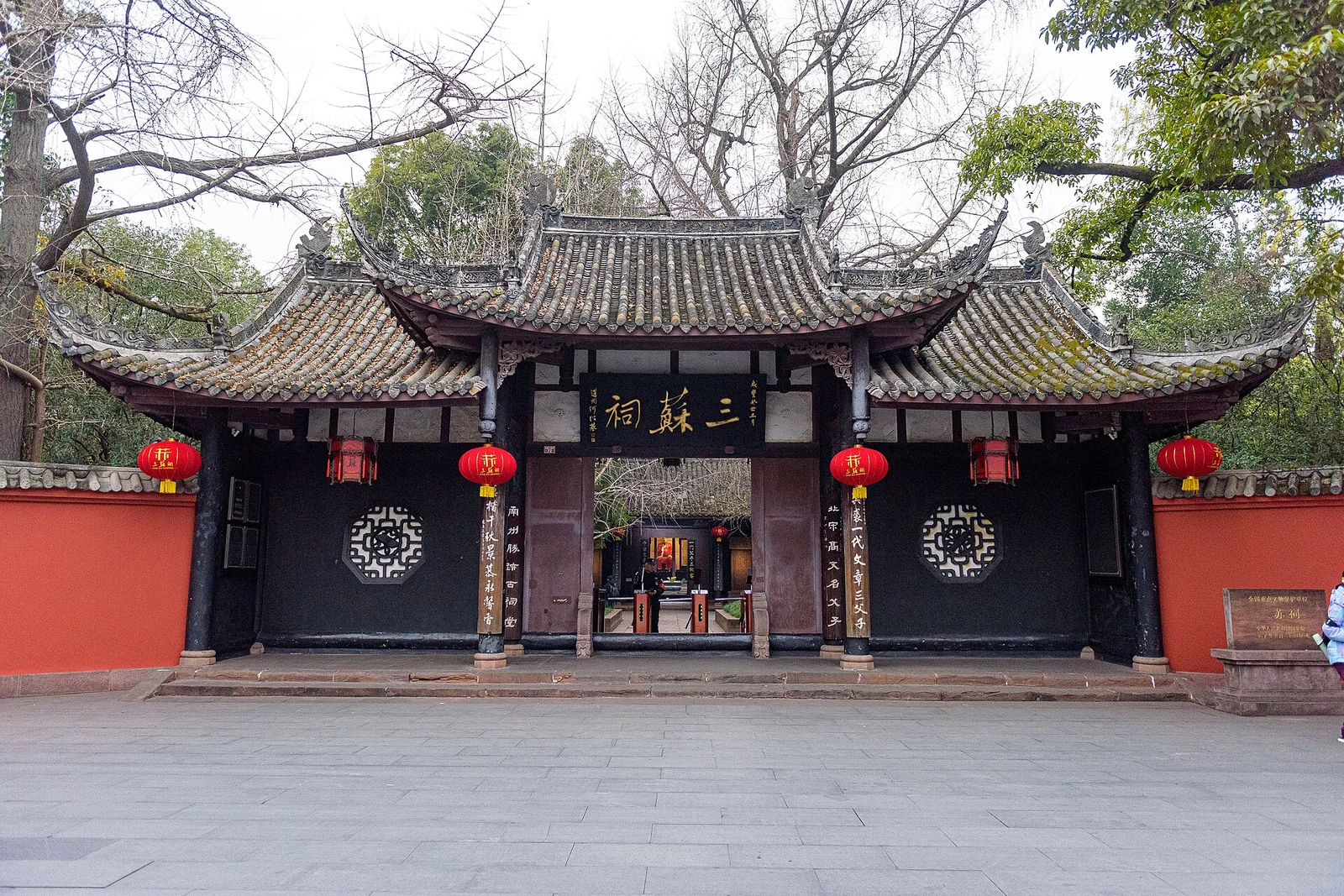
The residence became a shrine in the Southern Song, once the family's writing had become a public inheritance. It was destroyed in the late Ming and rebuilt on the same site in 1665, the fourth year of the Kangxi reign. The present site covers 106 mu and holds sixteen ancient buildings, courtyards, water and bamboo. It is a national first-grade museum and a key cultural relic. The sequence is the story: house, shrine, ruin, rebuild. Walking the rooms, a visitor is walking through a decision made repeatedly, that a writer's home should be kept as an institution even when the home itself has to be made again. It is also a working museum, with the well, the trees and the water treated as part of the collection.
Three parts water, two parts bamboo
The site describes its own plan with a phrase: three parts water, two parts bamboo, the shrine in the water. The formula is not a survey, but it explains what the body notices. Paths cross small channels; bamboo closes off a wall; the garden feels wetter and greener than a courtyard usually does. Su Xun, Su Shi and Su Zhe are remembered here as one family of writers, not as three separate careers. The Northern Song produced all three in one household, and the shrine keeps them in one conversation. The study, the garden and the water are shared, and so is the name on the gate. The phrase is a description a visitor can test by walking, which is not true of every heritage slogan.
What a rebuild keeps
A rebuild does not restore the life lived in a house. The work of 1665 replaced the fabric, and later repairs replaced parts of that. What remains is the site, the well, the plan, and the decision to keep the place as somewhere to read. Su Shi's essays recall a lychee tree in the garden; a tree still stands there. Whether the fabric is old matters less than whether the arrangement still teaches the visitor how the family lived. A shrine is an argument about continuity, made with stone, water and text. At Sansu Shrine the argument is visible in the well, which is the one element that has never needed to be justified by a text.