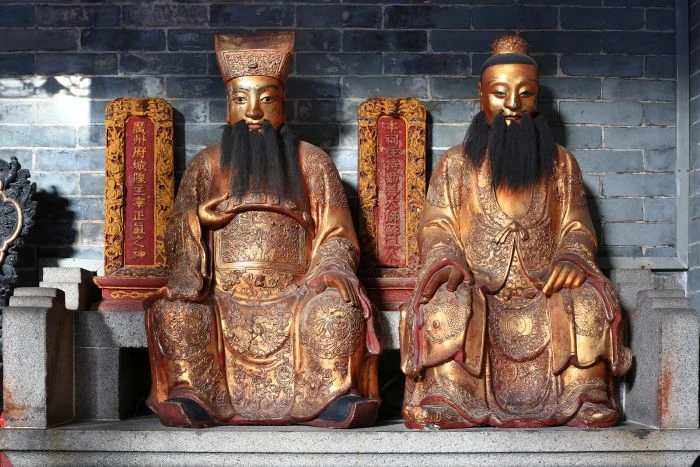
A shrine to the Northern Emperor
Zumiao, Foshan's Ancestral Temple, is devoted to Beidi, the Daoist Northern Emperor also known as Zhenwu. Its foundation dates to the Northern Song's Yuanfeng reign, between 1078 and 1085. The dedication gives the temple a particular religious identity within the much wider collection of buildings now managed as a museum.
New Year prayers and the observance of Beidi's birthday on the third day of the third lunar month connect the shrine with a recurring calendar. Buildings and ceremonies carry different parts of its history: one holds the spaces, the other brings people back to use them.
Different purposes within one compound
A Confucius Temple, built in 1911, stands within the museum's precinct alongside memorial halls for Huang Feihong and Ip Man. Learning, martial-arts memory and worship therefore have their own places within the larger complex.
The museum also organizes Cantonese-opera and lion-dance performances and ceremonies for children's first writing. These activities bring different forms of movement, sound and gathering into the precinct. Beidi remains the dedication of the old temple; the surrounding spaces open other chapters of Foshan's cultural life.
The names on bronze vessels
Among the museum's collections is a Qing Jiaqing-period set of five bronze offering vessels: an incense burner, two candlesticks and two flower vessels. The burner carries scenes of the Eight Immortals and other auspicious subjects. Its surfaces also preserve shop names.
Those inscriptions connect ritual objects with the foundry trade of Guangzhou and Foshan. Beside the shrine's long history and the museum's public activities, the bronze set gives another, smaller scale: objects made, marked and decorated by people working in the cities. A temple story also holds the work of its craftspeople.