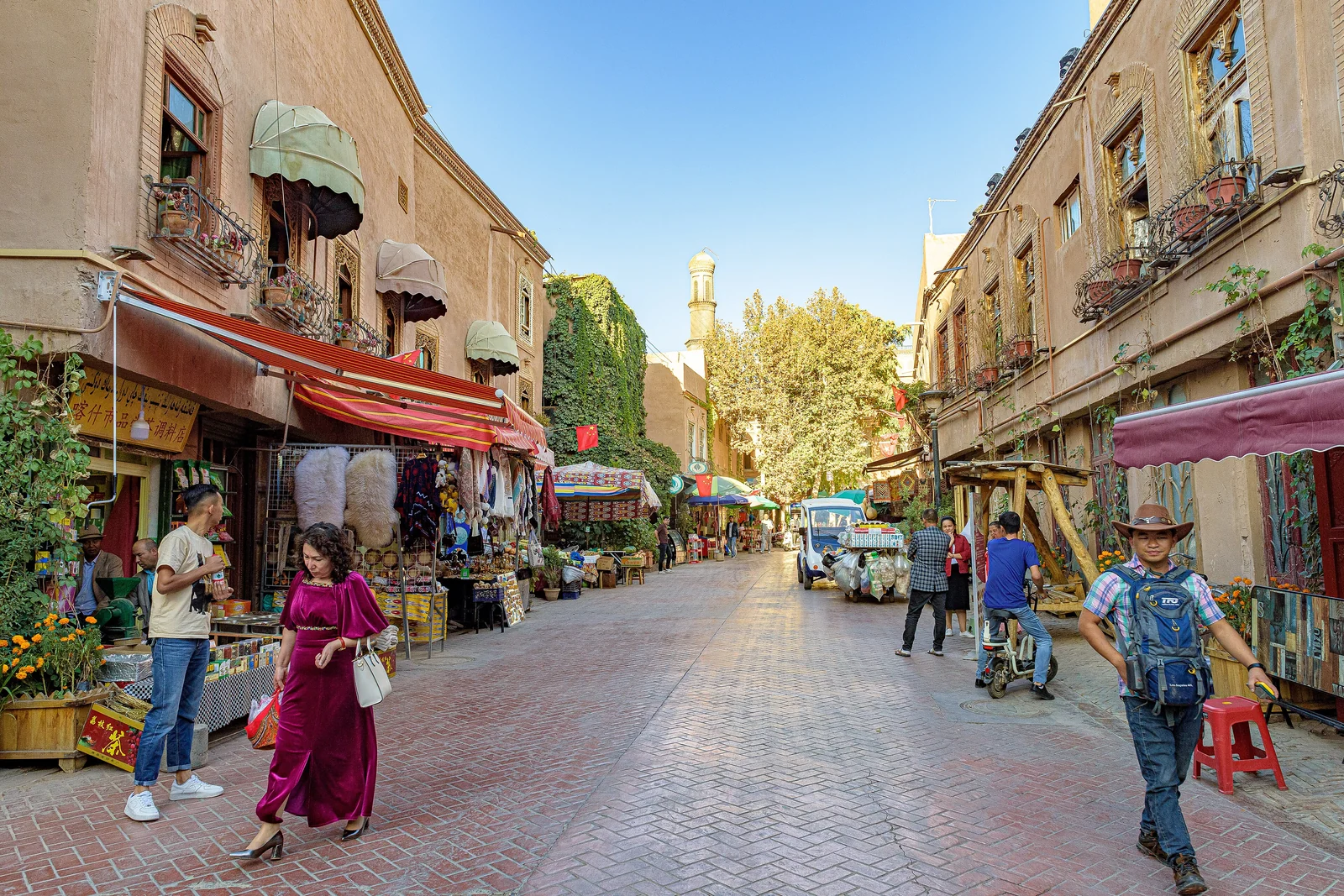
The regional culture department's notice of 31 May 2023 describes Kashgar Old City as a national 5A scenic area in the centre of Kashgar City, and as a place where people live. It counts 99 lanes and about 126,800 residents. The work, the notice says, rebuilt houses on their original sites so that families could live in earthquake-resistant buildings, while the overall appearance of the old city was kept. Design was taken household by household. A lane can be a visitor route and a way home in the same hour. The notice is plain that this is a Uyghur residential district as well as a scenic area. People live here. The numbers serve that fact.
From the journal
People live here
Kashgar's old city is a scenic area and a neighbourhood. Rebuilt houses can look old without being medieval brick.
In the same city · Kashgar ↗A scenic area with residents
A new brick is not an old brick
Rebuilding on the original site is a method. It does not turn every wall into a medieval wall. The notice names the aim as keeping the old appearance while giving residents houses that can stand in an earthquake. A brick laid in that campaign can match the colour of the brick beside it and still be a newer brick. The city a visitor walks is inhabited and repaired. Age is not spread evenly along one lane. A patched corner, a timber door and a fresh mortar joint can share a single house. The life in the lanes is the point of the walk. The new brick does not have to pretend it was fired centuries ago.
Workshops that are also neighbours
The notice counts 63 shops carrying traditional crafts, 47 plaques marking intangible-heritage shops, and 12 kinds of practice. The kinds include food, pottery, copper, wood and musical instruments, and also jewellery, dress, flowered caps, carving, ironwork, steamers and health tea. About 170 people work in these shops. The figures locate making on streets where residents remain. An instrument in a doorway, a wheel for clay, a tray of food: these are neighbours' work, visible because the houses were not emptied to make a set. A shop can show a craft. It does not, by itself, perform the whole of muqam, which is a repertoire rather than a storefront.