Jinsha Site Museum is closed for renewal until 2027. The gate is shut, the objects are in storage or on loan, and the Sun Bird is still the city's sign.
Words by IFreeing Editors3 min readJinsha Site · Chengdu
The gate, and the year
The gate at Jinsha is shut, and the forecourt is empty in a way a museum forecourt rarely is: no coaches at the kerb, no queue at the bag check, nobody waiting for a friend. The museum announced a closure for renewal, and reopening is expected in 2027. The building is not derelict and not a ruin. It is a working institution with its doors closed, which is a different thing and harder to photograph. The site is in Qingyang District, in the west of the city, and the streets around it keep moving without it. A visitor who arrives without checking dates will find a wall, a notice and a guard, and will have to decide what else to do with an afternoon in west Chengdu.
What is shut, and what is not
The closure covers the park, the excavation hall and the exhibition hall. The site itself remains: the workshops, the burials and the old river channel are in the ground, and a collection is still a collection whether or not it is lit inside a case. The museum keeps an online panorama running, so the rooms can be walked on a screen, more slowly and in worse colour. A museum's authority comes from the room: the case, the label, the dim light, the route that ends at the shop. Without the room, the same facts have to be carried by text. That is not the same as standing in front of the gold, and it is not nothing. It is a record of a building, made available while the building cannot be entered.
The bird that travels
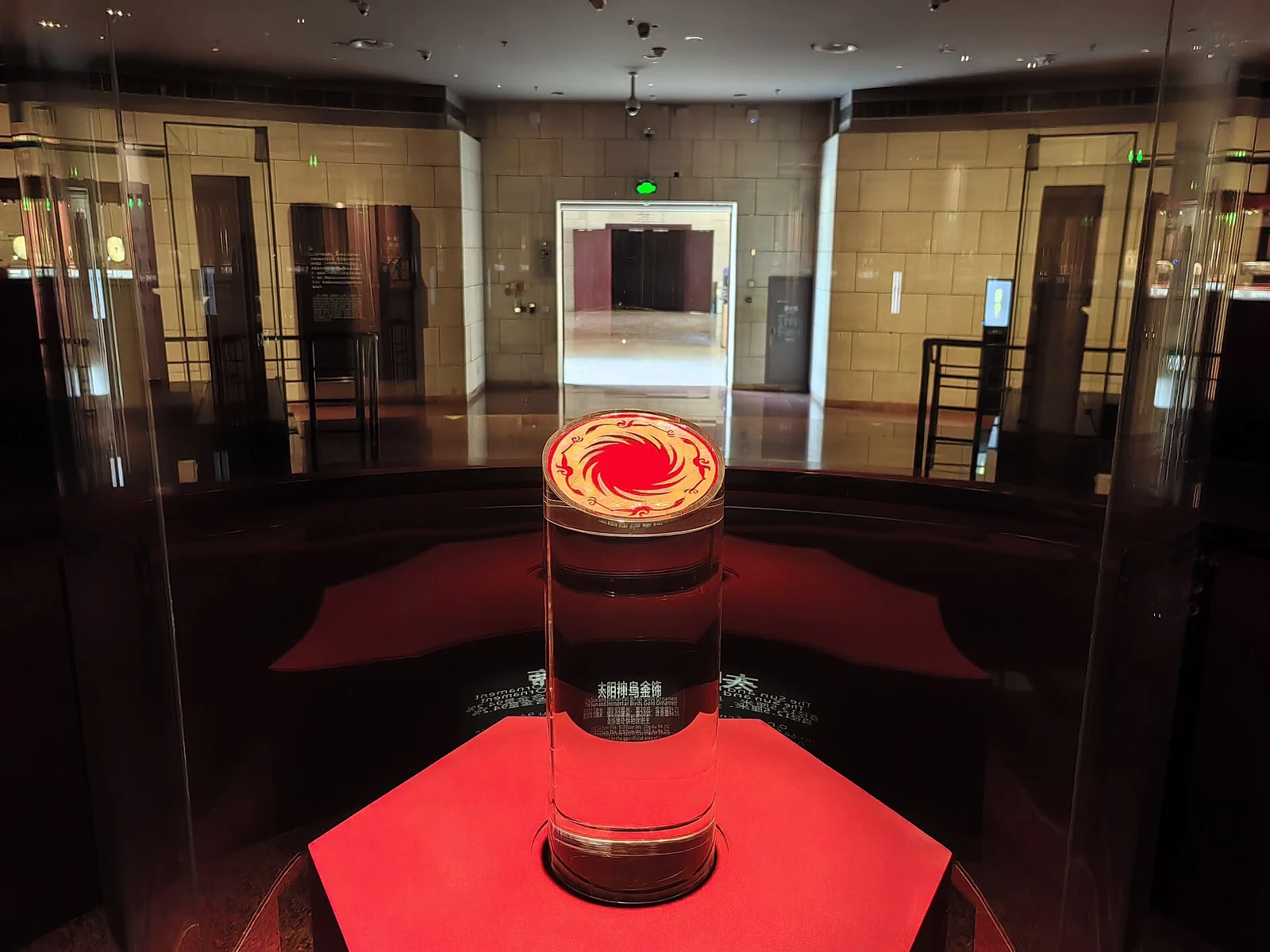
The Sun Bird ornament is about three thousand years old, a disc of gold with four birds set around a sun, and it has had a second life as a sign. Its design was chosen as the China Cultural Heritage emblem, so it appears on signage and publications at heritage sites far from Chengdu. In 2026 the object itself went to the National Museum in Beijing for an exhibition, which means that during the closure the best-known thing from Jinsha can be seen in another city. A design that can be printed at any size is useful to an institution, and the bird has been printed at every size. The image is everywhere, the object travels, and the site stays where it has always been.
Reading a collection without a room
A gallery is an argument made with sequence, light and distance. Take the room away and the argument has to be made from dimensions: the ornament is 0.2 millimetres thick and 94.2 percent gold, thin enough that a careless hand could bend it. You read about the workshops and the river channel instead of walking past them. The excavation hall was built over the ground where the objects were found, and that is what the panorama cannot reproduce: the depth, the dirt, the distance between one find and the next. The loss is real and temporary, and it has one useful effect. It separates the objects from the building that explains them, and shows how much of a museum is the walk between two cases.