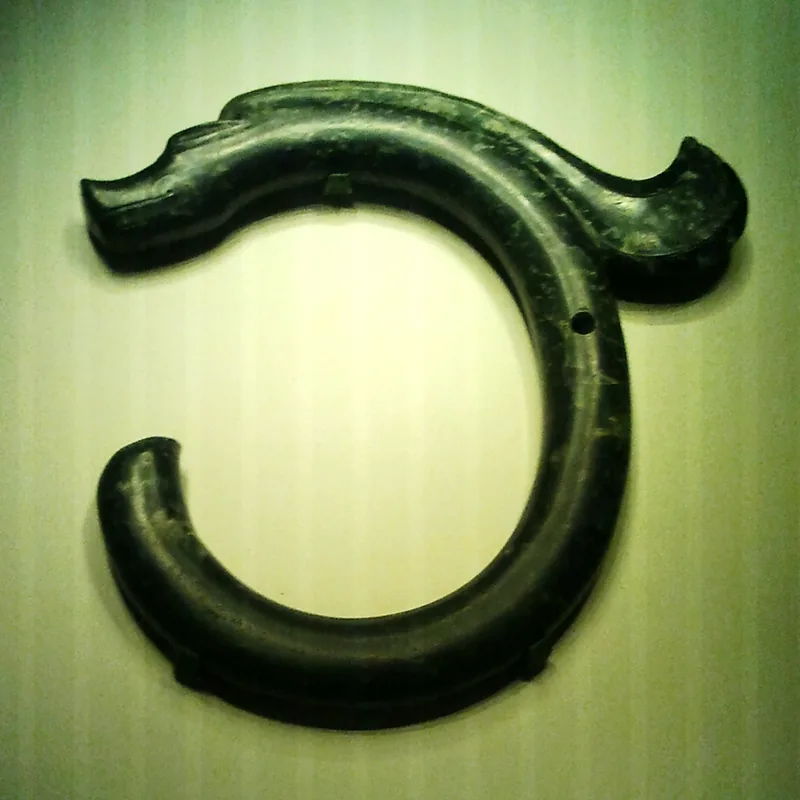
Twenty-six centimetres
On the National Museum's Hongshan exhibition page the C-shaped dragon is 26 centimetres high, and the mane measures 21 centimetres along its length. It is dark green Xiuyan jade. The snout lifts, the eyes are narrow, the mane streams back and the body curls like a hook. The museum calls it the largest known jade dragon of this Hongshan type, and it is in the National Museum's collection.
Chifeng, not Chaoyang
The object card says it was unearthed at Sanxingtala in Ongniud Banner, which is in Chifeng. The same page says this kind of jade dragon has so far been seen in the northern Hongshan area of Chifeng and has not been seen at Niuheliang in Chaoyang, Liaoning. The two sites are often folded into one photograph. They are not the same visit. The dragon is a Chifeng find.
A name from 1955
The exhibition text says the name Hongshan culture was first proposed by the archaeologist Yin Da in 1955, in his book on the Chinese Neolithic. The name points back to a red hill at Chifeng. It does not move Niuheliang across the provincial border. Hongshan is a culture spread over a river basin. This journal's Chifeng page keeps the object that is actually from Chifeng.