From the journal

Mindrolling Incense: Preparing Materials in Dranang

Mindrolling’s incense tradition connects the recognition and preparation of ingredients with grinding, hand-forming, drying and workshop teaching.

In the same city · Shannan ↗

A monastery gives the craft a place

Mindrolling, known in Chinese sources as Minzhulin, stands in Dranang County in Shannan. Its incense-making tradition is registered as a distinct extension of the national intangible-heritage incense project. That local identity matters: Tibetan incense includes different places and lineages of making rather than a single uniform workshop tradition.

The national heritage account locates this practice at the monastery and describes its transmission through production and teaching. The institution gives the craft a setting in which materials, repeated operations and the knowledge of experienced makers can be brought together.
The mixture begins before mixing

The account lists more than thirty ingredients, including sandalwood, clove, myrobalan and saffron. Their preparation is a substantial part of the work. Materials are pounded on a stone surface and cleaned; some require repeated boiling and washing over several days before being ground.

This sequence shows why a list of ingredients is only one part of a craft. Different materials arrive with different properties and must be brought into a condition suitable for further work. The maker has to recognise what each stage is intended to achieve before the prepared ingredients can be combined.

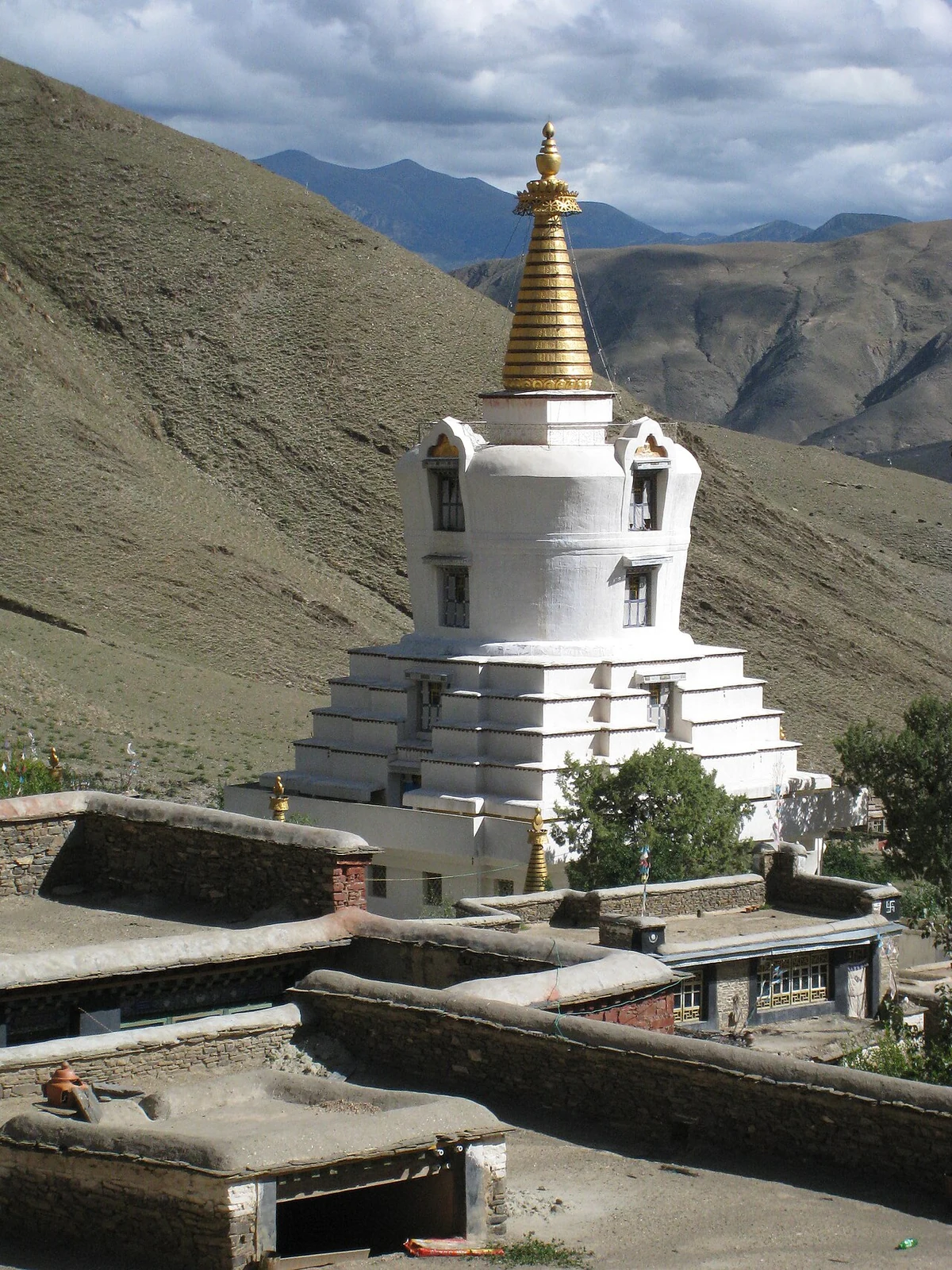
A stupa within the Mindrolling setting.
A second view of the monastery’s architectural surroundings.

The finished form depends on a sequence

Grinding and mixing lead toward hand-forming and drying. The material passes through several physical states before it becomes a finished object. Drying is part of that transformation, giving the shaped product the condition in which it can be handled and stored.

The heritage description places everyday production at the centre of transmission, supplemented by teaching activities. A learner encounters the whole sequence through practice, not simply the finished incense. Mindrolling’s craft can therefore be read through the relationship between an institution, its materials and the repeated work by which knowledge is carried forward.

Continue exploring · Mindrolling Monastery ↗
Photo credits and rights
  1. A second view of the monastery’s architectural surroundings.Angus Cepka · CC BY-SA 3.0 Photo source ↗ Rights information ↗