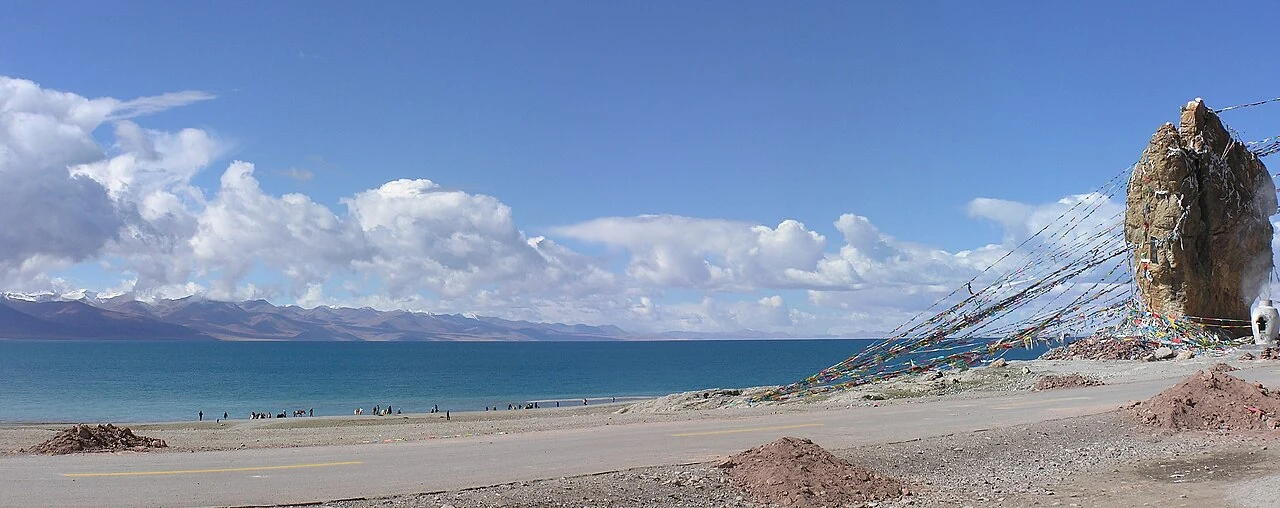
The Tibet Department of Culture and Tourism describes Baingoin County as lying between Nam Co and Siling Co, two of the region’s best-known lakes. A Ministry of Ecology and Environment profile adds a useful geographic correction: Nam Co itself lies across Damxung County in Lhasa and Baingoin County in Nagqu. The lake is not a single-county landmark. That cross-boundary geography matters when reading a photograph, a place name or an account of lake management. The same tourism report lists Nam Co, Siling Co and Bango Co among Baingoin’s defining resources, but notes that Bango Co is smaller than many lakes in the area.
From the journal
A County Between Three Lakes
Between Nam Co and Siling Co, Baingoin takes its name from the smaller Bango Co. The lake’s borax transport history and today’s heritage work reveal how a county’s identity gathers around water.
In the same city · Nagqu ↗Between two famous lakes
The smaller lake in the name
Why, then, is the county called Baingoin? The 2025 report quotes local historian Bawo Yeshi, a member of the Nagqu municipal committee of the Chinese People’s Political Consultative Conference. He traces the name to Bango Co and its role as a borax transport base after Tibet’s peaceful liberation. In his account, workers and officials from different ethnic groups worked together in the transport operation, which contributed to reconstruction and development. This is a specific historical interpretation attributed to a local researcher, not a geological explanation of the lake or a claim that it was the only source of the county’s identity.
History made into a record
The same report says Baingoin’s county committee invited scholars in 2025 to publish two collections on borax transport and memories of the borax works beside Bango Co. Their stated methods included sorting archival materials, oral interviews and field investigation. The details matter: the lake’s history is being assembled from records and remembered experience, rather than presented as a story already fixed in a single monument. Baingoin’s name therefore carries both a landscape reference and a history of labor and transport. The smaller lake gives the county a point of origin; research and oral accounts are beginning to fill in what that origin means.